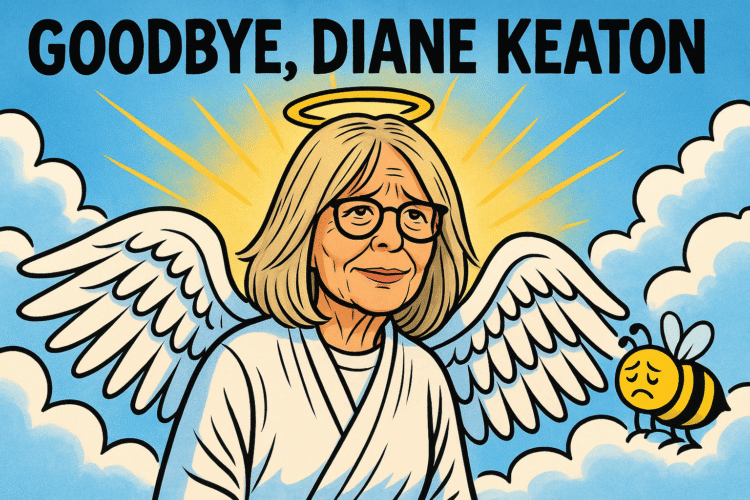
I want to start by acknowledging that writing satire about someone’s death is delicate—especially when the person is beloved, irreplaceable, and has left an indelible mark on our lives. Diane Keaton’s passing on October 11, 2025, at age 79, is real grief; the only ironic jabs I’ll risk are at the world she leaves behind, not at her memory.
A Quiet Exit in a Loud Year
2025 has been a dumpster fire of presidents launching missiles with tweets, media ecosystems eating their own children, generative AI promising “jobs for everyone except humans,” and the republic behaving like a teenager testing limits. In the middle of all that, Diane Keaton quietly slipped away. It’s the kind of understated exit that suits her: no spectacle, no screaming headlines (beyond the ones mourning her), just the dimming of a bright, original light.
If 2025 needed a confirmation that talent still matters, her death is a reminder: when the best among us leave, the rest of the year feels even thinner, more hollow, more starved for nuance.
Two Pillars of Her Grace: Father of the Bride and Something’s Gotta Give
If I had to pick two roles where Keaton crystallized her essence, they are Father of the Bride and Something’s Gotta Give. In the first, she played Nina Banks, a mother in stitches, navigating the wedding storm with composure, humor, and the subtle suggestion that emotional labor is real work. She was the calming axis of family chaos, a woman who held together crises at the expense of sleep, always knowing when to soften, when to insist, and when to let love fold over itself.
In Something’s Gotta Give, she embodied Erica Barry: a woman in midlife, wounded by divorce, demanding authenticity, speaking truth even when it hurt. She matched Jack Nicholson’s pull with a quiet force. She made the “older woman falls in love again” story feel real, lived, not campy trope. Her performance is one of the reason the film is remembered: a radiant anchor, delivering heartbreak and humor with the same cadence.
Some reports say Something’s Gotta Give was her favorite film in her canon. She once admitted she doubted it would succeed, yet it became a kind of capstone to her late-career renaissance—proof that a life in acting is never simply about youth, but about presence, experience, and owning the script you deserve.
The Price of Her Absence in a Hollow Culture
Look around 2025, and see how much of culture is the hollow shells of things once living. Streaming franchises that cannibalize themselves. Awards shows that feel rehearsed rather than celebratory. AI actors mimicking nuance. Social media feuds blaring like war drums. In that environment, Diane Keaton was a stabilizer—a human anchor in a sea of static.
Now that she’s gone, what do we have left? More noise, more ephemeral spectacle, more imitation. The void she leaves isn’t just emotional—it’s a cultural benchmark slipping away. We’ll lose every time we reach for subtlety, risk, heart, and presence, instead of recycling memes and hollow performances.
If 2025 is loopy, talent becomes sacred. Without it, the show collapses into motion twins dancing to the algorithm. Keaton’s departure pushes that collapse closer.
How She Carried Herself: Signature Style, Unyielding Integrity
Even offscreen, Diane Keaton was an original. Her wardrobe—turtlenecks, suspended pants, bowler hats, ties for women—was a personal code. Her photographic eye, her interior design instincts, her devotion to quiet things and subtle humor—they all formed a brand not of vanity, but of integrity.
She resisted the pressure to conform. She refused to smooth edges. She played characters who were messy, real, emotionally unfiltered. She made imperfect women felt, not ornamental. In an era when so much acting is about hitting beats, so much celebrity is about hitting pose, she stayed unposed.
Her life and art stood as a rebuttal to a culture of gloss.
A Final Scene: Where She Waits
I imagine Diane Keaton now, in some quiet place beyond the cult of performance, sipping morning light, reading letters she never answered, walking through rooms she once designed. In that silence, she is whole. Her parts are not lost—they’re repositories of memory, consolation, cinema.
When we watch Father of the Bride again, Nina Banks is more than a role—she is a lesson in care and courage. When we revisit Something’s Gotta Give, Erica Barry remains proof that you can age without becoming invisible. Her dialogue, pauses, gestures—they are her afterlife.
Closing Section: WHEN TALENT FINALLY SHUTS ITS DOOR
2025 is louder, more brazen, more hollow in her absence.
What remains is often plastic, chromed, algorithmic—not lived.
Herdeath doesn’t just change the obituary pages—it silences a frequency we sorely needed.
So we replay her laughs, her heartbreaks, her bearings.
Because in a year that wants to forget nuance, she guarantees one memory: the antenna of talent, still vibrating.
Rest, Diane. The world is quieter now—and that quiet weighs heavy.