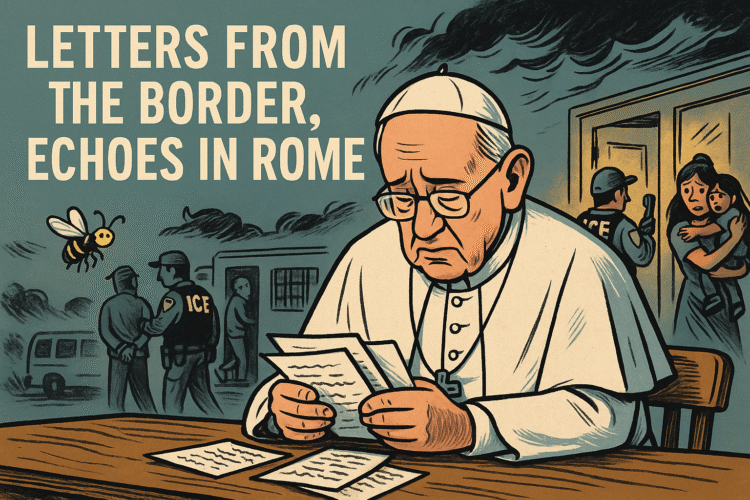
If you want to know how power really moves in 2025, don’t watch the tank convoys rolling down Chicago boulevards or the ICE jackets fanning out across El Paso school zones. Watch instead the moment when a packet of handwritten letters from parish shelters in Texas and New Mexico lands on the Pope’s desk in Rome, and suddenly the world’s largest religious institution is staring down the White House like it’s another council of Trent.
On October 8, 2025, CBS and the Associated Press reported that Pope Leo XIV—the first American pope, the cowboy pontiff from Oklahoma turned moral gadfly—sat in the Vatican with El Paso Bishop Mark Seitz, Auxiliary Bishop Anthony Celino, and Dylan Corbett of the Hope Border Institute. What they brought him wasn’t a theological dissertation but something more radioactive: stories. Handwritten letters from families terrorized by the Trump administration’s widened immigration sweeps. A short video clip showing children diving under beds at the sound of uniforms. Reports of workplace stings, pre-dawn door knocks, and even U.S. citizens questioned and detained in the chaos of “Operation Midway Blitz.”
Leo, visibly shaken, told the bishops: “You stand with me and I stand with you.” And then, in words no White House scriptwriter could sanitize, he urged the U.S. Conference of Catholic Bishops to speak—louder, firmer, coordinated.
A Timeline Written in Fear and Ink
The timeline itself reads like a parable of modern politics:
- October 1: Leo delivers remarks that those who back “inhuman treatment of immigrants in the United States” are “not really pro-life.” It’s a theological Molotov cocktail: placing immigration crackdowns alongside abortion and the death penalty as equal moral failings.
- October 3–7: In border dioceses, parish staff and Hope Border Institute volunteers gather letters and testimonies from families living through the raids. Shelters in Las Cruces, parishes in El Paso, school counselors in Sunland Park all scribble down the collateral damage—kids skipping school, lawful residents dragged into questioning, parishioners afraid to attend Mass.
- Morning of October 8: The packet arrives in Rome. A video clip is queued up on a laptop. Dylan Corbett presses play: a mother describing her son’s nightmares after a 4 a.m. raid.
- October 8, afternoon: The Pope meets with Seitz, Celino, and Corbett. He listens, watches, weeps. His staff compiles names and stories for follow-up. He pledges solidarity and directs the bishops to consider coordinated pastoral action.
The letters were written in the shadow of a national enforcement surge that looks less like routine policing and more like a theater of intimidation. “Operation Midway Blitz” is the name whispered in shelters: coordinated sweeps, expanded Guard deployments, officers empowered to conduct “appearance-based” stops. To parishioners, it feels like a war zone staged for political optics. To Leo, it is a moral test.
Bishops vs. Barricades
Mark Seitz, who chairs the U.S. bishops’ migration committee, told Leo that parishioners describe living under siege. Kids duck from uniforms on sidewalks. School zones are haunted by ICE vans. Families ration groceries because parents fear workplace stings. Auxiliary Bishop Anthony Celino, who has witnessed raids ripple through neighborhoods, seconded it.
The bishops aren’t just wringing hands. They’re considering tools of institutional power:
- A national pastoral letter condemning the tactics, circulated to every parish.
- Parish legal clinics to help families prepare documents, assert rights, and resist unlawful questioning.
- Sanctuary protocols declaring confessionals, rectories, and parish halls off-limits to federal agents except by court order.
- Pressure on Catholic hospitals and schools to publish clear “do not cooperate beyond legal duty” guidelines, so that medical charts and enrollment rosters don’t become ICE hunting grounds.
Leo’s Vatican staff is now compiling the letters into dossiers, mapping the names and stories, preparing to follow up parish by parish. A spiritual census of fear.
The White House and Its Defenders
The administration’s line is familiar: these operations “honor the rule of law” and “target criminals.” The press releases repeat the phrase “priority targets” like a Gregorian chant. But the stories in those letters expose the gap between press language and lived reality.
Civil-rights lawyers are already preparing discovery demands for stop logs and body-cam footage. Governors and mayors are filing court motions against federalized Guard deployments. Congressional offices are demanding hard data on how many U.S. citizens and lawful residents were swept up.
Meanwhile, DHS insists the chaos is necessary, even righteous. And yet, the very need to frame their campaign as “just enforcement” betrays their nervousness. When parishioners start writing directly to the Pope about raids on their kitchens, you’ve lost control of the narrative.
Catholic Conservatives in the Crossfire
The backlash is not just political; it’s ecclesial. Conservative Catholics, who once saw the papacy as a bulwark against liberal drift, now find themselves in open friction with Leo XIV. To them, the Pope’s “consistent life ethic”—weaving abortion, capital punishment, and immigrant dignity into a single moral fabric—feels like mission creep.
But Leo is unmoved. For him, pro-life means more than a single issue; it is a worldview. “If you stand with me, I stand with you,” he told the bishops. And what he meant was: your silence will no longer be tolerated.
What Next: The Collision Course
The stakes are now plotted on the calendar:
- By All Saints’ Day (November 1): Will the USCCB issue national guidance? The draft in circulation reportedly declares confessionals, rectories, and parish halls sacred ground, explicitly off-limits to immigration arrests. If released, it would be the strongest institutional rebuke to federal enforcement since the sanctuary movement of the 1980s.
- Mid-October: Dioceses are considering “letter-writing weekends,” turning parish halls into epistolary factories. Thousands of new testimonies would flood Rome and Congress, multiplying the packet Leo opened into a deluge.
- Legal Front: Civil-rights lawyers will push for disclosure of stop logs, body-cam records, and arrest stats. Subpoenas are prepped.
- Escalation Risk: The White House may accuse Catholic charities and schools of “harboring.” Diocesan lawyers will counter with federal humanitarian carve-outs and a century of precedent.
- Political Fallout: Leo’s framing threatens to recode the term “pro-life” in American politics. By equating immigration raids and the death penalty with abortion, he yanks the moral label from partisan custody.
The Paradox of Mercy
In an era when shutdowns furlough federal workers, budgets collapse city services, and ICE vans patrol school zones, the Pope is forcing a moral realignment. Is mercy a political liability or a doctrinal requirement? Can you call yourself pro-life while supporting raids that terrorize children?
Leo is wagering that conscience will outlast campaign slogans. And the packet of letters from the border is his proof: when parishioners beg the Pope to help, the Church cannot claim neutrality.
The Transatlantic Test
This isn’t just about Texas parishes. It’s about how American power meets Vatican power on the stage of global conscience. A packet of frightened family letters has become a transatlantic test:
- For the U.S. government: whether it can sustain the fiction that mass raids equal justice.
- For the bishops: whether they will risk institutional backlash by defying the administration.
- For American Catholics: whether “pro-life” means a narrow dogma or a consistent ethic.
- For Pope Leo XIV: whether his American birthright makes him braver—or more vulnerable—in confronting the homeland that raised him.
Closing: The Gospel of the Knock at the Door
The gospel was never about respecting uniforms. It was about protecting the vulnerable when the knock at the door came at midnight. In 2025, that parable has been rewritten: ICE raids at dawn, children hiding from boots, parishioners scribbling letters by candlelight.
Leo opened that packet on October 8, and in doing so, he opened a confrontation no one can easily close. If All Saints’ Day brings a pastoral letter declaring parish grounds off-limits, if mid-October floods Rome and Congress with testimony, if dioceses codify sanctuary as policy, then the government’s “Operation Midway Blitz” may meet its moral counter-blitz.
And in that clash, we’ll see what mercy really means: not a vague slogan, but a choice between silence and solidarity, between rule of law and rule of love.
Because the real “consistent life ethic” is not a phrase on a bishops’ committee agenda. It is a child hiding under a bed in El Paso, a packet of letters on a Vatican desk, and a Pope reminding America that the kingdom of heaven does not have a deportation wing.
Closing Section: “THE PRACTICAL MEANING OF MERCY”
The shutdown fights, the layoff threats, the raids in school zones—these are not abstractions. They’re collisions with daily parish life: a father questioned at a bus stop, a child missing Mass for fear of uniforms, a nurse at a Catholic hospital refusing to hand over patient charts.
Leo’s confrontation forces a brutal clarity: mercy is not charity, it’s resistance. And the question is no longer whether the Church will speak, but whether America can still hear.