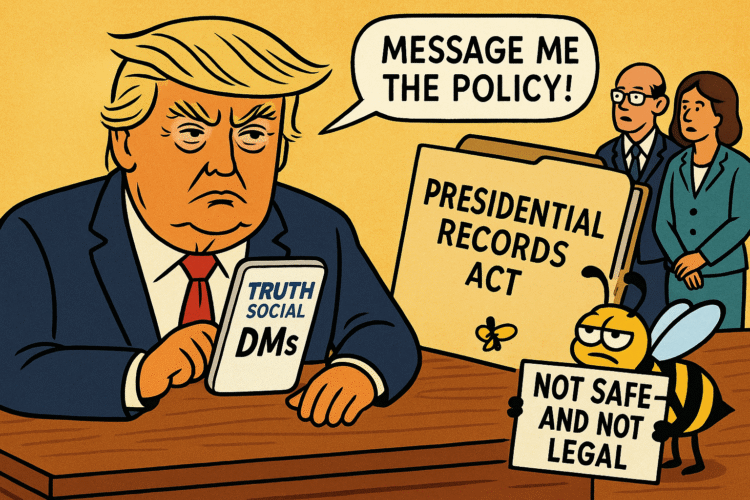
Once upon a time, presidents used secure lines, classified document systems, and the color-coded envelopes of official communication. Now, Donald Trump apparently prefers his cabinet to conspire via Truth Social direct messages. That’s not just sloppy—it’s a violation of everything grownups in government swear by. Using a public social app as a back-channel is like planning nuclear policy over text chain. It’s unsafe, it’s irresponsible, and it may well flout the Presidential Records Act.
A recent Wall Street Journal scoop confirms what should have been obvious: Trump is using Truth Social DMs to talk to his cabinet. Oh, and just so we’re clear: what you send through a direct message on a social media platform is not automatically archived, encrypted, or subject to federal recordkeeping. It’s closer to a group chat than a national security channel. It is the institutional equivalent of hiding classified memos in Post-It notes.
This is not a debate over style. It is a crisis of accountability.
Truth Social, But A Poor Substitute for a Secure Briefing Room
Let’s walk through the logic—or lack thereof. Trump sets up a public platform, Truth Social, ostensibly to bypass media filters, control the narrative, and speak without constraint. That platform now doubles as his internal communications system. Cabinet secretaries and department heads receive private messages on Truth Social, presumably about policy, staffing, or directives.
That’s like running NASA through TikTok DMs and expecting no launch failures. The problem is not merely convenience. It is whether presidential decisions belong in ephemeral shadow threads that vanish into algorithmic oblivion rather than sitting in the National Archives.
The Presidential Records Act: Not Optional
Do you remember the Presidential Records Act of 1978? It requires preservation of all “documentary materials” by which a president communicates with his staff, advisors, or the public in the course of carrying out official duties. Phones, memos, typed letters—all must be archived.
If the president is sending instructions via Truth Social DMs, and those messages are not being properly archived in the official record, then we have a violation. A serious one. The system is meant to preserve governmental memory, not let it dissolve in the ether.
Using non-archived messages for decisions weakens oversight, obfuscates responsibility, and gives one man the power to vanish his tracks simply by deleting messages. That’s not governance. That is cloak-and-dagger administration.
Unsafe, Unencrypted, and Unaccountable
Beyond the recordkeeping issue, there’s the matter of security. Social media platforms are inherently vulnerable. They are targets for hackers, foreign actors, subpoena abuse, server compromises, and internal bugs. Trusting strategic statecraft to social-media direct messages is like sending national intelligence via unsealed postcards.
There’s no guarantee the messages are encrypted end-to-end, no guarantee of access control, no guarantee that what’s sent or received isn’t captured by platform servers, logs, or backups outside the White House’s control. If a cabinet secretary leaks or is compromised, the chain of command becomes a mess—and national security can leak with them.
Why This Isn’t Just a Quirk
We should not believe for a second that this is some eccentricity or quirk of personality. This is an intentional erosion of institutional controls in favor of personal opacity. Trump benefits when messages disappear, when actions become whispers, when the record is a black hole he can claim never existed.
In effect, Truth Social DMs give him plausible deniability. Orders go through the social app, then vanish—no trace in the official ledger. Cabinet officials become messengers of the invisible, executing policies you can’t audit.
Snapshot: What the Journal Reported
The Wall Street Journal piece lays out key details:
- Trump is reportedly sending private messages on Truth Social to cabinet members.
- These messages may bypass archived White House channels.
- The move undermines normal paper trails, formal memos, and institutional checks.
- The Journal notes the risk of violation of the Presidential Records Act.
- Critics worry about creating a shadow communication network immune to oversight.
If this report is accurate—and it fits within patterns we’ve already seen—it confirms that one man is converting public office into private messaging.
The Stakes for Democracy
- Erosion of accountability: If policy orders don’t appear in the record, how do future generations or oversight bodies trace who did what and when?
- Legal jeopardy: Cabinet secretaries and agencies act on instructions. If those instructions exist off-radar, can they claim immunity, or can they be held responsible?
- Precedent for secrecy: If a president can use his own social app as clandestine admin, what’s to prevent future executives from using encrypted apps, burn-after-reading channels, or self-destructing notes?
- Institutional rot: Over time, the White House’s internal architecture becomes secondary to the will of the individual behind the keyboard. The presidency becomes about managing personal narratives, not governing with record and reason.
The Illusion of Convenience
Proponents—or enablers—will argue it’s for speed. “Look, he’s used to social media. This is faster than memos.” To which the institutionalists reply: the presidency is not a startup. Speed cannot trump permanence. Every directive must be traceable. Every decision must be documented. Leaks start in dark places; laws die in shadows.
If you get used to public policy being whispered in secret messages, you normalize the idea of rule by personal command. And that is exactly how institutions unravel.
The Drone of the Modern Autocrat
Consider how this fits into the broader choreography of this presidency. Trump has already weaponized media, narrative, executive orders, federal agencies, and the notion of “emergency” to convert normal functions into theater. Why not messaging too?
He doesn’t just traffic in spectacle—he traffics in disappearance. He wants channels that vanish. He wants orders no archivist can trace. He wants a presidency conducted like a closed group chat, not a public office built on statute and transparency.
Truth Social DMs: the final backstage of a staged regime.
What Should Happen Next
- Congress, particularly oversight committees, must demand those DM logs and compare them to archived communications.
- The National Archives and Records Administration should audit whether presidential records are missing.
- Whistleblower protections must extend to cabinet-level staff if they’re pressured to delete or not archive messages.
- Federal courts should interpret the Presidential Records Act broadly—not narrow it to paper and official files alone.
- Public watchdogs and journalists must push for disclosure, subpoena social app logs, demand chain-of-custody, and track divergence between public policy and social-messaged directives.
If the executive office becomes a private chat room, democracy becomes a spectator sport with blindfolded judges.
Closing: Message Me That Policy
Don’t let them fool you—this is not just a technical complaint. This is about whether public officials will make decisions in the light or in the shadows.
When a president says “DM me your plan,” and then erases it, the public is denied an archive. When a cabinet secretary receives a policy chunk via Sunset-filtered message that leaves no trace, the constitutional balance shifts.
We are not simply losing paper trails. We’re losing accountability. The presidency is being hollowed out—not by force, but by fragmentation.
Let’s be blunt: locking governance into disappearing DMs is fascism wearing a smartphone. It’s the idea that to disagree is to be dereferenced, to dissent is to disappear.
So demand the record. Demand the logs. Demand that we stop treating public office like a chat app. Because in a republic, messages do not expire, and history does not support disappearing acts.
If you can only persuade your government by hiding behind a private message, that government is already broken.