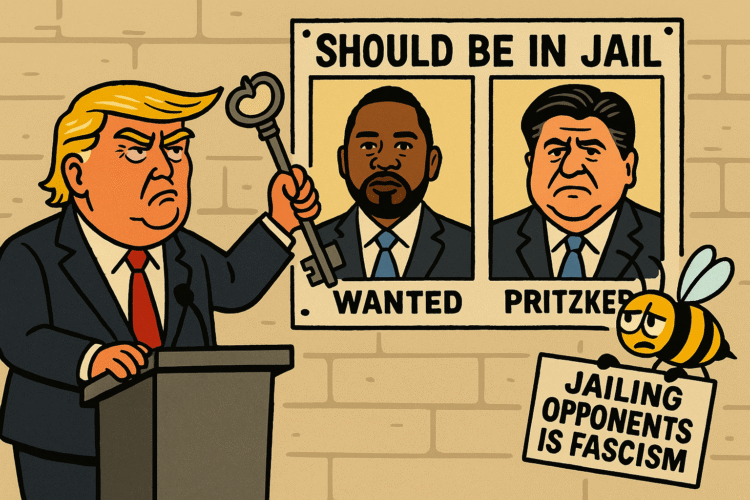
It starts, as so many American breakdowns do now, with a social media post typed out between the golf course and the motorcade. On October 8, 2025, President Donald Trump fired off on Truth Social that Chicago Mayor Brandon Johnson “should be in jail” for “failing to protect ICE Officers.” He added, as a flourish, “Governor Pritzker also!” This was not policy. This was not law. It was a presidential decree, written like a mob boss’s grocery list: who deserves handcuffs today.
The comment capped off two weeks of spectacle under the banner “Operation Midway Blitz,” a federal immigration crackdown so sprawling that it now resembles a traveling militarized theme park. Chicagoans since September 25 have been treated to downtown riverboat patrols with long guns glinting under the bridges, helicopter insertions rattling roofs, and door-kicking raids that produce more shattered glass than reliable arrest tallies. By October 4, in Brighton Park, agents shot and wounded a U.S. citizen, provoking both lawsuits and a new layer of crisis PR about “force protection.” Four days later, the president decided that the true villain wasn’t trigger-happy tactics or confused rules of engagement—it was two elected Democrats who apparently deserved prison cells for disagreeing with him.
This is where we are: a president calling for the jailing of political opponents without charges, warrants, or even the effort of an unconvincing grand jury. The charge is not treason, not corruption, not bribery—it’s “failing to protect ICE.” Imagine a country where your obligation is not to constituents but to an agency, and failing to genuflect fast enough makes you a criminal. If you’re looking for a quick definition of fascism, you won’t do better.
A Timeline of Manufactured Chaos
To understand how we got here, you have to walk the breadcrumb trail of dates:
- September 28–30: ICE and Border Patrol set up rolling cordons near Trump Tower and River North, detaining people on sidewalks based on what one commander later admitted was “how they look.” Chicago police disavowed involvement, civil rights lawyers started circling.
- October 1: The federal show of force coincided with the government shutdown. While paychecks froze for hundreds of thousands of civilian workers, helicopters still buzzed the Loop on taxpayer fuel.
- October 3: Protesters outside the Broadview immigrant detention facility were dragged off by federal officers. “Obstruction of enforcement” became the blanket charge, a convenient way to relabel the First Amendment.
- October 4: Brighton Park—agents opened fire during a raid, wounding a U.S. citizen. Officials insisted they were under attack, but body-cam and drone footage have yet to be released. Locals call it a federal drive-by.
- October 8: Trump, true to form, took none of the above as a lesson in restraint. Instead he posted his authoritarian fantasy casting Johnson and Pritzker as inmates-in-waiting.
This escalation is not accidental. Each date is a rung on a ladder: street stops → protest arrests → bullets fired → political opponents criminalized. The choreography is deliberate. What begins as “safety operations” quickly metastasizes into open talk of jailing dissenters.
The White House Narrative
Federal spokespeople have stuck to one talking point: “officer safety.” Every door kicked, every stop based on appearance, every protester zip-tied is retroactively justified by this sacred phrase. It’s as if the streets of Chicago are Fallujah and the only metric that matters is whether agents feel protected from the population they’re policing.
So when Mayor Johnson challenged appearance-based stops in court, and when Governor Pritzker filed motions to block Guard deployments and federalization moves, the White House turned the criticism back on them. You’re not protecting officers. You’re making them vulnerable. Therefore you are criminal. Therefore—straight from the president’s keyboard—you should be in jail.
It is the authoritarian trick in its simplest form: redefine loyalty to the law as loyalty to the enforcers. If you question methods, you’re a traitor. If you demand warrants, you’re pro-criminal. If you ask for footage, you’re endangering the troops. And if you’re elected and vocal about it? The president floats your mugshot before the indictment exists.
The Chicago and Springfield Pushback
City Hall and the Governor’s office have called the “jail talk” what it is: authoritarian grandstanding. Johnson dismissed it as “a performance of tyranny.” Pritzker reminded reporters that in America, disagreement with the federal executive is not a felony, no matter how itchy the president’s Twitter-adjacent thumbs get.
Judges, meanwhile, are being asked to weigh Temporary Restraining Orders on Guard deployments, since the state never consented to becoming a training ground for federal immigration theater. Civil liberties groups are suing over appearance-based stops, warning that wrongful detentions will multiply under a policy that equates “how you look” with probable cause. Every constitutional lawyer in Illinois is now drafting briefs as fast as helicopters can circle the Willis Tower.
The Human Footprint
The federal crackdown has been sold as a show of strength. In practice it looks like rolling cordons choking River North retail, tourists photographing more rifles than architecture, restaurants operating under the constant thrum of rotor blades, and immigrant neighborhoods turned into open-air checkpoints. Q4 tourism projections have already been revised down. Who wants to book a weekend in Chicago if the Navy Pier ferris wheel comes with sniper overwatch?
Small businesses report walk-in traffic plummeting on days when ICE patrols set up visible lines. Residents trade group texts about where helicopters are hovering, which intersections are blocked, and whether it’s safe to pick up kids from after-school programs. The city never asked for this presence, yet its economy and its daily rhythms are being kneecapped by it.
What Remains Unreleased
For all the bravado about “officer safety,” the federal government has yet to disclose the data that might justify its tactics. Where are the warrants? Where are the stop logs? Where is the body-cam, dash, or drone footage from Brighton Park? Where are the arrest tallies and their outcomes?
The absence is glaring. If the operations were airtight, the government would flood the zone with evidence. Instead it offers only rhetoric, backed by the president’s fantasies of imprisonment. The secrecy is not incidental; it is strategic. Without numbers, the spectacle becomes the point. What matters is the sight of agents on boats, not the ledger of constitutional violations they leave behind.
Why Jail Talk Matters
There are countries where presidents can declare you should be in jail and you will be. They are not democracies. The United States, in theory, is not one of them. Our system requires charges, evidence, courts, due process. Yet each time Trump blurts out that a critic belongs in prison, the line blurs a little further between rhetoric and power.
What happens if an ambitious prosecutor, hoping to curry favor, interprets that rhetoric as instruction? What happens if agencies already pushing constitutional edges decide the president’s words are a green light? We’ve already seen agents detain based on appearance, already seen citizens shot in their neighborhoods. The distance between “should be in jail” and “is in jail” is not as long as we’d like to believe.
And that, stripped of spectacle, is the definition of fascism: when disagreement with the executive becomes criminal by default. You don’t need gulags; you only need a leader willing to label dissent a felony and a bureaucracy eager to comply.
The Dangerous Normalization
Supporters will insist it’s just Trump being Trump. Just rhetoric. Just social media. But the normalization of this rhetoric is precisely the danger. Each repetition dulls outrage. Each new “lock him up, lock her up” shifts the baseline. By the time actual prosecutions of political opponents arrive, the soil is already tilled.
This is how democracies decay: not with one decisive coup, but with endless rehearsal. Each performance of tyranny prepares the audience to accept the real thing. By calling Johnson and Pritzker jail-worthy today, Trump rehearses for the moment when courts and agencies stop pretending it’s theater.
Closing Section: The Prison of Disagreement
In the end, the question is not whether Brandon Johnson or J.B. Pritzker will be handcuffed for doing their jobs. Courts will almost certainly block any such absurdity. The question is what kind of country we accept when a president treats disagreement as a crime scene.
When streets fill with helicopters, checkpoints, and agents measuring “how you look,” it is already a kind of imprisonment. When businesses are throttled and residents reroute their daily lives around federal theater, the cage is already here. And when a president openly declares opponents belong behind bars without trial, the door clangs shut in the public imagination long before it does in real life.
Fascism is not only about prisons; it is about the idea that power defines innocence. That is what was rehearsed on October 8, 2025. And that is why every resident of Chicago, every tourist, every small business owner, every American with even a shred of democratic reflex should hear the clang of that door and refuse to step inside.