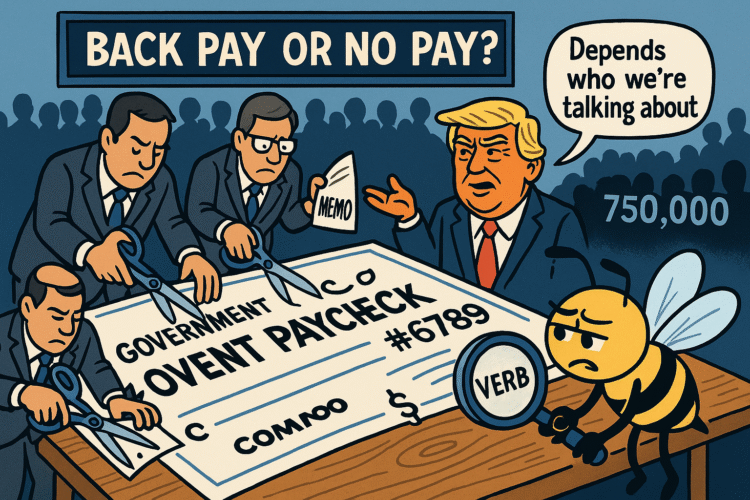
The United States government has perfected a kind of experimental theater in which the actors are unpaid, the audience is hostage, and the script is rewritten mid-performance by whichever lawyer has the best thesaurus. This week’s act: the White House Office of Management and Budget arguing, with the straight face of a man who has learned to sleep through fire alarms, that furloughed federal workers might not be legally entitled to back pay once this shutdown ends.
Yes, you heard that correctly. Seven days into the shutdown, hundreds of thousands of families are living paycheck-to-paycheck with no paycheck, and the administration is floating the idea that the wages owed for their labor might just… not be owed at all. Unless Congress specifically inserts the right verbs into the right sentences of the eventual funding bill.
The Memo That Launched a Thousand Facepalms
The bombshell came in the form of a draft memo by OMB general counsel Mark Paoletta, addressed to OMB director Russ Vought. Circulated quietly but exposed loudly, the memo reinterprets the Government Employee Fair Treatment Act of 2019—the law Congress passed after the last protracted shutdown to guarantee workers would be paid retroactively.
Paoletta’s spin: the law doesn’t actually appropriate money. It just sets a condition. Therefore, unless Congress explicitly appropriates funds in the bill that ends the shutdown, the workers may be out of luck.
Translated into English: Your pay stub is now a Mad Lib.
From Guidance to Gaslighting
The whiplash is not theoretical. On Friday, OMB revised its public guidance, removing references to the 2019 law. One day federal employees were comforted by the promise of back pay. The next day, that promise vanished into the ether of “ongoing legal interpretation.”
If this sounds like bureaucratic hair-splitting, that’s because it is—but with the delightful twist that the split hairs are actually the wages of 750,000 people. Each comma becomes a month of rent. Each clause becomes whether or not you can refill a prescription.
The Numbers Game
The Washington Post’s budget trackers put the number of furloughed workers at roughly three-quarters of a million as of October 7. That’s not an abstraction. That’s hundreds of thousands of TSA agents, air traffic controllers, USDA inspectors, and office staff sent home or told to work without pay. Families making calls to landlords. Kids watching parents stress about bills.
These are not distant statistics. They are the human scaffolding of the federal system. Without them, airports slow, food inspections lag, veterans’ benefits stall, research labs freeze. And yet, their paychecks have been reclassified as bargaining chips.
The Trump Doctrine: “Depends Who We’re Talking About”
President Donald Trump, ever the master of the shrug, told reporters that whether workers get back pay “depends who we’re talking about.” This is the policy equivalent of “I’ll get back to you after I see how the crowd reacts.”
Workers are not supposed to depend on presidential mood swings. That is why Congress passed the 2019 law in the first place. But in Trump’s America, everything is a loyalty test, and every paycheck can be politicized.
Enter the Peanut Gallery
House Speaker Mike Johnson has gone on record saying workers should get back pay—but hedged it with the disclaimer that “some legal analysts” question whether the law requires it. Translation: I want credit for sounding supportive without the burden of delivering results.
Democrats, by contrast, are less coy. Senator Chris Van Hollen called the reinterpretation “lawless.” Senator Patty Murray said it “flies in the face of the plain text of the law.” Both are correct: the GEFTA is not ambiguous. It was passed specifically so workers wouldn’t be held hostage. But this administration has discovered that if you treat every statute like a riddle, you can force the other side to fight for common sense.
The Permanent Axe Hanging in the Background
While OMB fiddles with commas, the administration has been openly signaling interest in more permanent cuts—program eliminations, agency downsizing, and even layoffs. The strategy is obvious: let a shutdown drag on, scare workers into submission, then use the chaos to slash programs you always wanted to kill.
It’s not just about back pay. It’s about rewriting the balance of power between Congress and the executive branch. If a president can hold wages hostage by reinterpreting appropriation law, then the power of the purse has already migrated across Pennsylvania Avenue.
From 2019 Promise to 2025 Threat
The Government Employee Fair Treatment Act of 2019 was supposed to be a guarantee. It was bipartisan. It was signed into law by Trump himself after the longest shutdown in history. It said plainly: when a lapse ends, workers will be paid.
Fast forward to 2025, and suddenly that promise is a bargaining chip. Suddenly “will be paid” is recast as “may be paid, pending future appropriations language.” The reinterpretation is not about legality. It is about leverage.
By creating doubt, the administration creates a new hostage. Not just the workers, but the families depending on their pay. Congress can now be forced to trade policy concessions in exchange for what should have been automatic.
Legal Origami
Here is how you fold a paycheck into a weapon:
- Take a statute designed to protect workers.
- Pretend it is merely “conditional,” not “self-executing.”
- Circulate a memo to allies saying so.
- Quietly revise guidance to match the claim.
- Let the rumor spread that back pay is not guaranteed.
- Watch as panic drives negotiations.
This is not governance. This is origami with people’s lives.
The Media’s Role in the Circus
Axios obtained the memo. Government Executive flagged the edits. The Washington Post counted the furloughed. CNN summarized the spin. The Guardian, finally, pieced it together into a coherent story.
But notice how fragmented that coverage was—like shards of glass on the floor. You only see the full reflection if you collect them all. That’s part of the strategy. Confuse the narrative, spread the pieces, and let exhaustion do the rest.
The Human Cost of Verb Wars
This is not just an academic debate about appropriations clauses. It is about a single mom in Ohio whose rent is due. A veteran in Virginia who can’t get his VA claim processed. A scientist in Maryland whose lab freezer full of samples is warming because maintenance workers were sent home.
Try explaining to them that whether they get back pay depends on the “express language” of the next bill. Try explaining that the verbs didn’t line up, so their wages are gone.
This is where satire collapses into tragedy. The farce is real, but the pain is not funny.
Democrats’ Dilemma
Democrats are right to call this “lawless.” They are right to insist on the plain text of the 2019 law. But they face the same trap as always: argue too loudly and you sound hysterical. Argue too softly and you normalize the outrage.
What they need to do is flip the narrative. Not “Are workers entitled to back pay?” but “Why is this administration trying to steal wages that were already earned?” Frame it as theft, not legal ambiguity. Because that is what it is.
The Endgame: Appropriation as Blackmail
Shutdowns were already a cynical game. But this reinterpretation adds a new level of cruelty. It makes back pay contingent, not guaranteed. It tells workers their time has no value until Congress reaffirms it. It weaponizes ambiguity as leverage.
And it sets a precedent: if this reinterpretation stands, every future shutdown becomes not just about when the government reopens, but about whether workers are ever repaid. That is a chilling shift of power away from Congress, away from law, and into the hands of whichever executive counsel wants to try new origami.
Closing: The Cost of Living in a Riddle
We are now a country where wages are subject to riddles, where your rent depends on a comma, where your mortgage hinges on a footnote. The plain text of the law is no longer plain. It is raw material for reinterpretation.
And the cruel genius of this administration is that by the time you prove them wrong in court, the damage is done. The bills are late, the food is gone, the families have already paid the price.
This is not fiscal conservatism. This is extortion by memo.
So next time you hear a politician say “workers will get their pay,” listen closely. Because in shutdown America, every promise comes with an invisible asterisk: subject to reinterpretation, subject to negotiation, subject to the whims of power.