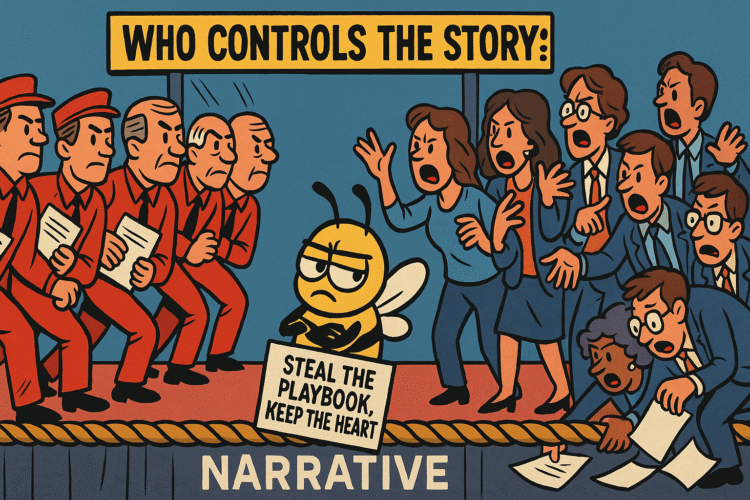
If American politics were a sport, Republicans would be the team that shows up in matching uniforms, drills the exact same play for three seasons, and then executes it with a discipline usually reserved for marching bands and cults. Democrats, by contrast, would be the club team made up of brilliant but argumentative grad students who rewrite the rulebook midgame because somebody read a paper about ethics at brunch, then accidentally bench their best player because the uniforms are ethically fraught. One side has a strategy, whether you like the strategy or not. The other side has principles, which often look suspiciously like a self-inflicted tactical wound.
This is not a call to abandon principle. It is a diagnosis. Our problem is not that Republicans are smarter, or that Democrats are cowardly, it is that Republicans are ruthlessly strategic in service of power, while Democrats have a reflex to apologize for having power at all. Republicans treat politics like a war for territory, with a command structure, a playbook, and a willingness to tolerate, or even celebrate, collateral harm if it secures the hill. That willingness has allowed them to centralize agenda control, enforce loyalty, and execute sweeping, coherent moves that reshape policy even when those moves are unpopular. The practical upshot is a discipline of consequences, and it matters.
Here is the bitter lesson: discipline wins. Discipline, not virtue signalling, not internal purity tests, not the slow, constitutionally devout hand-wringing that ends with a press release and a sigh. Republicans decide what they are going to do, they tell you they are going to do it, and then they do it, even if half the country thinks it is a terrible idea. This is not admiration, it is analysis. It is an ugly efficiency that translates into legislative outcomes, judicial appointments, and narrative control. It forces the rest of the political ecosystem to respond on their terms.
You see this in the way the modern Republican movement operates, in the cultivation of a base that prizes loyalty, in the willingness to flout norms to redefine what is normal, and in the relentless effort to frame the conversation before anyone in the opposition has their shoes tied. There is strategy in the chaos, a logic behind what looks like lawlessness. That logic is simple: act openly, make the moves, absorb or repel the backlash, then normalize the outcome through repetition and institutional pressure. It turns out that if you do a thing enough, it becomes the new baseline, and the story is no longer about the transgression but about adaptation. That is terrifying, because it means that power can be used to remake norms quickly.
Democrats, by habit and temperament, inhabit another political species. They argue in public because they think debate equals clarity, they fracture because they believe ideological purity is a sacrament, and they punish their own because the internal moral calculus values doctrinal correctness. The result is often a beautiful circus where every moral nuance is aired on loop, and the only thing that gets punched through to policy is the thing that does not offend a single internal faction. The consequence is often paralysis, or worse, a small, defensible policy that is later sold as a moral victory while the governing field is reorganized by an opponent who never asks for permission.
This tendency to self-sabotage is not just rhetorical. It is tactical. From internal feuds that derail legislative opportunities, to messaging that plays to the choir instead of persuading the persuadable, Democrats have an unfortunate knack for taking an advantage and turning it into an opportunity to demonstrate their virtue, often at the cost of governing power. You could call it noble, or you could call it political malpractice. Either way, it leaves the field to a faction that does not care if governing wrecks the place, as long as they win.
So here is the blunt argument I want lodged in your skull, like a ticket stub to a show you cannot unsee: we need to adopt the tactical conviction of our opponents, but not their ends. We need the Republican machinery of narrative-setting, the discipline that turns rhetoric into law, the willingness to take the blame for hard decisions, the unashamed ownership of power, but we have to direct it at broadly popular, life-saving policy. Imagine the strategic competence of a party that says, without hesitation, “We will pass universal health care, and we will not apologize for it,” and then marshals the apparatus to make it happen. Imagine the political consequences when the opposition no longer gets to own the central narrative, because we are actually shaping it proactively. This is not a call for moral equivalence. It is a call for methodological theft.
Let us be blunt about the stakes and the arithmetic of persuasion. Policies like Medicare for All have long enjoyed respectable support among a plurality of Americans, with some polls even showing a majority leaning in favor when the benefits are clearly framed. The left gets lost in internecine debates about the exact structure, the financing model, the philosophical purity, and while we are dithering, the other side is hardening their coalition, cutting judges, and rewriting the rules. If more Americans favor universal coverage than oppose it, then why are we not using every tool to make it inevitable rather than optional? If a policy is popular, yet politically stalled, the failure is not only in policy design, it is in strategy.
Republicans do not need everyone to like them, they need enough people to accept their dominance. They move boldly on priorities that excite their base, and then they legislate until the new normal sets in. You can hate the content or the consequences, but you cannot deny the method. Democrats, meanwhile, have mastered the art of guilt, and then they use that mastery to avoid making the hard call. They apologize for power, they cave to short-term optics, and they let the narrative drift because they fear the perception of overreach more than they fear failure. That fear is a political luxury we cannot afford, because the people who suffer are not abstract—they are real, living Americans.
Take the rhetorical posture. Republicans announce, posture, and then legislate. Trump, as an exemplar of this method, weaponized openness. He would say a thing, flout the rule books, and treat the resulting chaos as a campaign phase. That chaos becomes an opportunity, because even outrage has a lifecycle. The opponent, if meek, will chase the outrage and cede the framing. Instead of reciprocating outrage, imagine the left using that energy to set an alternative frame that is anchored in a compelling moral case and in popular preferences. Imagine saying to the public, in plain language, “We are going to do X because X saves lives, protects families, and costs less than doing nothing,” then refusing to nuance it into the void.
Now for the uncomfortable truth: this requires ruthlessness about implementation, not ruthlessness about ends. It means getting better at telling a story, and then telling it louder and sooner, so the story becomes the context in which opponents appear reactionary instead of plausible. It means choosing fights that can be won, and then organizing the hell out of them. It means controlling the ballot measures, the PR operations, the fundraising, the local elections, and the narrative machines that turn policy into an idea the public can touch. It means deploying discipline to the side of broadly popular public goods, not to the enrichment of a narrow clan.
Envision a Democratic strategy squad that plans like a campaign operative, not like a committee of philosophers. That squad would identify policies that poll well when framed empathetically, then design the legislative pathway that minimizes intraparty landmines. It would do the constituency work—face-to-face, community-based, relentless persuasion. It would prepare messaging for every Republican counterattack, not as an apologetic response, but as a pre-emptive narrative strike. It would pass policy through popular, digestible frameworks, and then back it with implementation plans that leave less room for hairline defections. This is not magical, it is boring. It is grind and organization, combined with a willingness to wield power unapologetically.
We must also get pragmatic about the moral theater. Too often, Democrats treat governing like a high-stakes morality play, where every compromise is a betrayal and every victory is suspect. This is performative purity, and it eats political capital. When you are the party that needs to demonstrate competence, you cannot treat hypocrisy as a moral failing and tactical necessity as a sin. The public does not admire self-punishment, they admire results that improve their lives. If the policy is popular, fight to make it law. If the policy is complex, make the argument simple and repeat it until it lodges in the public imagination. If the policy will strain budgets, show how the strain is less than the human cost of inaction. Stop making governing look like a therapy session for liberals. It makes the other side look like they have a spine. We need a spine and we need strategy.
This is also a plea about honesty, because honesty builds legitimacy when paired with action. Own the trade-offs, own the fights, own the consequences. If Medicare for All requires higher taxes on the wealthy, say so, and then show the calculations in a way that people can understand. Do not apologize for the redistribution imperative if the policy redistributes toward broadly supported outcomes like medical security. The Republican advantage is not only rhetorical, it is a willingness to own the narrative of consequences and to make the case unapologetically. If we want to beat them at their own game, we need to stop treating honesty as a prelude to retreat. We need to make honesty a weapon for the public good.
There will be a chorus that tells you this is manipulation, that you cannot borrow the tactics of a party that has embraced authoritarian flirtation without risking your own soul. That is a fair worry. But tactic and ideology are separable, and we can adopt the organizational and rhetorical disciplines without copying the corruption of ends. We can be strategically ruthless in pursuit of universal health care, living wages, climate stabilization, and voting rights. We can be aggressive in framing the opposition as a threat to the common good when the opposition deserves that framing. We can be as relentless about protecting democracy as the other side is about consolidating power, only our consolidation is for broad access and public welfare, not patronage.
Let us be tactical about scale. Start local, where policy experiments can become persuasive exemplars. Pass single-payer at the state level where possible, then trumpet the human stories: people who did not go bankrupt, families who could breathe again, clinics that could plan budgets rather than pray for donations. Use those wins to render the national argument irresistible. The conservative machine built a pipeline from local office to national story, using statehouses to incubate policy and judges. We can do the inverse, and we must. Organized, relentless, unembarrassed action at scale becomes not an ethical compromise but a moral imperative when it saves lives.
We must also do something Democrats have been spectacularly bad at, which is set the narrative instead of reacting to it. When our opponents yell about deficits, we should say, quickly and clearly, “Fine, then tax the people who can afford it and cut the waste that benefits the already wealthy,” and then do the math, repeating the same sentence until it becomes boring and therefore true. When they scream chaos, we should calmly hold up lived examples of improved lives and ask a simple question: “Do you want your neighbor to have health care or not?” Make the framing easy enough for a bus rider to understand, and repeat it until the opposition looks like a racket of contradictions. That is how you neutralize culture wars without surrendering to them.
Finally, this is about courage. Not the abstract, performative courage that fills op-eds, but the kind that legislates when the polls will punish you in the short term if the long-term payoff saves lives. Courage with a plan. Courage with messaging. Courage with grassroots mobilization. Courage backed by the mechanics of victory. If you have a beloved policy that is popular when explained, do not let internal aesthetics and performative purity shred it. Build the plan, tell the truth about consequences, and then do the thing. Be disciplined, be strategic, and be ruthless about implementation, not about morality.
We can steal the best parts of the Republican playbook, which are basically organization, narrative control, and an utter refusal to apologize for governing. We must, at the same time, reject the worst parts, which are the authoritarian impulses, the spectacles of cruelty, the bending of law, and the demonization of dissent. The ethical boundary is non-negotiable. But a moral majority that is disorganized is still a minority, functionally speaking. A disciplined minority that is ethically driven can be a governing majority in practice.
Our opponents have shown us that politics is not a literary salon. It is a messy fight club where narratives are weapons and institutions can be turned into scaffolding for durable change. If Democrats want to win lasting reforms that improve lives, then they must learn to fight with the same hunger and discipline, while never losing their moral bearings. Do not mistake this for cynicism. It is strategy wrapped in compassion. It is the knowledge that the world will not give you what you are owed because you are right, it will give it to you if you can make it inevitable.
So here is the challenge: be principled, and then be tactical about it. Stop apologizing for power, do the unpopular math when the outcome is humane, and then sell the result like you mean it. Pass Medicare for All with the organizational rigor of a Republican campaign, and tell the nation, plainly, that this is what decency looks like when it is organized. Make governing look like competence, not contrition. The other side built a machine. Build one that fixes things. Use their tools to do good, and then refuse to be ashamed of the good you have done.
Closing: The Art of Ruthless Benevolence
Politics is an instrument, not a confessional. The question is not whether we should keep our souls, it is whether we have the courage to wield power to save them. Be strategic, be disciplined, be unapologetic for compassion, and then watch what we can do when we refuse to surrender the narrative to nihilists. The goal is not to become them, it is to outmaneuver them with better aims. If you love the country enough to fight, fight like it matters, and win in a way that makes the next generation safer, healthier, and less frightened. When power is inevitable, let it land in hands that will use it to heal, not to hoard.