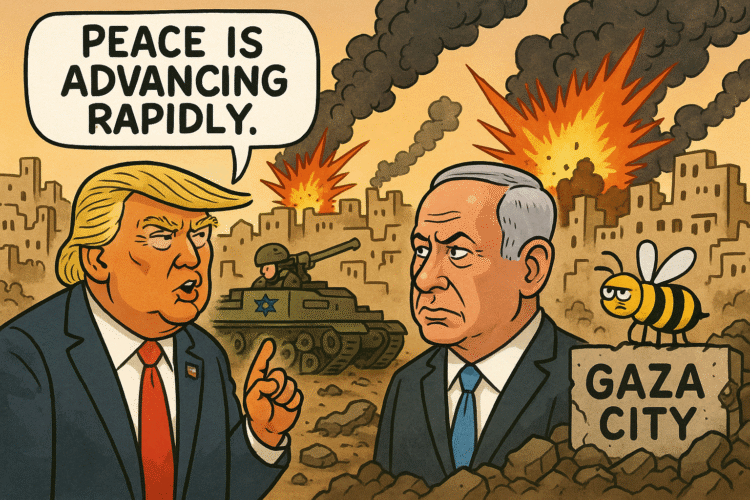
They flew to Cairo under banners of hope and exhaustion, but the very earth under Gaza still trembled with explosions. Trump spoke of peace “advancing rapidly,” urged halts to strikes, promised hostage resolution—but the bombs kept falling. Sixty-plus lives lost in a single 24-hour span. Sixty-plus. The diplomatic caravan arrived while the devastation kept racing ahead of them.
At its core, the plan on the table is theatrical in ambition: the remaining hostages freed in exchange for a mass Palestinian prisoner release, an initial Israeli pullback a few miles into Gaza, a ceasefire, and then governance handed over to a U.S.-led technocratic authority that would manage Gaza’s reconstruction while Hamas demilitarizes. Netanyahu retorts that Israel will still “stay in most of Gaza.” Hamas nods warily. The region holds its breath.
This is not peace. This is a blueprint drafted inside a storm.
The Toll & the Players
By the time talks began, the human ledger was already devastated. More than 67,000 dead, over 170,000 injured in Gaza. Across the Israeli border, roughly 1,200 lives were lost in the initial attacks, and 251 hostages were taken. These numbers are more than headlines. They are the weight, the sorrow, the urgency pressuring every briefcase in Cairo.
The cast is familiar but brittle: Israeli negotiators, Hamas led by deputy political chief Khalil al-Hayya, and an Egyptian delegation. The U.S. side would include Envoy Steve Witkoff and other officials. On stage too is Secretary of State Rubio, calling the deal “the closest we’ve come.” Germany’s Chancellor Merz praised it as the “best chance for peace.” Trump threatened Hamas with “complete obliteration” if they balk.
Every name carries history: Netanyahu’s hawkish instincts, al-Hayya’s cautious pragmatism, the Egyptians’ role as middlemen, American envoys balancing pressure and posture. The tragedy is that every name is also a lever.
The Proposal That Thinks It’s a Cheat Code
The anchor of the proposal is the hostages-for-prisoners idea. Bring 48 hostages home, release more than 1,000 Palestinian prisoners, pause fire, and mitigate harm. If that exchange succeeds, the camp believes it buys credibility, that goodwill can seed governance.
Then comes the pullback: Israeli withdrawal to a mapped “line” within Gaza—two to four miles inward. That initial distance is raw math, not a solution. It is porous by design. Israeli military officials already hint they’ll keep boots “in most of Gaza.” So the plan would ask Gaza to pause but not to disarm entirely.
At the center is the most fragile idea: a technocratic U.S.-led authority to administer Gaza, oversee reconstruction, and ensure transitions. This entity must be credible, not a puppet. It must have legitimacy, not just decrees. That requires infrastructure, security, funding, local buy-in—especially in Hamas-led neighborhoods.
The framework pushes to ultimate withdrawal, but only once assurance is built that buffer zones, policing, reconstruction, border control, humanitarian corridors, demining, and coordination with West Bank and Egypt all function. Each node is itself a battlefield.
What is not clear is how to manage “defensive operations.” If Israel strikes under the rubric of defense, is that violation? When do strikes resume? Who watches? Who enforces?
The Operational Knots & Political Clocks
Every minute the deal stalls, the death toll surges. The verification of a 72-hour hostage exchange is logistic poison: where do hostages wait? Who monitors release? Can militants intercept convoys? Which border do they cross? What’s the chain of custody?
Ceasefire policing is fraught. In Gaza, if independent observers, UN monitors, or coalition forces want room to maneuver, their safety is on the line. Israeli strikes under “defensive operations” carve exceptions—and those exceptions are how ceasefires evaporate.
Netanyahu may claim partial compliance. Ministers may balk. Coalition partners (far-right elements) may demand stronger measures. Every soldier who stays delays legitimacy.
Hamas factions may rebel. Not every militant will disband. Some may splinter. What if rogue cells refuse? Who arrests them? Which authority enforces? If the technocratic authority tries, it risks being treated as a front.
Humanitarian aid must flow. But corridors are already management nightmares. Famine-risk zones are starved for deliveries. Reconstruction cannot wait months. Hospitals need resources now. Water, electricity, clearance of rubble—all must begin under duress.
Meanwhile, cities in Israel under rocket fire want swift action. Political pressure mounts to stall or halt any pullback. Each delay is leverage, each flank a threat.
The Hypocrisy of “Peace Advancing Rapidly”
Trump’s messaging—halt strikes, advance peace—clashes violently with what the bombs say. How do you declare momentum while bombing zones of civilian density? The linguistic dissonance fractures credibility. It’s like announcing duck soup while mustard gas drifts through the dining hall.
That is the danger of combining theater with war. The PR team crowns progress while the body counts rise.
Why This Matters Beyond Gaza
If this deal is enshrined, multiple precedents shift:
- Hostage diplomacy as statecraft: The state sets parameters for mass prisoner exchanges, potentially incentivizing future hostage-taking as leverage.
- Coalition-driven governance: A U.S.-led authority ruling territory is de facto extraterritorial power. It rewrites sovereignty in conflict zones.
- Pullback as facade: Leaving boots in place while claiming withdrawal is a pattern—an exit without exit.
- Ceasefire exceptions as loophole: War becomes continuous. Ceasefire becomes a breath, not a stop.
- Built-in fragmentation: Hamas is asked to vanish. But if it fractures, the new authority must stabilize contested zones, each with its own claim.
And globally, the eyes of nations seeking to carve zones, establish buffer states, or redefine governance will watch. The model is contagion if successful.
Satire in the Madness
Is this diplomacy or a messaging war with drones at the edges? A hostage deal wrapped in the lipstick of consent, a pullback that is still presence, a technocratic authority that must claim legitimacy while enforcing from above. It is a stage where the actors recite peace while bombing scenes play behind them.
If foreign policy is performance, then Gaza becomes a case of tragic theater: the audience is hostages, civilians, displaced masses. The props are corridors, cameras, press briefings. The script changes mid-act. The director, in this play, claims he is diplomacy while editing scenes of violence.
Yet the satire is sharp: a blueprint for peace that acknowledges war, a roadmap that refuses to leave the map, an authority that demands legitimacy but arrives under gun. It is a show in which the stage is rubble, the actors in uniforms, and the applause measured in survival.
What to Watch Now
- Hostage & prisoner verification: who sees what, who monitors, who confirms.
- Ceasefire enforcement rules: map of withdrawal, ROEs for strikes, monitoring authorities.
- Technocratic authority proposals: who leads it? What staff? Whose loyalty?
- Funding & reconstruction flows: how much money? From where? Under what guard?
- Coalition compliance: Israel’s cabinet, Hamas factions, regional actors—will all hold to the deal?
- Document leaks: internal memos, diplomatic cables, UN assessments may unravel the public gloss.
- Casualty reports: explosive shifts in death or injury numbers will test faith.
- Public perception: if citizens in Gaza or Israel feel lied to, the legitimacy of the deal crumbles.
The Mirage of Peace
It is easy to overstate slogans, assemble frameworks, and map corridors. It is harder to survive them. In this moment, Trump’s peace is being weighed against mortar fire, hostage suffering, political pressure, structural legitimacy, and the capacity to govern.
If a deal collapses—as so many have before—the blame will land on all sides. But what shape the ruin takes is what matters. If peace is built on a scaffold laid over rubble, it collapses when wind blows.
This term of diplomacy is not just about endings. It is about how war burrows into law, how governance enters under blast, how a presidency recasts itself as arbiter of statecraft while bombs still fall.
If that becomes the standard, we will not remember the hostages released or the paroles signed. We will remember that peace was proclaimed under siege—and that a blueprint for governing through violence was allowed to draw the map.