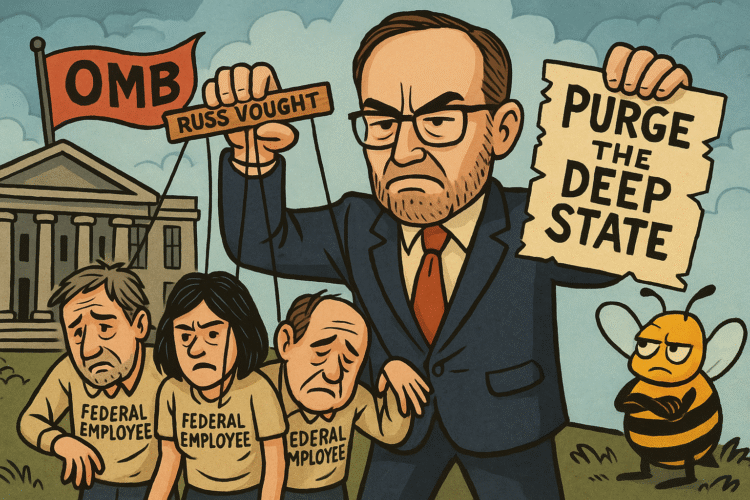
If ever a man wore his ambition like armor, it is Russell “Russ” Vought. In the span of a government shutdown’s heartbeat, the OMB director transformed from policy wonk to de facto czar of executive re-engineering. The BBC’s profile of him on October 3, 2025, paints Vought not just as the architect behind Project 2025, but as the hand pushing the switch on this administration’s structural takeover. He is the ideological valve turned operational engine—the man who champions governing by memo, centralizing power, purging the civil service—and now, in real time, wielding a shutdown as both scythe and blueprint.
Vought’s trajectory is neither secret nor sudden: once Trump’s OMB chief, then head of the Center for Renewing America, now returning to power with the kind of authority that breaks precedent. But the speed with which he’s converted executive theory into shutdown doctrine is what has watchers gasping. In a week when Congress failed to fund the government, the White House triggered Antideficiency Act procedures. On October 1, Vought told House Republicans that mass firings would commence “in a day or two”—not as threat, but as plan. In that moment, the shadow of Project 2025 became government’s new daylight.
The Fulcrum of Crisis
Congress missed its funding deadlines. At midnight on October 1, shutdown procedures snapped into place. Agencies began furloughing, declaring “excepted” operations, and notifying employees. Vought moved quickly. He invoked the January 20, 2025 reinstatement of Schedule F—reborn from earlier proposals to strip civil service protections from policy-facing roles. He pointed to the July 2025 Supreme Court ruling lifting injunctions on mass firings, removing what had been a judicial constraint. He ordered OMB/OPM guidance that accelerated a Reduction-in-Force (RIF) sequence: rank employees by tenure, performance, veterans’ preference, then purge the bottom tiers. Meanwhile, “excepted” programs—those deemed politically useful—would remain alive.
So the blueprint reads: furlough broadly, but kill selectively; purge the expendable; freeze the vulnerable; weaponize the lapse. Centralization becomes default. The White House gets to punish what Congress won’t pass.
Vought’s Toolkit: Freeze, Cancel, Rewrite
Vought’s reach extends beyond purges. His operational toolkit is vast and chilling:
- Impoundment via apportionment delays: billions of dollars destined to megaprojects—especially in states opposing the administration—are frozen by withholding authorization. New York’s transit hub expansions, for example, are locked in limbo.
- Clean-energy clawbacks: DOE was ordered to rescind $7.6–$8 billion in grants across 200+ projects in 16 states, including $1.2 billion from California’s ARCHES hub. Projects in Texas and parts of Appalachia remain untouched.
- Tariff-inflation messaging: Whenever prices rise, instead of market logic or supply-chain distortions, the administration spins blame on its political enemies. The invisible hand becomes a conspiracy hand.
- Legal theory of shutdown as structural opportunity: Vought treats ordinary shutdown discretion—not a failure, but a lever for permanent change. The lapse is not the problem; it is the mechanism of transformation.
This is not governance by default. It is governance by design.
The Choreography of Political Theater
The public embrace of Project 2025 on October 2—after Trump’s 2024 disavowals—was not inadvertent. It was choreographed. The day before, Defense Secretary Pete Hegseth delivered a Quantico sermon about purging “politically correct” leaders. His words primed command culture. Then, the administration’s communication apparatus cast civil servants as part of a “deep state” obstacle—the bureaucratic sand in the gears of Trump’s agenda.
When Vought commands mass firings, cancels climate investments, and delays infrastructure within hours, the line between personality and state erodes. The messaging is explicit: failure is not accident; it is enforcement.
Agency Impacts, Fallout, and Resistance
The effects ripple through every department. Unions are suing in federal court alleging unlawful Schedule F reclassifications, revocation of civil service protections, and mass firings without due process. Inspectors general warn of oversight gaps—unmonitored funding, unvetted terminations, no records. Governors and city mayors bristle: procurement freezes, lost grants, infrastructure contracts in limbo. Contractors are idled without back pay.
Programs in CDC, NIH, FDA, EPA, State—each slows or halts. National parks open but unstaffed. Passport offices freeze. Visa backlogs balloon. Small-business lending stalls. The FAA’s NextGen modernization, already slowed, slips further.
Within the Navy, rumors swirl that Undersecretary Hung Cao’s recent elevation is aligned with Hegseth and Vought’s broader personnel shakeup: loyal officers selected, dissenters sidelined, command culture consolidated.
If this shutdown is merely phase one in a longer reset, it begins to look like Vought is converting lapse into legacy.
What to Watch (and Fear)
The real stakes will be determined by what happens next—and how fast:
- First pink slips appear in fee-funded offices despite existing balances: killing projects with cash still in bank accounts is a message, not a necessity.
- Test-case litigation over Schedule F reclassifications: who challenges first? Which court holds the power to enjoin?
- Whether Department leadership begins wholesale personnel reshuffles under the guise of “reform” targeting political loyalty.
- How aggressively the administration uses impoundment and apportionment to cut key Democrat-leaning programs even after funding resumes.
- Whether Congress reclaims the power of the purse or lets this reset slide.
On a deeper level: if Vought’s path holds without serious pushback, the doctrine shifts. Appropriation becomes conditional, personnel protections optional, executive control the new default. The arm of governance is recast as the muscle of executive will.
The Rebalancing We Didn’t Choose
Russ Vought is no bureaucrat in the shadows. He is this administration’s executioner, converting ideological blueprints into structural realty. He is reshaping the federal state while cameras look elsewhere.
Whether the courts, Congress, unions, or public protest stop him from cutting this new model into stone, the ambition is clear: the next administration may inherit not just policy choices, but a remade machinery of power.
Last Act: The Purge’s Promise or Problem
We are living through a turning point. If Vought’s shutdown-era playbook becomes the baseline, then budget lapses no longer end—they begin something new. Whether that something is dark will depend on resistance, legal courage, and whether democracy remembers that the power of the purse was never meant to sleep through midnight.