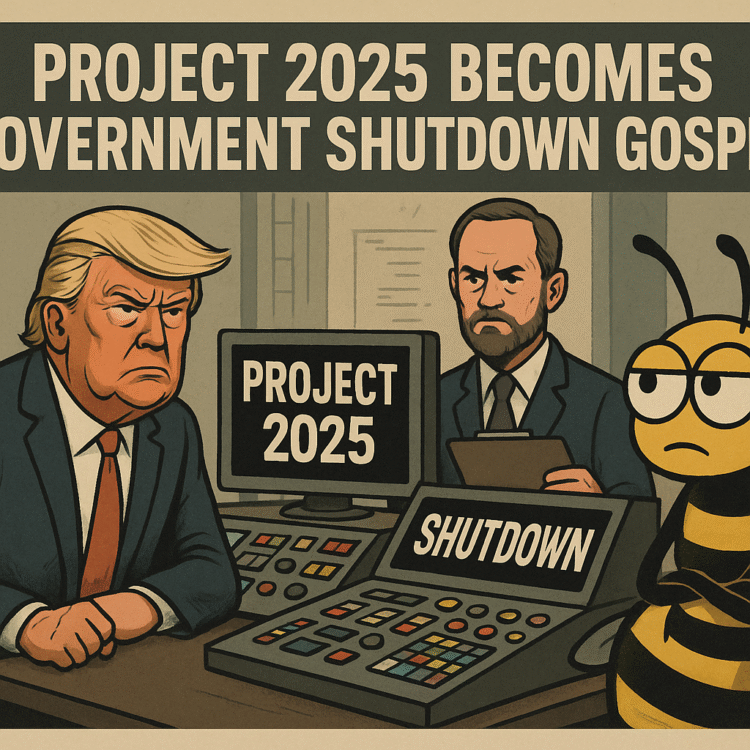
It took exactly two days. Forty-eight hours into a shutdown that had already darkened laboratories, silenced grant pipelines, and furloughed three-quarters of a million civil servants, the White House finally dropped its pretense. What was once billed as a think-tank fantasy, a right-wing wish list too radical for the campaign trail, was suddenly elevated to scripture. Axios reported that President Donald Trump, who spent 2024 claiming he had nothing to do with Heritage’s Project 2025, has now embraced it with open arms. His chosen interpreter? Russ Vought, the Office of Management and Budget director who also happens to be the architect of the plan’s most dangerous chapter: the remaking of the civil service into an ideological machine.
Vought did not simply show up. He had been preparing the stage since January, quietly drafting reclassification schemes that stripped protections from anyone whose job touched “policy.” In the language of Project 2025, these are the “influencers,” the analysts and scientists and lawyers who keep an agency running whether or not the president likes what they say. By October 1, Vought was on the phone with House Republicans telling them mass firings would begin “in a day or two.” By October 2, he was sitting in the Oval Office with Trump, mapping out which programs to freeze, which to cancel, which to let rot in silence.
The shorthand was brutal: “Democrat Agencies.” That was the White House phrase of the day. Energy and climate, housing and transit, research and regulation. If it had been built by statute but championed by Democrats, it was now a target. In New York, $18 billion in infrastructure plans were locked in the freezer. Across sixteen states, $8 billion in climate projects were canceled with the flourish of a memo. For supporters, this was discipline at last. For critics, it was punishment by geography. For those who still believed in the separation of powers, it was nothing less than a constitutional demolition derby.
The Whiplash of Disavowal
Trump’s campaign voice was all disclaimers. Project 2025? Too extreme. Not mine. I don’t know it. The usual repertoire. But disavowal was only ever camouflage, a tactical lie to soothe suburban voters who would never read a Heritage white paper. Once elected, he circled back to the same gospel he had publicly discarded. A classic bait-and-switch: deny it until the votes are counted, embrace it once the lights go out.
The timing is part of the play. A shutdown turns the normal functions of government into emergency maneuvers. In that vacuum, you can slip in structural changes under the guise of crisis management. Executive power is never so expansive as when Congress has left the room, when appropriations have lapsed, when the Antideficiency Act reduces the work force to “excepted” skeleton crews. It is in that gray zone that Vought thrives, where a memorandum can function as policy and a purge can masquerade as compliance.
The Meeting
Accounts of the October 2 meeting between Trump and Vought describe it less as consultation than choreography. A map of agencies on the table. A list of programs under review. The president calling them “Democrat Agencies,” the director providing the tools to dismantle them. Freeze here, reprogram there, starve that, cancel this. The spirit was not one of fiscal responsibility but partisan targeting.
What makes this different from past shutdown theatrics is the operational readiness. Vought has spent years designing mechanisms to reclassify staff and circumvent protections. Schedule F was just the prototype. Now it returns in expanded form, a blanket authority to declare whole swaths of the bureaucracy “policy influencing” and therefore disposable. Combine that with Reduction in Force procedures and a Supreme Court ruling that lifted injunctions on layoffs during shutdowns, and you have the machinery of purge disguised as fiscal triage.
Guardrails, Thin and Brittle
There are still laws, still limits, though how long they hold is uncertain. Congress created most of these agencies, and the Constitution gave Congress—not the president—the power of the purse. The Antideficiency Act bars spending in the absence of appropriation, but it does not grant the executive the right to permanently cancel programs Congress has already funded. Reduction in Force rules give veterans preference and require elaborate ranking procedures. Courts can, and almost certainly will, enjoin overreach. Unions are already lawyering up, ready to argue that the shutdown is being twisted into an unlawful layoff machine.
But law is only as strong as enforcement, and enforcement is only as strong as judges willing to act quickly. If memos are issued on Friday and lawsuits take months to process, the damage may already be irreversible. That is the cynical bet: move faster than the courts, deeper than Congress, bolder than the opposition believes you will dare.
Blue States as Hostages
The geography of the freezes is too conspicuous to dismiss as coincidence. The Second Avenue Subway and the Hudson Tunnel Project—both in New York, both essential, both blue-state projects—are on ice. Climate initiatives across Oregon, California, Colorado, and Massachusetts are among the eight billion canceled. Governors call it retribution. The White House calls it prioritization.
The result is a two-tiered government: one where red-state priorities continue with federal blessing, and one where blue-state programs are defunded not because the money ran out but because the president prefers it that way. The constitutional idea of equal protection begins to warp. Infrastructure itself becomes a partisan weapon.
Consequences of a “Launch Week”
If this week becomes precedent, governance itself is redefined.
Civil service independence erodes. Staff no longer serve the law but the president’s preference. Policy is made not through deliberation but through memo. Shutdowns become not failures but opportunities—chances to reset government on ideological terms. Agencies become partisan turf wars, their survival tied to political loyalty rather than statutory mandate. And once dissent is punished through reclassification and dismissal, the chilling effect spreads: scientists censor findings, lawyers shade opinions, analysts self-erase.
In that world, separation of powers is not contested, it is bypassed. Congress appropriates, but the president cancels. Courts may object, but the firings already happened. Governors may protest, but the cranes on their construction sites are idle.
The Irony
Project 2025 was supposed to be too radical to touch. Trump himself dismissed it when votes were at stake. Now, with government dark, it is the operating manual. That is the irony: not that he changed his mind, but that he never needed to mean his denial in the first place. The playbook was waiting for the right crisis.
The Final Image
Picture it: the Capitol dome in darkness, agencies shuttered, construction sites padlocked, workers clutching pink slips. In the West Wing, Russ Vought with a stack of Heritage playbooks, Trump with a marker circling names of programs to cut. It is governance by blackout, lawmaking by impoundment, democracy by attrition.
The shutdown is not an accident. It is a strategy. The question now is whether the courts, Congress, or the public will treat it as such—or whether America will simply watch as a temporary lapse becomes the permanent launch of an executive state.