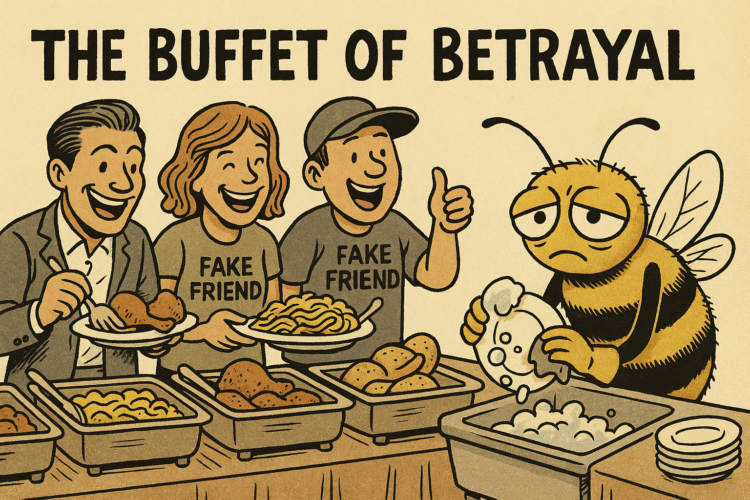
There is a certain genre of person who insists on showing up to your table with Tupperware in hand, uninvited, ready to scoop the last spoonful of your mac and cheese while loudly congratulating themselves for “being here for you.” These are the same people who clap when the plane lands, repost inspirational quotes on Instagram, and consider loyalty a seasonal accessory. In other words: the Fake Ones. The counterfeit companions. The permanent plus-ones who only RSVP when there’s free food, free validation, or free spotlight.
What inspires this essay is not a song itself but the spirit of it, the sermon it delivers with blunt force: stop confusing access with friendship. Stop mistaking smiles for support. Stop letting people eat from your plate when they refuse to touch a dish sponge afterward. This is not about music—it’s about survival in an age when hypocrisy has better PR than honesty.
Act I: The Cookies Nobody Asked For
Everyone knows the archetype. They arrive at your doorstep with their metaphorical “cookies,” some lukewarm offering meant less to nourish you and more to get applause. They want you to marvel at their effort, not at the taste. And if you don’t hand over validation like a Michelin star, they sulk. What they really want is for you to let them keep serving you their bland recipes while you starve of actual support.
Here’s the secret: no one owes them a five-star Yelp review for showing up with crumbs. In fact, if your recipe for friendship is that dry, please stop baking.
Act II: Trench Warfare, But Make It Social
There’s a special kind of rage that comes from realizing you were in the trenches while someone else was busy curating their “best life” collage. You were dodging bullets, crawling through mud, fighting battles no one applauds—and your supposed allies were nowhere to be found. They didn’t send reinforcements. They didn’t even text back.
And yet, the moment you find daylight—when the blood, sweat, and bankruptcy have given way to a faint success story—they return. Suddenly they remember your number, suddenly they’re nostalgic for “the good old days,” suddenly they want in on the afterparty of your survival.
These people are not comrades. They are tourists. And tourists always leave when the weather shifts.
Act III: Smile in the Face, Knife in the Back
There’s a reason the old phrase “smiling assassin” never goes out of style. The counterfeit friend is fluent in facial expressions. They beam in your presence, shower you with compliments, and cheer just loud enough for others to believe they belong in your corner. But behind you? That’s where their real choreography begins—whispers, shade, distortions, and sudden auditions for your role.
They eat from your plate like they’re family, but when it’s time to wash the dishes, they’re gone. They leave behind grease, crumbs, and the sinking realization that you mistook appetite for loyalty.
The true test of friendship is not who claps when you win, but who helps clean the mess when you lose.
Act IV: Bandwagons and Bankruptcy of Character
Counterfeit loyalty has its favorite vehicle: the bandwagon. It rolls through town every time money, status, or headlines appear. Fake friends leap aboard with the grace of Olympic athletes, waving from the wagon as though they’ve been riding all along. They shout about “loyalty,” but the only team they know is whichever team looks like it’s winning.
Here’s the brutal comedy: they mistake motion for commitment. They confuse presence for loyalty. But riding the bandwagon isn’t the same as helping build the road.
And when the road ends—as roads always do—they’re gone, searching for the next wagon with free snacks and no accountability.
Act V: Ghost Protocol
One of the sharpest betrayals isn’t even the gossip. It’s the silence. The moment they decide to ghost you, mid-conversation, mid-crisis, mid-sentence. They vanish not because they’re busy, but because they’ve calculated you are no longer useful. It’s a cruel math, the kind that reduces friendship to transaction.
And then, when you’re “all the way up” as the song spirit suggests, they return, arms open, pretending amnesia. But ghosts don’t get resurrections. If you left me for dead when I was gasping, you don’t get an encore now that I can breathe.
Act VI: Buffet Politics
Let’s talk about the buffet. Fake friends treat your life like one: grab what’s appealing, ignore the rest, and leave a mess behind. They’ll take the victories, the Instagram-worthy nights, the name drops. But when it comes to grief, rent due dates, or doctor’s appointments, suddenly their plates are full elsewhere.
The lesson? Stop letting people treat you like an all-you-can-eat menu. Real friends cook with you, clean with you, starve with you. Fake friends just want the carving station and the dessert bar.
Act VII: Middle Fingers and Benedictions
Every satire deserves a climax, and here it is: the day you realize that middle fingers are not weapons but boundaries. They are signs in neon letters that read: “I will not host counterfeiters in my temple anymore.” You don’t need to throw shade; you just need to stop sharing light.
The applause you were handing out like candy? Save it for the ones who showed up when you were invisible. The plates you kept filling for freeloaders? Hand them instead to those who actually cook with you.
Because for every fake, there are real ones. Quiet, loyal, backbone-solid friends who don’t need cookies or applause to stay. The satire is that we waste so much time diagnosing the frauds instead of celebrating the constants.
Curtain Call: The Real Ones
The world is full of frauds, and it always will be. They are loud, hungry, and allergic to dish soap. They will smile in your face while carving your absence into their narrative. They will shout loyalty until the road runs out.
But the real ones? They’ll never audition. They’re already cast. They don’t announce themselves with applause; they prove themselves with presence. They don’t raid your plate; they bring their own dish and stay to clean. They don’t ghost; they grieve with you.
So raise your middle fingers high—not as anger, but as a farewell. Let the bandwagon roll on without you. And then turn back to the table where the real ones sit, the ones who’ve been there since the trenches, the ones who don’t confuse friendship with performance.
Because the only applause worth hearing is the quiet kind: the steady hands clapping for you in the dark, when no one else is watching.