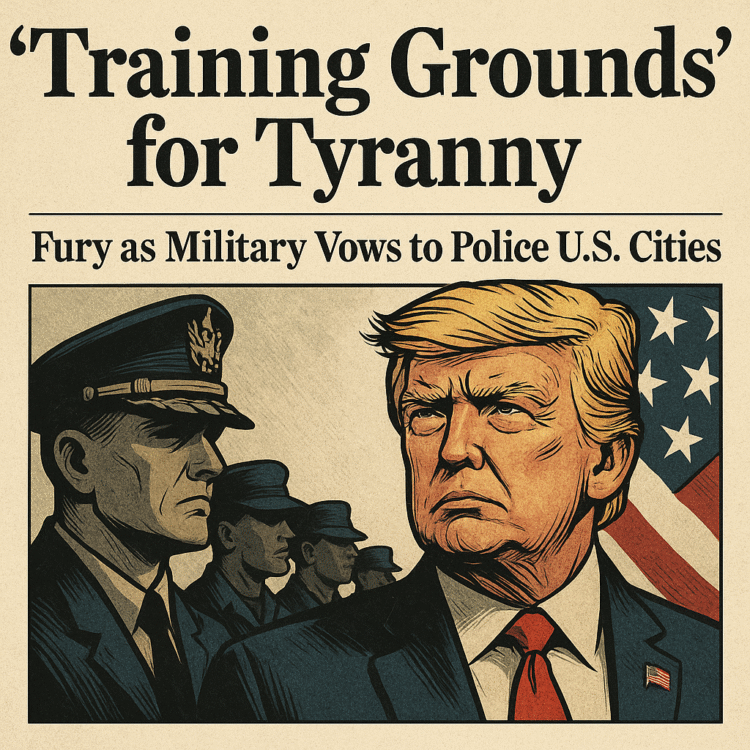
In the glare of flags, in the shadow of rank, Donald Trump addressed roughly 700–800 generals, admirals, and senior enlisted leaders at Marine Corps Base Quantico. It was a moment staged with the precision of a director: Defense Secretary Pete Hegseth’s prelude, the audience summoned at short notice, the hush in the hall as Trump delivered twenty minutes of rhetoric heavy with allusion, signal, and spectacle. Retired Lt. Gen. Mark Hertling now calls it “sinister,” warning that buried in Trump’s words was a directive: treat American cities as training grounds under the rubric of “enemy within.”
This is not casual commentary. It is a messaging play with possible operational consequences. Let me walk you through how the event was orchestrated, what was actually said, how contemporary reporting and fact checks respond, and why this might be less a speech and more an ask—to turn institutional force inward.
The Staging of Power
Days before the speech, Hegseth began laying cultural groundwork: speeches about “woke leadership,” male fitness, “political correctness” molting patriotism. He ginned up a narrative that the military must rebuild culture before it can enforce legacy. The generals and admirals were told to assemble at Quantico—as though summoned to a counsel of war, not a public address. The press release called it a “culture summit” but the optics were unmistakable.
On stage, behind Trump, a wall of American flags rose like a fortress. The generals sat in near silence, their eyes fixed. The politicians in the crowd shifted uncomfortably. The mood was both ceremonial and charged, as though a new mission had already been written in the silence.
When the speech came, Trump spoke of crime, of a broken nation, of threats that are less foreign than internal. He said he would use U.S. cities as “training grounds.” He talked about an “enemy from within.” In context: a populace, or segments thereof, cast as potential fifth columns. He framed domestic deployment as proper, moral, necessary. The crowd cheered, but the undertone was tactical.
Key Lines and Their Weight
He said, verbatim or close to it: “We are fighting an enemy from within. We must reclaim our cities. These are not just training grounds for foreign operations—they must be training grounds in our own land.” He referenced urban zones of violence as areas in need of “military-style discipline, enforcement, leadership.” He intimated that law enforcement was overwhelmed, that local institutions were failing, and that the federal military must intercede.
Those were not rhetorical flourishes. To a trained officer, these are signals. Cities as training grounds is an ask for domestic deployment. Enemy within is a recharacterization of dissent or disorder as an internal threat. On their own, perhaps vague lines. But delivered to uniformed leaders, in that context, they become something like instructions under color of authority.
Fact Checks, Reporting & Echoes
CNN’s Daniel Dale immediately flagged multiple false claims in the address: inflated crime statistics, misattributed data, overstated claims of media suppression. In parallel, AP and the Wall Street Journal reported that the urban-training idea is now moving from rhetorical sketch to policy concept, citing internal Pentagon documents and think tanks exploring joint federal–local training initiatives. Some have said: “We’re seeing flash drafts that combine DoD, DHS, and DOJ overlap.”
Observers noted that these ideas echo earlier rhetoric from Trump and Hegseth about purging “politically correct” leadership, enforcing male fitness standards, prioritizing ideological loyalty in promotions. The Quantico address seems less new ground than the clearing of existing brush.
When an officer listens to “training ground” in a city context, she hears not metaphor but a proposition. When he hears “enemy within,” the question is: who is defined as enemy? Are protests, civil disobedience, journalistic dissent folded in? Once that axis is crossed, law enforcement becomes an adjunct of political will.
Legal & Operational Stakes
Deploying the U.S. military domestically is not trivial, legally or operationally.
- Title 10 vs Title 32 vs Insurrection Act: Title 10 is federal active-duty forces, restricted by the Posse Comitatus Act from acting as domestic law enforcement. Title 32 (National Guard under state control) is more flexible. The Insurrection Act allows presidential deployment under specific criteria “to enforce laws if authorized by Congress or to suppress rebellion.” Each carries limits, oversight, and requirements.
- Force protection vs citywide patrols: Force protection—guarding federal property, embassies, installations—is less controversial. But sweeping patrols in local neighborhoods, arrests, curfews—that is law enforcement in policing domains not belonging to the military.
- Chain-of-command pressure: Officers would face impossible choices. If ordered to deploy into U.S. cities under a novel “training” rubric, refusing might look mutinous. Obeying might violate law. The military oath is to constitution, not pronouncements. But the risks are real.
- Mission creep and ambiguity: Start in “crime hotspots,” drift to protests, drift to neighborhoods with political opposition. If “enemy” boundaries are elastic, the mission becomes indistinguishable from intimidation.
Reactions & Risks
Retired brass like Hertling have spoken out. They warn this is a turning point: either the military guards democracy, or it becomes the enforcer of a political faction. They call the framing “sinister,” “domestic militarization of politics.”
Inside the Pentagon, silence holds. Publicly, few comment. But private memos—leaked or whispered—indicate unease. Some agency chiefs are urging caution, reminding that morale, public trust, and political neutrality are core military capital.
Governors and mayors bristled. Cities like Detroit, Chicago, Philadelphia issued statements: don’t treat our streets as firing ranges. Local law enforcement said: we don’t need troops, we need resources. The risk: foot soldiers in uniform treading into municipal sovereignty.
Morale in ranks is at stake. Officers who see themselves as guardians of constitution may balk at becoming instruments of domestic suppression. Retention may suffer among those who won’t serve a politics-first military.
The Test for Military Resistance
At issue is not whether military doctrine can change—but whether senior leaders will object. Will Joint Chiefs signal dissent? Will commanders defy unlawful orders? The moment a president’s stagecraft and catchphrases become operating instructions, the chain of command fractures. If the military bows without protest, the precedent is set. If it pushes back, the limit is saved.
That is the real point of Hertling’s alarm: not that Trump might send troops into U.S. cities someday—but whether the uniformed leadership will sound the alarm now, before orders are issued, before doctrine shifts, before deployment begins.
We watch Quantico not as theater, but as trial. The lines “training ground” and “enemy within” are not speeches—they are summons. The question is: who answers, who resists, who cedes.
In short, they didn’t just address the brass—they tried to recruit them. And that is a moment when silence is complicity.