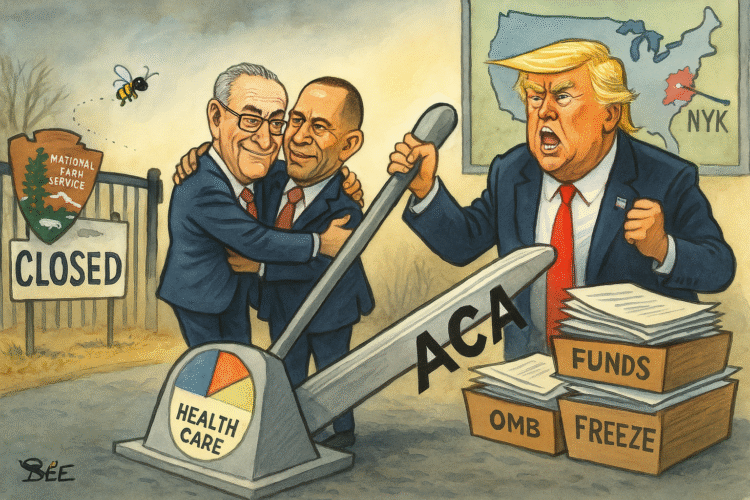
When the federal lights went dark at 12:01 a.m., they went dark not from incompetence but by design. On Day One of the shutdown, Democrats—led by Schumer and Jeffries—did something rare: they leaned into it. They embraced disruption as leverage. They would treat a government shutdown not as failure, but battlefield, by insisting that any reopening must include restored ACA premium subsidies and the reversal of Medicaid cuts baked into Republican legislation.
It is a bold gamble. It is also a signal: if you don’t treat your shutdown stance as a vulnerability, you might catch wind that it’s your strongest weapon. Let’s reconstruct the timeline, sift through the messaging, list what’s at stake, and watch whether this political gambit becomes a legacy—or a calamity.
Timeline: Brinkmanship to Vote to Shutdown
Late September—Escalation
As funding expiration looms, Democrats quietly shift posture. Internal polling (as reported) shows public anger rising at high prices for insurance. Messaging teams begin to float the possibility: if you tie reopening to healthcare relief, Republicans lose political cover. Schumer, Jeffries, and aides begin secret talk of shutting government to force concessions.
Republicans, under Senate Majority Leader John Thune, start pushing short-term continuing resolutions (CRs) as stopgaps—weeks or months at a time. The White House counters with signals: “We won’t reopen unless we match our priorities.” The pressure meter ticks.
Midnight, October 1—Shutdown Begins
At 12:01 a.m., funding lapses. OMB/OPM memos trigger furloughs of non-excepted workers. Some hearings are canceled, grant approvals halted, data releases delayed. The White House treats it as power play, signaling they will withhold or freeze select funds (impoundment-style maneuvers) to punish key states and jurisdictions. Reports emerge that ~$18 billion in infrastructure funds (e.g. New York’s Gateway, Second Avenue line) could be withheld.
Wednesday (3rd day)
Senate votes on two proposals. One: a short CR that excludes health provisions. One: a health-tied CR. Both fail. Schumer leads Democratic senators in rejecting the GOP CR that lacks ACA subsidy relief. The messaging is: you don’t reopen unless you do health justice. GOP senators blame “radical Democrats,” Republicans blame obstruction. Meanwhile, the shutdown lurches on.
Messaging, Whip Counts & the Chess Moves
Schumer frames this as “holding the line for people who can’t afford health care without help.” Jeffries says the debate is about what values the country will reopen with. They argue that any reopening without restored ACA subsidy levels (2025 rates) would be tyranny of neglect.
Behind the scenes, whip counts are brutal. Some moderate Democrats are nervous: states like Ohio, Pennsylvania, Michigan may see blowback. The centrists want shorter CRs, incremental fixes. But Schumer leans on promises, public appetite, and internal polling to force loyalty. Republicans, meanwhile, lean on accusations that Democrats want “eternal entitlement expansion,” that this is a “shutdown by Democrats for Democrats.”
The White House counter-messaging is immediate: they accuse Dems of playing political chicken with people’s lives. They claim that Democrats are just protecting “covid-era” subsidies. Staffers push that Trump has signed 20 executive orders already to stabilize prices. They argue that the shutdown is entirely Democrats’ choice.
The competing narratives converge in media: WaPo editorials warning of a “shutdown trap” for Democrats who overplay their hand; AP/Reuters clocks ticking hour by hour through shuttered parks, closed permit offices, cancelled inspections. GOP claims Dems are obstructionists; Dems counter that Trump is weaponizing the purse.
The Machinery of Shutdown: Who Stops, Who Stumbles
As the shutdown rolls, the following gears grind to a halt or slow to crawl:
- Grant approvals: NIH, NSF, arts funding—all pending grants freeze. Universities and researchers lose operating certainty.
- Inspections & compliance: EPA audits, OSHA enforcement, FDA reviews slow or stop. Some factories, clinics, food-safety regimes are vulnerable.
- Parks, monuments, tourist attractions: Some close or reduce hours—particularly in federal lands, national parks, DC memorials. Tourism dollars evaporate.
- Data & statistical reports: Labor Department, Census, economic indicators miss deadlines. Markets and media scramble with missing inputs.
- Social services: Some discretionary services are interrupted. Refugee processing, immigrant assistance may stall.
- Essential operations: Air traffic control, military operations, Social Security, Medicaid — these remain, but staffing stress intensifies.
In strongly Democratic districts, these disruptions amplify grievances. In Republican strongholds, the damage may feel more remote. It’s uneven pain, politically calibrated.
Constitutional Risk & the Power of the Purse
What Democrats are betting on is that the power of the purse resides in Congress, not in an executive clutching funding like a toy. But that script is messy. The Trump administration’s playbook includes impoundment-style delay of legally appropriated funds, targeted freezes, and use of Schedule F or reclassification purges to weaken oversight.
If courts allow selective funding freezes based on political animus, the separation-of-powers boundary is cleaved. The president withholds funds from jurisdictions he dislikes. Congress’s authority weakens. Where does that leave states or cities dependent on federal help? The fiscal system becomes a weapon.
Add to this the mass-resignation gambit (100,000 workers under deferred-resignation program) and threatened budget cuts, and you see how the executive can hollow institutions and starve opposition next cycle. Democrats are betting they can hold that line.
Political Risk vs Reward
If Democrats succeed, they’ll reopen under healthcare gains—say, restored ACA subsidies, Medicaid protections—and present a narrative: “Trump tried to cut health care; we held firm.” It becomes a campaign message for 2026.
If they fail—or if shutdown fallout outpaces their gains—the narrative will be: “Chaos. Government shut. Problems for everyday folks. Democrats closed the doors.” The messaging burden is heavy. The political temperature is high.
Further risk: if city or state services are blamed—parks closed, permit offices offline, inspections delayed—the public may not parse nuance. Trump may frame it as Democratic sabotage. The very act of shutdown gives political cover for opponents.
Final Thought
This is not a naive gamble. It’s high-stakes brinksmanship. Democrats have embraced a shutdown only when they felt they had no margin for retreat. They’re not betting on kindness. They’re betting on zero leverage and maximal pressure. If you love health care—or democracy—you root for Congress, not stability.
But there’s a danger: allowing shutdowns to become legitimate weapons gives the executive the option to wield them again. To hold power hostage. To force compliance not through legislation but through darkness.
The twenty-first-century question is not whether governments shut down. It’s whether shutdown becomes the method of rule. On Day One, Democrats tried to seize that method. Let’s see whether they become masters—or victims—of the trap they entered.