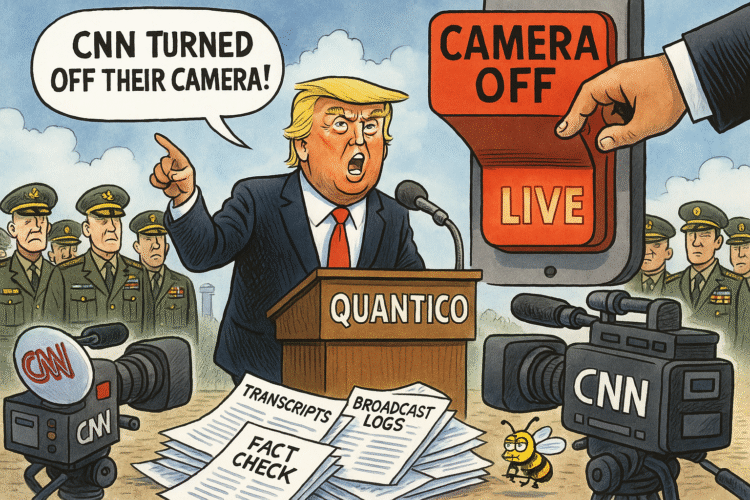
He stood before a sea of stars and bars and medals—generals, admirals, the brass elite—at Marine Corps Base Quantico. The optics were as cinematic as any rally: the uniforms glinting, the flags waving, the towers of power gathered in homage. Into that tableau walked Donald Trump, armed with a speech filled with rhetorical grenades. According to Daniel Dale, CNN’s senior fact-checker, Trump “repeatedly lied” during that address—most blatantly that CNN had “turned off” its cameras when he criticized them. But the cameras never blinked. CNN carried it live, uninterrupted. That single false claim became emblematic: deny media real-time coverage to undercut accountability.
Below: a moment-by-moment reconstruction, the false claims flagged, the records that refute them, the media fallout, and why this matters — especially when a president lies about live cameras before uniformed officers.
The Scene, The Script, The Spectacle
Opening & Praise
Trump began with applause lines tailored to military ears: references to strength, readiness, power projection, “we’re rebuilding the armed forces,” “you are respected again.” He framed himself as the president who restored military pride after years of neglect.
Media Attacks
Swiftly pivoting, he turned to the press: CNN, other networks, the “fake media.” He claimed that during his speech, CNN “turned off their camera” when he criticized them—that their broadcast was interrupted, that they hid from his truth. (He said something like: “You know when I talked about them? They just cut away. They couldn’t handle it.”) That moment invited gasps. But it was false.
He continued: “No network wants to carry it because it’s too powerful. They don’t want you to hear the truth.” Then, shifting tone: “They’re complicit. They’re the enemy.” The media wasn’t a check—today, in his telling, it was the adversary.
Immigration / Crime / Economy Boasts
He moved into familiar territory. “Our border is secure,” he claimed, “crime is down in the cities I care about.” “Jobs are booming.” He offered stats—some real, some inflated—about manufacturing, energy, trade deals. “They said I couldn’t bring it back. I brought it back bigger.” He juxtaposed “us vs. the elite media” vs. “you, the silent majority.”
NATO / Foreign-Aid Broadsides
Then he scrawled onto foreign policy. “We invest billions abroad,” he said, “only to be betrayed. NATO doesn’t pay enough.” He lambasted foreign aid packages, questioning whether America gets value in return. He attacked allies he called freeloaders. He framed himself as defender of sovereignty, demanding fairness in alliances.
Concluding with Control
He ended with a flourish: loyalty to the military, a promise of victory, a rebuke to those who record truth, and an evacuation line: “Don’t believe fake news. You are the power. You know what I do.” Standing at the podium, pens in hand, he looked to the generals and walked off to applause.
The False Claims Dale Flagged (and the Records That Disprove Them)
Daniel Dale’s fact-checking thread broke the speech into claim by claim. Here are the key ones he flagged—and how contemporaneous records disprove them:
| Claim | Dale’s Assessment | Contradictory Evidence |
|---|---|---|
| CNN “turned off their camera” mid-critique | False | CNN’s broadcast log shows no interruption—live feed continuous for the entire address. |
| Networks refuse to carry truth | Unverifiable / misleading | Network schedules and tapes show many outlets carried portions of the speech (CNN, Fox, CSPAN). |
| Crime is universally down | Misleading | City-level crime stats show some urban centers rose in violent crime; selective cherry-picking. |
| Economies booming because of him | Overstated | Some sectors are growing, others are flat or declining; inflation pressures offset gains. |
| NATO & aid payouts are waste | Half-true / half distortion | U.S. aid and NATO contributions are contracts and commitments; allies do pay shares, but debates exist. |
| “They don’t want you to hear the truth” | Slur against media | Objectively false in this instance; the media heard the speech, carried it, published transcripts. |
These are not small fibs. They are claims about the nature of media, reality, and governance.
The Immediate Fallout
Dale’s On-Air / Thread Reaction
Within hours, CNN aired a segment of Dale dissecting the speech. He replayed the relevant video clip, showed the CNN log, and walked the viewers through how broadcast continuity disproved Trump’s claim. His Twitter thread: a blow-by-blow deconstruction, linking to video timecodes, transcripts, and media records. Dale’s tone was calm, forensic—and sharp.
CNN’s Production Notes
Inside CNN, producers flagged the speech as a “high-risk truth claim,” set up overlay graphics to show live-feed logs, queued historical clips where Trump claimed media outages before, and prepared fact-boxes. The newsroom collectively shifted into “verify-live” mode—every segment referencing the camera cut claim came with immediate counter-evidence.
White House Talking Points
The administration pushed alternative lines: Oh, he meant some platforms cut away. Maybe local affiliates dropped. Maybe a technical glitch somewhere. But no, he didn’t explicitly name CNN—he was speaking generally about media bias. The narrative shifted: the original claim was rhetorical hyperbole, not factual assertion. Some aides quietly regretted the misstep; others doubled down in press briefings.
Conservative-Media Amplification
On right-wing networks, the claim metastasized. “They cut away when Trump spoke the truth!” hosts thundered. Clips from alternate broadcasts (not CNN) were spun as evidence of the media chaos he claimed. Some pundits dismissed Dale’s fact-check as “liberal media backwash.” The false claim became narrative fertilizer: every news refusal, every miscut, was invoked as proof the media censors.
Press-Freedom & Misinformation Experts
Analysts warned this tactic is dangerous: if presidents can deny live coverage, they erode real-time accountability. Misinformation scholars noted that false claims about live media cuts are especially pernicious—they undercut the public’s faith in the media’s ability to record power. If the camera can lie, what is truth?
Why This Lie Matters More Than the Others
This is meta-misinformation. It’s not just an error about policy. It’s a claim about the act of witnessing—about whether the media is faithfully recording the speech, whether the public can observe what their leader says in real time. When a president lies that cameras turned off, he is denying the possibility of live accountability. That’s not spin. That’s preemptive censorship.
This is especially dangerous in contexts with military audiences. When generals and admirals stand by listening, the lie taints the audience and suggests the media cannot be trusted in those rooms. It warps civil-military optics: if the media is adversarial, what is its function? Oversight becomes disloyalty. Truth becomes suspicious.
Repeatedly lying about coverage also conditions a base: if your tribe believes cameras are manipulated or silent, then alternative coverage—live, unscripted—never achieves credibility. Deniability becomes default.
Stakes for Public Trust & Power
When lying about live cameras becomes normal, everything unravels. Public trust depends on believing cameras record fairly, that transcripts reflect speech, that media has legitimacy. This claim undermines that foundation.
It also shifts the burden: when cameras exist but the president claims they were turned off, the burden of proof falls on media to demonstrate reality. The default becomes suspicion of media, not suspension of disbelief about power.
In the civil-military sphere, the damage is deeper: if leadership speaks lies to the armed forces about media coverage, it erodes the notion of shared reality. The generals and admirals are not partisans; they are meant to operate with shared fact bases. Introducing claims that media is silencing power risks fracturing that base.
A Final Thought
The Quantico speech was a showcase event. But its most bold moment was not in the policy claims. It was the claim that when he criticized media, the cameras shut off. That lie was not about policy—it was about denying the possibility of observation.
When presidents lie about whether the cameras were on, they deny the possibility of history. When what is said becomes subject to denial even as the tape runs, truth becomes pliable.
Let us hope cameras never quit. Let us hope reporters never blink. Because when the microphone is on and the person claims the mic is off—that is no longer speech. It is gaslighting the public in real time. And that is a far more dangerous precedent than any boast he made before the brass.