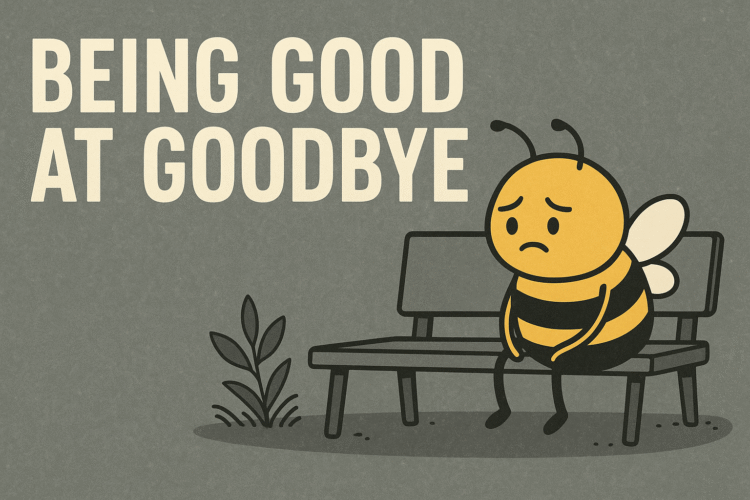
The hardest skill I ever learned was not empathy or leadership or writing a book. It was goodbye. Goodbye is the only thing I’ve been allowed to master. It’s the only certificate hanging on the wall. Some people collect diplomas; I collect exits.
I don’t mean the cinematic goodbye—the one where a person drives off in a convertible while someone runs after them waving a scarf. I mean the smaller, duller goodbye: the text that stops getting answered, the dinner invitation that quietly vanishes, the sense of someone leaning back just a little farther until they’re out of range.
For as long as I can remember, I’ve been disposable. Family, friends, lovers—each of them at one time held my hand, then one day let go without a backward glance. One day I’m in, the next day I’m out, just like Project Runway. People love to toss me away. They probably have their reasons. We outgrew each other. I wasn’t useful. I did something wrong. They moved on. I’m not perfect; I’ve done my share of ghosting. But the through-line is this: my life has been a series of trash-bin drafts.
Childhood: The First Auditions
The first time you’re thrown away, it doesn’t register as a pattern. It feels like a glitch. Maybe the best friend in elementary school moves away. Maybe they find a new best friend with better markers. You think it’s just kids being kids.
But then it happens again in middle school. And again in high school. By college, you start noticing that you’re not just losing people—you’re being processed out. Your friendships are term-limited. You’re a temp worker in other people’s lives.
Most friendships are relationships of convenience. You go to the same school, work at the same job, date the same people, share the same schedule. Once that convenience evaporates, so does the relationship. You stop going to the same bar, and the texts go unanswered. You graduate, and the group chat becomes archaeological dust.
I’ve been guilty of this too. I’ve let friendships lapse once the convenient glue dried up. But when it’s every friendship, every relationship, every family bond, it starts to look less like happenstance and more like a curriculum: “Goodbye 101.”
Adult Life: Chosen Family as Gig Economy
Last year, this time, I thought I had a large group of friends—a chosen family. The kind of thing you see in sitcoms or in carefully curated Instagram slideshows. A band of people who “get” you. A ragtag cast of regulars.
Since then, it’s become obvious: the majority were there because of what I offered them. My time, my network, my energy, my generosity. Once that was gone, so were they. The chosen family turned out to be a gig economy. When the contract ended, the job postings disappeared.
It’s not just rejection. It’s market logic. Relationships are investments. People invest when the returns are high. Once the yield drops, the portfolio gets rebalanced. The human gets reclassified as non-essential.
The Psychology of Disposability
Here’s the punchline: you don’t even need to be bad for people to leave. You just need to be inconvenient. And once you’ve internalized that, you start living like a person under layoff notice. You stop believing in tenure. You learn to make your desk portable.
It’s exhausting. And numbing. Even when I meet someone I truly connect with, I already know the timer is ticking. It’s all finite. You can’t build on quicksand, and modern friendship feels like quicksand with Wi-Fi.
So you adapt. You learn to pack light. You become friendly but not attached. You’re pleasant in the break room but don’t plan a road trip. You cut down the risk of heartbreak by lowering the stakes. You become good at goodbye.
Goodbye as Skill Set
We celebrate people who are good at “hello”—networkers, charmers, the ones who light up a room. We never talk about the skill set of goodbye. But it’s a real curriculum:
- Rapid assessment: sensing when someone is about to withdraw.
- Boundary setting: pre-emptively detaching before you’re discarded.
- Narrative control: framing the loss as “mutual” or “inevitable” rather than “abandonment.”
- Memory triage: deciding which details to keep, which to shred.
- Emotional minimalism: not pouring more fuel into a dying flame.
Goodbye competence is emotional automation. You become like an HR department for your own life—processing separations, sending exit surveys, updating the directory.
The Trash Bin Metaphor
I’ve always described it as “the trash bin.” Not because people are trash, but because of the feeling: used, discarded, waiting for the truck. It’s a passive metaphor. Trash doesn’t protest. Trash just waits. Trash knows it’s routine.
But there’s another layer: the trash bin is also where drafts live. Everything on a computer goes there before it’s erased. You can still retrieve it for a while. Some people do come back. Some relationships revive. But you don’t count on it. You assume deletion is next.
Being good at goodbye means living as if everyone is a draft. A few lines of code that will soon be overwritten.
The Self-Blame Loop
I can list the reasons people gave or might give. We outgrew each other. I didn’t measure up. I became too much. I became not enough. I was inconvenient. I was selfish. I was boring. I was intense. I was distracted. I was depressed.
All of those may be true. I’ve hurt people. I’ve neglected people. I’ve failed people. But the pattern remains even when I try to be better. And that creates a loop: maybe I’m unlovable. Maybe I’m the problem. Maybe I was never meant to be chosen.
It’s a seductive narrative because it gives you the illusion of control. If it’s my fault, maybe I can fix it. But what if it’s not entirely my fault? What if disposability is the default mode of modern relationships? What if the problem isn’t me but the culture of convenience, speed, and perpetual audition?
Numbness as Armor
Now, I’m mostly numb. If you’re gone, you’re gone. I won’t replace you. Friendships feel overrated. I don’t have the energy to do it anymore. I’ll be friendly at work. We can joke at the coffee machine. But I won’t build a new family just to watch it evaporate.
This isn’t bitterness as much as triage. You can only bleed out so many times before you stop opening the wound.
I have Matthew. I have a few people still around. As they dwindle, I will not replace them. There will not be another batch.
The Culture of Convenience
Zoom out. Our culture rewards disposability. We swipe left on people. We ghost texts. We move jobs every year. We churn through communities like Netflix series.
Even chosen family, that sacred queer construct, can get commodified. It’s a hashtag, a marketing angle, a branded experience. But at its core it still requires work, maintenance, mutuality. And our culture of convenience is allergic to work.
So friendships become subscriptions. They renew automatically until you cancel. They lapse when your credit card expires.
When you’ve lived your life as the canceled subscription, you stop believing in renewal notices. You cancel first. You become your own algorithm of detachment.
The Irony of Goodbye Mastery
Here’s the structural irony: being good at goodbye makes you look bad at relationships. People read your detachment as coldness. They say you’re the one who disappears. They don’t see the training scars.
It’s like a soldier flinching at fireworks. They call it antisocial; you call it reflex. You’re not running from intimacy; you’re ducking from incoming fire.
But irony also holds a gift: you can write about it. You can analyze it. You can turn the skill of goodbye into a narrative, into an essay like this, into art. It’s not a cure, but it’s a reframing.
Why Goodbye Hurts More for Some
Not everyone feels this deeply. Some people shed relationships like old coats. They’re fine. But if you grew up learning that love was conditional, that attachment was precarious, each departure reactivates the original wound.
You’re not just losing a friend; you’re confirming a prophecy. “See? No one stays.” The prophecy becomes a self-fulfilling habit. You pre-emptively detach, and then they leave, and you say “See?” again.
It’s hard to break that loop. It takes extraordinary reciprocity—someone who insists on staying even when it’s inconvenient. Matthew, perhaps. A few others. But even then, you brace for impact.
Choosing Solitude
I’ve reached the point where I’d rather be alone than replay the madness. Solitude can be bleak, but it’s honest. You don’t get ghosted by your own company.
This doesn’t mean I hate people. I’ll still be kind. I’ll still mentor, collaborate, chat. But I won’t invest in new emotional real estate. I won’t pour a foundation on land I don’t own.
Some might call it giving up. I call it sustainable living.
The Power in Saying No
Being good at goodbye can be corrosive, but it can also be liberating. You stop begging to be chosen. You stop auditioning. You stop over-functioning to be indispensable. You reclaim your time.
When you stop chasing replacements, you discover a quieter form of self-respect. It’s not the high of belonging, but it’s not the hangover of betrayal either. It’s a stable baseline.
What Remains
Matthew remains. A few others remain. Maybe that’s enough. Maybe the scarcity is the point. Maybe deep connection can only happen with a few, not the many.
I don’t know if I’ll ever unlearn goodbye. But I know this: being good at goodbye is not the same as being unworthy of hello. It’s just what happens when you’ve been drafted into too many exits.
Maybe one day the culture of convenience will slow down. Maybe someone will build a relationship like a house instead of a tent. Maybe chosen family will mean permanent, not provisional.
Until then, I will keep my boundaries, write my essays, and let goodbye be what it is: not a failure, but a skill forged in the furnace of disposability.