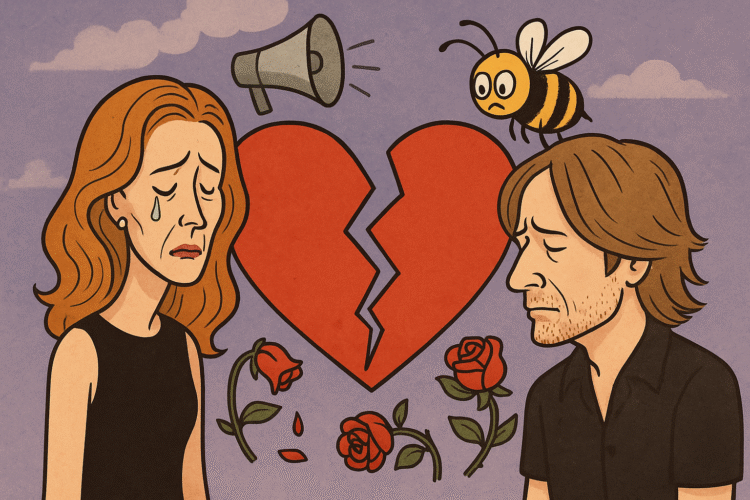
I don’t know who put “Public Divorce” on this year’s marquee, but somehow it cast Nicole Kidman and Keith Urban as its centerpiece act—the tragic stars of a love story we all believed in. Their separation announcement hit like a meteor strike: stunning beauty in motion frozen mid-dance, two icons unraveling in public while fans stagger in disbelief. It feels less like news and more like a wound reopening in slow motion.
They were one of Hollywood’s rarest kind of couples: grace and rock star, elegance and grit, cameras flashing while their love pulsed quietly in the background. Nicole — stately, luminous, statuesque — married Keith, the Australian country rock troubadour with guitar strings in his blood and sincerity in his voice. Their relationship felt like a movie script you wanted never to end, except real life doesn’t come with rewinds.
The Fairest Romance—Before the Crack
Remember when they met? The chemistry already flickered in the edges of every photograph: she in couture, he in denim; she glancing warm and composed, he unscripted, vulnerable, eyes glinting with admiration. They moved through red carpets and family dinners, through lullabies and awards shows, framing a narrative of partnership, balance, support.
Across an unforgiving public stage, she remained a Hollywood legend. He remained an artist whose heart wrote into melodies. And together, they projected a kind of soft power: a marriage that said, “Yes, it’s possible—even in this crucible—to build something tender.” Their public displays weren’t always grand, but they felt earned—small glances, hands on backs, shared laughter. When divorce comes for a couple that looks like a painting, the canvas seems smaller afterward.
So when the statement arrived—immutable, impersonal, “by mutual decision,” “deep sadness”—our chests cracked. How do you mourn a marriage over social media? But we do it anyway. We scroll, we speculate, we share tributes. Because part of us believed in “Nicole & Keith” the same way we believe in magic.
Why It Feels Like a Betrayal
Not every celebrity split stings. We brace for them. We roll our eyes. But theirs is different.
First: because they seemed so… unbreakable. The rumors passed by like hurricanes over weaker boats. They stood together through public scrutiny, relocation, family tragedies, career shifts. For years, the narrative was: love endures.
Second: because they were a counterexample. In a culture that divorces love like old jeans, they embodied something rare. A power couple not built on gaslighting headlines but on mutual curiosity, mutual respect. Their union felt like a soft rebellion in a world wired for shallow spectacle.
Third: because we made them part of our own story. People whose relationships fail in private we feel empathy for—but couples we lift as symbols, we feel grief for. Their separation is not just theirs; we fear theirs invites the end of ideal partnerships for the rest of us.
The Anatomy of the Statement
There is always a statement. The form is familiar: short paragraphs, passive voice, no blame, many “mutual decisions.” The sad symmetry of the public apology: “We ask for privacy.” “We remain committed to our family.” “Deep gratitude.” Always the gratitude, even in the dissolution.
What the statement cannot show: whom they slept next to last night, who held whose hand first this morning, who first thought, “Maybe I can’t.” The statement is necessary theater: manage the optics. But it is a lie to think it captures the heartbreak.
The Ripple Effects
Fans send flowers to their houses. Articles appear of “10 times they looked in love” or “What might have gone wrong.” Tabloids spin rumors: career conflicts, distance, midlife crises, Instagram fatigue. Sometimes, we collaborate in the rumor mill because grief without narrative feels endless.
For the industry, it’s a signal: a once stable Hollywood marriage ends. Even icons decrease. Agents, PR teams, co-stars shift posture. Critics will weigh screens of their past work for coded signs: lines in films, album lyrics, interviews where they looked distant. The divorce becomes a performance after the fact.
The Memory Glitches
I remember moments: Nicole backstage after an award, her hand on his shoulder as he accepted. Keith writing songs about gold-dust love, about desert nights and home. When she made art about emotional honesty, when he sang it back with grit. I replay their ads, their interviews—the way she laughed, the way he watched her.
But memory is selective. The cracks, the arguments, the missteps are invisible. We gloss over them. Our grief is the fantasy we built, not the contradictions they carried. The marriage was never perfect—but it was beautiful in its imperfection. And so we divorce our illusions now.
Why We’re Sobbing for a Celebrity Split
Because longing is sticky. Because we associate their love with possibility. Because when someone you admire unravels, you fear your own axis is tilting. When celebrities divorce, we feel—even if academically—that the ground is shifting.
Because defying the divorce narrative is a minor radical act. To marry publicly and age publicly and mourn publicly: these are protests in a culture built on separation and resurfacing stories. When they separate, we feel the system won.
Because they gave us permission to believe that moody men and immaculate women can build something tender. And when it ends, our permission feels pulled. We fear the age when tenderness is the risky bet, not the safe bet.
The Last Act Is Silence
We will never know all the reasons. It may be distance. It may be divergence. It may be wounds unsaid. It may be the slow erosion of private selves. We will see appearances, social media posts, legal filings, nostalgia pieces. But we will never see the true pain.
What stays is their artistic legacy. Their children (if any) who will live with dual stories: the years of love and the years of parting. Their careers, perhaps reframed through the lens of this heartbreak. And our own internal remapping: how we love, how we believe love lasts.
A Heart Never Truly Departs
Love is not vanishing. The part of us that rooted for them still lives. I am deeply saddened by this separation not because of their fame, but because of what their love represented: that tenderness in the glare is possible, that harmony can be forged even in public life. Their beauty was ours to watch. And now grief is ours to carry.