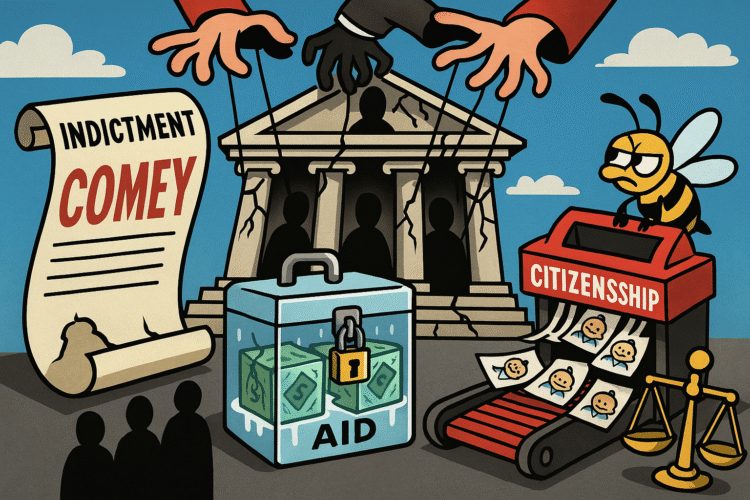
Some weeks in Washington feel like episodes of prestige television: you think you’ve reached the cliffhanger, only to discover the writers had two more shocking twists lined up for the same hour. This was one of those weeks.
First, the Justice Department indicted former FBI Director James Comey, accusing him of lying to Congress and obstructing its oversight. Then, almost without pausing to wipe the ink off the indictment, the Supreme Court signed off on a freeze of billions in foreign aid. And before the justices could put down their gavels, the Solicitor General popped up like a stagehand with a fresh script: please fast-track our executive order to strip birthright citizenship.
Three acts, one play. And the plot isn’t subtle: the courts aren’t just referees anymore—they’re props.
Act I: The Ghost of Hearings Past
Comey’s alleged crime? Saying the wrong thing at a hearing years ago. He’s charged with making false statements and obstructing Congress. The statutory citations may sound clinical, but the theater is obvious: if you ever crossed this president, the archives will be scoured until something sticks.
Attorney General Pam Bondi delivered her lines with gusto about “accountability” and “restoring trust.” FBI Director Kash Patel chimed in with his own chorus about “past politicization.” Meanwhile, the case landed in the lap of an interim U.S. Attorney who owes her job to loyalty more than prosecutorial chops. It’s less Law & Order and more Casting Couch for Authoritarians.
The moral of this scene isn’t about Comey’s fate. It’s about the precedent: if a former FBI director can be dragged into court for testimony dusted off from years ago, what judge wouldn’t wonder if they’re next?
Act II: The Purse, the Freeze, and the Pocket Pick
The next day brought a different trick. Congress had appropriated billions in foreign aid. The White House froze it. Lower courts said, “That’s unconstitutional.” The Supreme Court said, “Actually, go ahead.”
And just like that, the president discovered a new toy: the pocket rescission. You don’t need to veto appropriations when you can just let the money sit in the freezer until it spoils. Congress still gets to hold the purse strings; it just turns out the purse is locked in a presidential freezer bag.
The dissent warned of separation-of-powers erosion, but the majority waved them off. And you could almost hear the Oval Office laughter: why haggle with appropriators when the courts have blessed procrastination as governance?
Act III: Citizenship on the Express Track
Sensing momentum, the Solicitor General filed a petition to fast-track the administration’s executive order restricting birthright citizenship. Lower courts had already blocked it, citing something called the Fourteenth Amendment, but why wait for appeals when the justices have just proven they’re willing to speed-run the Constitution?
The move wasn’t subtle. First, intimidate a former FBI director. Second, bend the Court into permitting a $5 billion legislative bypass. Third, demand the justices change constitutional interpretation on a tight deadline. It’s the political equivalent of shoving the Monopoly board off the table and declaring victory.
The Reactions
Civil-rights groups screamed about authoritarianism. Lawmakers warned of creeping court capture. Legal scholars invoked Watergate, the Federalist Papers, and whatever dusty precedents they could fling like garlic at a vampire.
But beneath the outrage was real fear. The DOJ’s independence looked compromised. Congress’s control over spending looked perforated. And the Court’s willingness to grant emergency relief looked less like judicious caution and more like political convenience.
The message to the judiciary was simple: compliance is rewarded; resistance is punished.
The Stakes
This isn’t about one man’s indictment, one pot of aid money, or one executive order. It’s about the merger of law enforcement, fiscal power, and constitutional interpretation into a single lever of executive dominance.
If prosecutions become political weapons, Congress’s appropriations become optional, and the Constitution itself becomes a negotiable contract, then the courts are no longer a coequal branch. They’re scenery.
The Comey indictment isn’t just a case. It’s a warning shot. And the justices, watching the shell hit the water near their ship, have to wonder if the next one is aimed at them.
The Kingdom of Checks and Balances (Now on Fire)
Once upon a time, the judiciary prided itself on insulation—robes instead of uniforms, lifetime tenure instead of polls. But when the executive can summon criminal charges, freeze legislative intent, and demand constitutional makeovers on deadline, the robe is no shield.
The fairy tale ending is gone. The castle is smoking. And the punchline is bleak: the courts are being dared to prove they’re still courts.
Closing Note
The administration has written a new script for government: one where prosecutions teach lessons, budgets bend to will, and the Constitution is subject to expedited shipping.
The question left hanging: will the judiciary play its assigned role—or finally, belatedly, walk off stage?
The Summary of All Things Judicial (and Ridiculous)
What began as a legal skirmish with an ex-FBI director has ballooned into a coordinated campaign to fold the courts into political theater. Criminal charges, frozen aid, and citizenship games are not isolated stunts—they are rehearsals for executive supremacy. If judges blink, the curtain falls on judicial independence. And when that curtain closes, democracy doesn’t get an encore.