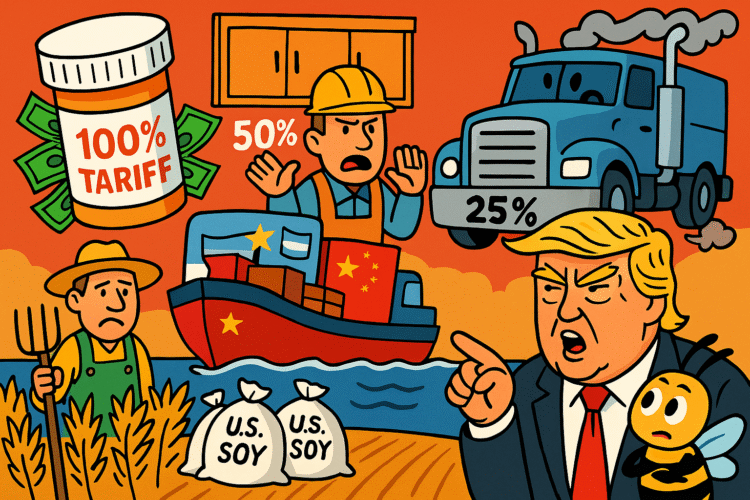
It is not hyperbole to say that on one cheerful afternoon in late September, President Trump rolled out a tariff package that feels like a slow-motion economic apocalypse. Effective October 1, the administration slapped a 100 percent tariff on pharmaceutical drugs, 50 percent on kitchen cabinets and bathroom vanities, 30 percent on upholstered furniture, and 25 percent on heavy trucks. He promised to protect American industry, to punish foreign exploiters, to re-engineer trade in our favor. What he unleashed, however, is far darker.
Farmers out in the Midwest already watching China slip away as a buyer declared “zero” new-crop soybean sales to China, while China booked at least ten Argentine cargoes. Homebuilders braced that cabinetry tariffs would raise new-home costs. Furniture retailers scrambled to shrink margins or absorb price hikes. Truck buyers realized the chassis under their rigs just got pricier—and freight rates will catch the pass-through. And patients, insurers, hospital systems looked at 100 percent drug tariffs and wondered whether the “carve-outs” for U.S.-based manufacturing would save them—or simply create a new price floor no one can afford.
Meanwhile, Fed Chair Jerome Powell warned this spring and summer that tariffs were already injecting inflation pressure into the economy; new estimates from the Yale Budget Lab now suggest the average effective U.S. tariff burden is near Depression-era levels—about 17 percent to 19 percent. The burden falls squarely on consumers, rural communities, supply chains, and the political promise that tariffs would revive, not punish, the people they claim to protect.
This is a guide, a lampoon, and a warning: what the tariff rollout is, who it hurts, and why those who cheered for economic sovereignty may soon find themselves bent double in the price aisle.
The Who / What / When / Where / Why (All the Details)
When & What
On September 25, 2025, President Donald Trump announced the new tariff schedule, effective October 1. The structure is aggressive and sweeping:
- 100% on pharmaceutical imports
- 50% on kitchen cabinets & bathroom vanities
- 30% on upholstered furniture
- 25% on heavy trucks
Though the pharma tariff drew the most rhetorical heat, it’s the sum of parts—household goods, furniture, heavy equipment—that reveal the true ambition: to reengineer trade flows and supply chains, to punish foreign manufacturers back into mercy, to reshape what “Made in America” means.
The legal hook is partly Section 232, the national security statute used to impose steel and aluminum tariffs earlier, and partly new proclamations citing “economic vulnerability, manufacturing sovereignty, and import dependency.” The White House claims these tariffs will incentivize onshore production and reward domestic investment.
Who
- Trump Administration / Office of the U.S. Trade Representative (USTR): driving policy, defending political edges
- Farmers / Soy Producers (Iowa, Illinois, Missouri, etc.): the primary casualties in the export war
- Homebuilders / Cabinet Makers / Furniture Retailers: downstream manufacturers and merchandisers
- Truck Manufacturers / Freight Operators / Logistics Cos.: users of heavy trucks whose cost inflections ripple across supply chains
- Pharma Companies / Insurers / Patients: victims of drug-price spikes and political theater
- Fed / Macroeconomists: sounding alarm bells about inflation, growth, income pressures
- Importers, supply chains, port operators, logistics hubs: caught in cost shock & re-sourcing scramble
Where & Pivot: Soybean to Argentina
Formerly, China was a primary buyer of U.S. soybeans. But under retaliatory tariffs and tightening diplomacy, U.S. soybean exporters reported zero new-crop sales to China in the weeks following the tariff announcement. By contrast, China booked at least 10 cargoes from Argentina, meaning U.S. soy fields may face a seasonal glut while Brazilian and Argentine rivals scale up market share.
In the Midwest, farmgate prices, storage costs, harvest logistics, and credit lines all strain under the loss of demand. Rural communities that voted for tariff nationalism now find themselves waiting for the benefits that won’t arrive.
Why / The Promise & The Hypocrisy
Trump’s pitch is familiar: foreigners exploit us, we pay for their goods, we want reciprocal trade. Tariffs are his blunt instrument of global negotiation. He promises that tariffs will force manufacturing back to U.S. soil, create jobs, and restore sovereignty. But the disconnect is glaring: those tariff burdens fall immediately on Americans—not on the foreign exporter. The hope is distant; the pain is present.
Industry Reactions & Political Blowback
Farm & Agribusiness
Farm bureaus across Iowa, Illinois, Missouri, and Minnesota issued statements calling the drug tariffs “devastating” and the furniture/cabinet tariffs “counterproductive.” Some state agriculture secretaries warned of loan delinquencies, storage overflows, and cooperation with midwestern senators to demand relief.
Homebuilders & Cabinet Makers
Builders warned that kitchen cabinet tariffs alone could raise the cost of a typical new single-family home by $8,000–$15,000. Cabinet manufacturers, many whose parts are imported and assembled domestically, said they faced impossible sourcing choices—they can neither cut margins nor pass full costs to buyers without crashing sales.
Furniture Retailers
Retail chains like Ashley Home, IKEA U.S., smaller regional retailers, and design firms scrambled to recalculate margins. Some said they would absorb as much as 50 percent of tariff costs just to maintain price stability, hoping consumers won’t notice immediately. Others threatened to push sticker costs or delay restocking.
Truck & Freight Sector
Buyers of heavy trucks—logistics companies, municipalities, shippers—now see chassis and engine imports subject to 25 percent duty, raising new-truck costs by tens of thousands per unit. That ripples into rental fleets, replacement cycles, lease rates, and ultimately freight prices. Consumers will pay via higher prices on everything shipped.
Pharma / Health Sector
The 100 percent drug tariff threat triggered panic. The administration backed down somewhat, announcing carve-outs for firms that built or expanded U.S. plants. But those expansions take years and capital; they don’t mute the risk of price ceilings, reimportation wars, and lobbying battles. Hospitals, insurers, and patients braced for drug-cost shocks in the short term.
Economic & Monetary Authorities
Fed Chair Jerome Powell had already flagged tariffs as a source of inflation pressure during earlier months. Now, with major tariffs kicking in, his worry is that headline inflation—food, housing, transportation, medicine—will accelerate. That in turn crowds out wage gains, squeezes real incomes, and forces monetary pivots.
Macroeconomists at think tanks and universities scrambled recalculations: the Yale Budget Lab projected that the effective average tariff burden—the real cost weighted across goods—could now sit near 17 percent to 19 percent, levels unseen since the Great Depression. That means consumers pay for nearly one-fifth of their baskets in new tax-inflation.
Political & Electoral Blowback
Red-state congressmembers whose districts grow soybeans already face constituent anger. Legislators warned of hearings, demands for relief packages, tax credits, and emergency liability. Some Democrats saw an opening: arguing that tariffs were not just economic policy but redistribution by burdening lower- and middle-income households to reward narrow industrial or political allies.
Even within Trump’s coalition, rumbles of discontent surfaced: small business associations, interior-state Republicans, regional manufacturers asked: who is actually protected here?
Tariffs as a Mirror: How This Reflects the Promise and the Lie
Tariffs have long been sold with a myth: the myth that foreign exporters pay the tax, that tariffs create jobs, or that they only hurt elites. But the truth is harsher: tariffs are regressive consumption taxes disguised as sovereignty tools. They hit poorer people harder—who spend more of their income on goods. They punish regions like the Midwest, where export incomes are critical. They concentrate benefits in protected firms and erect entry barriers that favor incumbents.
Moreover, the political narrative has always overlooked elasticity and substitution. If Chinese imports become unprofitable, buyers shift to competitors—Argentina, Brazil, Vietnam. That pivot is not just likely, it’s happening. U.S. goods don’t automatically find domestic buyers; supply chains unravel.
Then there’s the timing hypocrisy. The White House says it wants to punish foreign exporters, but its own carve-outs for domestic investment reveal the true logic: reward politically acceptable producers, punish everyone else. That’s not fair trade. It’s favor-trading.
How Tariffs Underpin Inflation, Supply Shock & Income Loss
Inflation
Tariffs function like a consumption tax. When a sofa or drug costs more at the border, that cost is passed along. With broad categories affected, inflation across household staples likely rises by several percentage points over baseline, especially in furniture, home goods, trucking.
Supply Chains
Imports of intermediate parts—cabinets, furniture components, truck parts—are integral. Disrupting those linkages breaks production flows, causes delays, forces sourcing shifts, and raises working capital costs. Just-in-time inventory models, lean manufacturing architectures—already stressed—will creak.
Real Incomes
Higher prices plus stagnant wages mean lower purchasing power. Farmers receive less for exports, consumers pay more at retail. The net effect is negative—while the administration sells the economic nationalism slogan that this will revive incomes. That message becomes harder to swallow when your grocery, your home, and your medicine go up.
Export Loss & Rural Impact
Farmers facing zero Chinese demand will be stuck with surplus crops, storage costs, debt burdens, and downward price pressure. Rural counties reliant on ag income will suffer local revenue declines, bank distress, and political disillusionment.
The Political Trap: Tariff Promise vs. Tariff Reality
Supporters of Trump’s tariff approach have long promised a certain kind of populism: bring jobs back, force foreign exploitation to pay, rebuild manufacturing. But what they omit is that tariffs are fundamentally taxes—not subsidies. They do not create goods; they just reassign who bears cost.
When real households see price increases on medicine, homes, and necessity goods, the political blowback will be swift. But the narrative will be managed: blame middlemen, blame global supply constraints, blame China. And still, the beneficiaries of the regime—protected firms, politically favored industries—will never feel the pinch as sharply.
Thus, tariff politics is a trap: inflate now, explain away the anger, preserve the protected crony class, and negotiate later with the same powers you incited trade war against.
A Satirical Checklist: What We’re Watching
- Commodity Pivot – Chinese buyers pivot to Argentina, Brazil, hurting U.S. farms.
- Tariff Carve-Outs – Domestic investment exceptions that reward politically connected firms.
- Defense by Litigation – Imports converted into national-security exceptions via Section 232.
- Regulatory Smokescreens – Claims of “structural vulnerability” mixed with national security.
- Inflation Narrative Control – Tariffs blamed on supply chain or logistics, not policy choice.
- Political Insurance – Relief packages for victims that look like giveaways, not compensation.
- Supply Chain Realignment – Shifts in sourcing, production relocation, and global trade reconfiguration.
- Silent Erosion of Competition – New entry barriers, consolidation advantages for incumbents.
These are the mechanics. The political theater is the mirror reflecting the pitch of power’s promise.
Where the Joke Ends and the Damage Begins
Satire can exaggerate, but here the gap between reality and parody is narrow. Suppose you write a script where the president tariffs pharmaceutical imports by 100 percent—your satire gets applause. But when it actually happens, reality plays the part of the cruelest comedian.
What looks like a joke on paper becomes a tragedy in every state. Some watchers will laugh. Others will lean in disbelief. But the moment to speak is before the first price spike lands. Because once the cost is real, satire becomes desperation.
The tariffs are sold as protective walls. But in fact, they are siege engines—designed not to guard, but to crush nonaligned actors: farmers who export, builders who use imported parts, patients who depend on accessible medicine.
In a polarized era, the political promise is always fragile. Tariffs were once a beacon to blue-collar workers. Now they resembled a fracturing fracture, dividing urban from rural, consumer from producer, promise from outcome.
A Final Thought on Tariff Nationalism
When the effective tariff burden hits Depression-era levels (17–19 percent), it is not “populist revival.” It is blunt national double taxation. When homeowners pay more for their cabinets, patients pay more for their pills, and farmers get cut off from their largest markets, the rhetoric of protection sounds hollow.
But here’s the cynical lesson: political systems rarely collapse from protest. They collapse by failure—when the voters realize the promise betrayed them. The grand irony of these tariffs is that they may succeed in making America feel smaller, poorer, more constrained—just at the moment Trump promised to make it greater again.
That irony is the true punchline. And for those still believing in trade war as salvation, it is the kind of satire they’ll eventually live in.