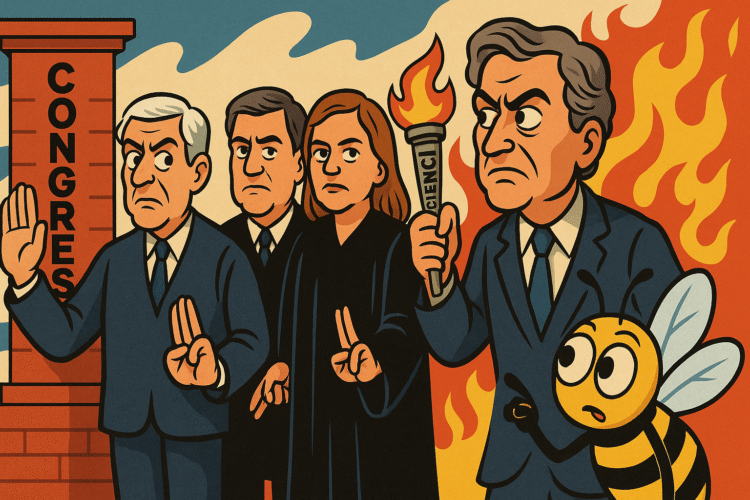
Somewhere between the solemnity of congressional hearings and the cheap thrill of cable news lies a phrase so heavy it used to rattle marble columns: lying to Congress. It once suggested disgrace, a scarlet letter on a public servant’s record. Now it is being hauled out as a courtroom cudgel, with prosecutors preparing to indict James Comey for allegedly misleading lawmakers during testimony a few years back.
Comey is not the first powerful man to waffle under oath, but he may be one of the few to face the full brunt of the criminal process for it. What makes this moment so uncanny is not the charge itself, but the selective vision behind it. If lying to Congress is the gold standard of prosecutable sin, then whole wings of government ought to be empty by now. Yet oddly enough, only certain figures seem to make it onto the docket.
So let’s test the standard. If Comey is criminally accountable for testimony that didn’t square with reality, how do we measure the worth of what Neil Gorsuch, Brett Kavanaugh, Amy Coney Barrett, and Robert F. Kennedy Jr. solemnly told senators in their confirmation or oversight hearings—only to follow with actions that brazenly contradicted those assurances?
The Judicial Oaths That Aged Like Milk
When Neil Gorsuch sat before the Senate Judiciary Committee, he spoke in the genteel tones of judicial restraint. Precedent, he insisted, carried weight. Stability mattered. He positioned himself as a jurist reluctant to detonate the minefields of constitutional doctrine.
Brett Kavanaugh followed a similar script during his own bruising confirmation. He described Roe v. Wade as “settled as precedent” and even coined the phrase “precedent on precedent.” The implication was clear: nothing radical was coming from him. He was the kind of judge who would keep the boat steady, not capsize it.
Amy Coney Barrett entered the chamber with the same choreography. Asked about Roe, she rejected the notion of “super-precedent” but spoke about respect for established rulings. Her calm confidence was meant to soothe, to project reliability and moderation.
These three sailed through on the strength of such assurances, sometimes swinging skeptical senators with their words. Then came the decision that stripped away all pretense: the Dobbs ruling. Roe was overturned in a majority opinion that carried the fingerprints of every one of them.
The betrayal was political theater of the highest order. Senators who voted for them on the basis of their testimony fumed in public. Susan Collins declared she had been misled. Joe Manchin, no stranger to political hedging, said he felt deceived. And yet, despite the outcry, not a single prosecutor so much as whispered about perjury. Apparently, testimony that creates an illusion for votes is fine—so long as you have a lifetime appointment to back it up.
The Scientist Who Promised Science, Then Fired the Scientists
Robert F. Kennedy Jr. faced his own credibility test when he sat before lawmakers at the start of his tenure as Health Secretary. Critics worried that the country’s most famous vaccine skeptic had been given the keys to national health policy. Kennedy calmed them with practiced humility: science would guide decisions. Expert advisory committees would remain independent. The nation’s vaccine schedule, he assured, would be protected by process, not prejudice.
The ink on those promises was barely dry when he dismissed the entire Advisory Committee on Immunization Practices. Seventeen experts gone in one sweep, replaced with a slate of individuals friendlier to his skepticism. The committee, once a bulwark of scientific consensus, became an echo chamber of curated doubts.
In its first meetings, this new panel recommended scaling back COVID-19 vaccination guidance and restructuring childhood immunization schedules. They called for delaying certain shots, discontinuing combinations, and leaning away from universal recommendations. Public health leaders were aghast.
Meanwhile, testimony emerged from former CDC officials who said Kennedy pressured them to pre-approve recommendations before evidence was even presented. When they refused, they were fired. That is not just policy change—it’s an attempted rewrite of the scientific process itself.
Then came the flourish: Kennedy and the president declaring to crowds that Tylenol in pregnancy might cause autism. No credible evidence, no consensus, no guardrails. Just a soundbite with catastrophic potential for public trust. All of it after he had promised lawmakers to respect the very scientific norms he bulldozed.
Comey’s Turn on the Stage
And so we return to James Comey. His alleged misstatements about the Russia investigation may or may not survive the prosecutorial gauntlet. The point isn’t his guilt or innocence. The point is why his words are the ones dragged to trial when so many others who made solemn declarations under oath are free to reshape history contrary to their promises.
It’s not as if Comey is some uniquely skilled deceiver. The Supreme Court justices played verbal gymnastics with “precedent” in ways that now look indistinguishable from duplicity. Kennedy assured respect for scientific institutions and then decapitated them. Yet somehow only Comey faces the threat of indictment.
If “lying to Congress” has become the standard for criminal accountability, then justice must be blind. Instead, it appears to be squinting hard, singling out opponents while excusing allies.
The Three Costs of Selective Perjury Prosecutions
First: The Death of Testimony.
When witnesses believe every phrase could be used as ammunition in a later prosecution, they will stop speaking honestly—or stop speaking at all. Congressional hearings will collapse into nonanswers, lawyerly hedges, and constitutional evasions. Oversight will suffocate.
Second: The License of Power.
Those who hold seats of entrenched authority—lifetime judges, Cabinet officials with partisan protection—will learn they are untouchable. They can testify one way and act another, secure in the knowledge that the law only hunts the vulnerable.
Third: The Collapse of Trust.
If the public sees that Comey is charged while justices and a Cabinet secretary skate, the lesson is clear: perjury is not about the truth, it is about who holds power. Faith in institutions is already fragile. To weaponize perjury as a partisan tool is to shatter the illusion of fairness altogether.
The Hypocrisy Test
Here is the hypocrisy test in its simplest form: if lying to Congress is prosecutable, then apply it evenly. If it is not, then drop the charade of selective justice.
Under oath, Supreme Court nominees swore by precedent and stability. Then they detonated Roe. Under oath, RFK Jr. promised deference to scientific committees. Then he fired them, stacked the deck, and spun myths about pain relievers and autism.
All of these acts diverged dramatically from sworn testimony. Yet not one of them will be led into a courtroom. Only Comey will. That is not justice. That is partisanship with a robe on.
Closing Summary: The Partisan Sword
This saga reveals that perjury, once treated as a solemn taboo, has been recast as a partisan sword. James Comey now faces prosecution, not because his testimony was uniquely false, but because he is uniquely expendable. Meanwhile, justices who soothed senators with promises of stability and a health secretary who vowed allegiance to science before dismantling it remain untouchable.
The stakes are enormous: if perjury is no longer a neutral standard, then testimony before Congress ceases to matter. Oversight becomes theater, accountability becomes a joke, and the rule of law becomes a costume change. What remains is hypocrisy—sharp, selective, and entirely in charge.