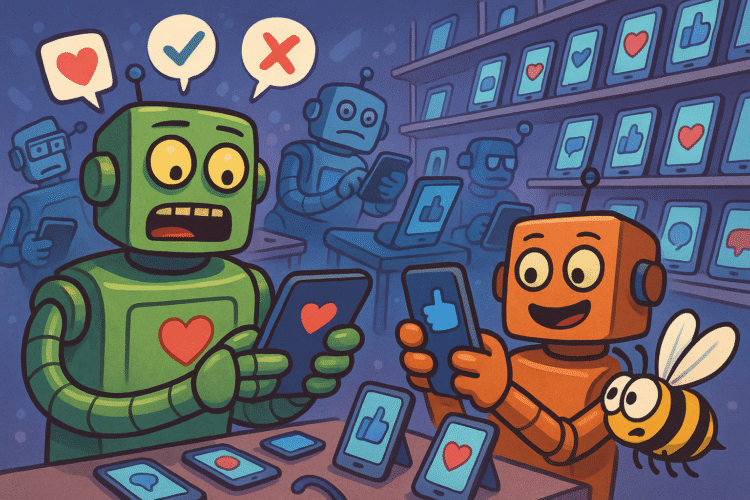
We were warned about the robots. We were told they’d take our jobs, our cars, maybe our dating lives if someone perfected the silicone. What we weren’t prepared for was that they’d take our democracy. And not even in a cool, cinematic Skynet way—no, in the most humiliating way possible: by faking retweets and filling comment sections with emoji-clogged propaganda. Humanity’s final struggle against the machine apparently isn’t the Terminator’s glowing red eye—it’s a Russian bot farm running 5,000 Samsung Galaxy knockoffs in a warehouse that smells like old vape juice.
In 2025, the battleground isn’t ballot boxes or town squares. It’s your timeline, and the frontline soldier is a jittery refurbished iPhone 8 running thirty sockpuppet accounts with names like PatriotDale1776 and NurseJennyAntiVax69. These aren’t the trolls of 2016 who at least had the decency to be human, to labor over their bad grammar and vaguely Slavic grasp of colloquialisms. No, today’s disinformation is an artisanal blend: smartphones on shelves like battery-powered soldiers, running AI scripts that can mimic arguments better than your uncle after two Coors Lights.
Welcome to the Attention Sweatshop
Imagine a room in some unmarked office park, fluorescent lights buzzing, racks upon racks of smartphones each displaying the same post: “President Trump is the healthiest man alive—doctors HATE him!!!” Every time you refresh, a different cluster of bots agrees, likes, shares. It’s not persuasion. It’s Pavlov. You see something enough, and suddenly it feels true—like avocado toast being worth $14 or Elon Musk being a genius.
And these aren’t just Russian labs anymore. That was last season. Now you’ve got domestic influencers leasing bot swarms the way your aunt rents a karaoke machine for her fiftieth birthday. Need your bad take about vaccines to go viral? Pay a few grand and suddenly you’ve got a thousand concerned moms from Omaha echoing your Facebook Live. Running for office and want to look popular? Easy—order ten thousand retweets before breakfast.
It’s Uber for disinformation. Except the drivers are all virtual, the surge pricing never stops, and you always end up at the hospital.
Numbers Don’t Lie, But Bots Do
According to experts, “bad bots” now account for 37% of all internet traffic. Thirty-seven percent. That means over a third of everything you see online is synthetic. One out of every three comments under your news article is a hallucination. One in three likes on your Instagram thirst trap is probably from @RealAmericanTruckLover542—a phone duct-taped to a radiator in Saint Petersburg.
Think about that: you’re not unpopular, you’re just competing against an army of ghosts. Every tweet, every post, every meme is now a rigged election of attention. Democracy itself has become a comment section, and like all comment sections, it’s rigged, cruel, and smells faintly of Axe body spray.
But the Bots Agree With Me, So They’re Fine
Here’s the fun part: everyone hates bots until the bots like them. Suddenly that influencer who decried foreign interference has 50,000 new “followers” overnight, all with usernames that read like someone mashed the keyboard in Cyrillic. But who’s counting? Engagement is engagement. Democracy dies in darkness, but it thrives on dopamine.
Politicians pretend to be outraged at bot manipulation, but campaign managers call it “microtargeted engagement enhancement.” Influencers call it “community growth.” Platforms call it “Tuesday.” Everyone’s mad at disinformation, but no one actually wants to delete the bots—because then we’d find out how few people really care.
Strip away the bots and most politicians would be shouting into a void, like actors at a regional dinner theater. Strip away the bots from social media and it’s just you, your mom, and a man named Gary from Milwaukee posting Minion memes.
Detection: The Art of Pretending to Care
Platforms love to say they’re “working hard” to detect bots. Translation: they add a CAPTCHA, watch as the bots solve it faster than you do, then declare victory in a blog post.
Remember when platforms thought “blue checks” would save democracy? Spoiler: the bots bought them too. Now every AI-generated profile picture with slightly asymmetrical ears is verified and spreading talking points about gas stoves being a CIA plot.
Detection tools are like mall cops chasing a Ferrari. The bots evolve faster than the platforms. Every time X or Meta patches a hole, the bot farms update their script. It’s Whac-A-Mole, but the moles have GPUs and you’re armed with a foam hammer from Dollar Tree.
Domesticating the Disinformation Beast
Let’s not pretend this is just Russia or China anymore. U.S. authorities busted a Russian network in 2024, but guess what? Domestic actors looked around, saw how well it worked, and thought: What if we just do it ourselves?
Now you’ve got political campaigns boosting “organic” support with their own bot armies. America finally localized its disinformation. We brought the jobs home, folks! Made in the U.S.A.—even our lies.
So when you scroll your feed and see thirty posts about how “only one man can save America,” remember: it may not be a foreign op. It may be your neighbor’s PAC spending your donations on bot farms instead of yard signs.
The Metaphor of the Roach
Here’s the thing about bots: they’re digital cockroaches. You can kill a few, but more will always crawl out from under the fridge. Why? Because the incentive structure rewards them. Bot engagement drives ad revenue, inflates egos, and sets the news agenda. They’re not a bug in the system; they are the system.
Imagine Twitter without bots. You can’t—because it would be empty. Imagine Facebook without fake accounts. You’d be left with four photos of babies and an ad for toenail fungus cream. The bots aren’t invaders. They’re tenants, paying rent in attention.
Transparency Theater
Calls for transparency are cute. Platforms promise dashboards, reports, disclosures. You’ll be able to see which accounts are bots, they say. But will that stop you from clicking? No. Knowing that PatriotDale1776 is a Russian algorithm won’t stop your brain from thinking, wow, lots of people agree with this take. Information is rational; influence is chemical.
Transparency is the lettuce garnish on the Big Mac of disinformation. It looks healthy, but no one eats it.
Democracy in the Age of the Algorithm
So where does this leave us? We live in a world where elections, vaccines, wars, and recessions are debated not by citizens, but by clusters of refurbished iPhones on a power strip in Jakarta. The marketplace of ideas has been outsourced to machines, and they’re better at it than we are.
What we should have learned is that democracy requires real humans engaging in messy debate. What we’ve learned instead is that people are expensive, bots are cheap, and outrage can be scaled.
The old saying was “history is written by the victors.” The new version is “history is written by the algorithms that get the most engagement.” And let’s be honest: the bots are winning.
Summary: Echoes in an Empty Room
We now live in an echo chamber where most of the echoes aren’t even ours. Thirty-seven percent of the internet isn’t human, but it’s shaping human decisions. Foreign governments, political campaigns, and influencers alike are buying influence wholesale from digital sweatshops. Platforms flail, regulators wag fingers, but the incentives remain: outrage sells, engagement rules, and bots deliver both at scale.
The scariest part isn’t that the bots are tricking us. It’s that we don’t care. We like the applause too much, even if it’s coming from an empty room filled with phones on chargers. Because nothing says democracy like winning an argument against a refrigerator full of Androids.