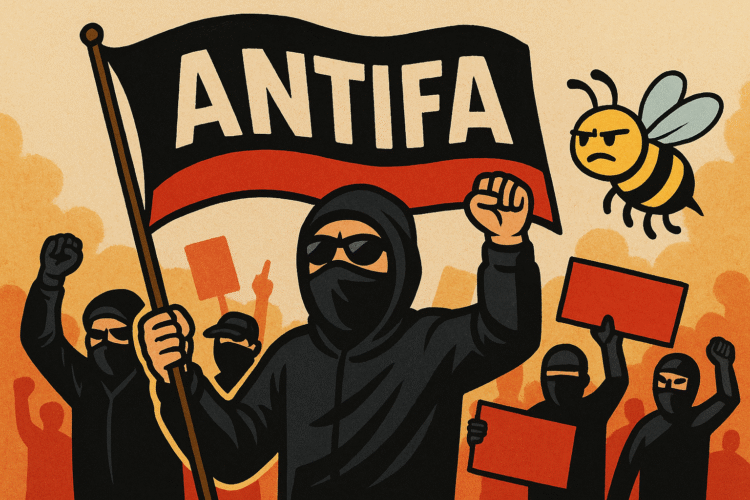
America has a long history of misunderstanding things on purpose. Evolution? “Just a theory.” Climate change? “Maybe the sun’s just in a mood.” The First Amendment? “It means I can say the n-word at work without getting fired.” And now, the most recent, most hysterical misunderstanding: ANTIFA.
Yes, ANTIFA—our country’s favorite boogeyman, the clandestine, hyper-coordinated, well-funded shadow army that… wait for it… isn’t actually an organization. That’s right. ANTIFA isn’t a club. There’s no membership dues, no secret handshake, no quarterly bake sales. It is literally an abbreviation for “anti-fascist.” That’s it. A stance. An idea. An ethical position that says, “Hey, maybe fascism is bad.”
And somehow, that’s controversial.
The Magical Thinking of MAGA: Building a Villain from Vapor
For conservatives, ANTIFA is the perfect villain because it can be anything and anyone at any time. Broke teenager spray-painting a Starbucks? ANTIFA operative. Middle-aged professor with a tote bag? ANTIFA mastermind. Grandma holding a “Black Lives Matter” sign? ANTIFA general.
It’s like “communist” during the Red Scare, or “witch” in Salem—an infinitely flexible label for anyone who makes you uncomfortable. Except in this case, the right doesn’t even have to prove coordination. They just shout “ANTIFA!” and suddenly they’ve invented a terrorist cell without so much as a Zoom call.
If You’re Against Antifa, What Exactly Are You For?
Let’s pause here and appreciate the simple absurdity. ANTIFA stands for anti-fascist. Meaning: against fascism.
So when politicians puff up their chests and say, “We’re cracking down on ANTIFA,” what they’re literally saying is, “We’re cracking down on people who oppose fascism.” Congratulations, you’ve outed yourself. If opposing fascism makes you uncomfortable, you might want to take a long look in the mirror—or at least check your closet for the brown shirts you keep insisting are “heritage uniforms.”
It’s the rhetorical equivalent of saying, “I don’t like firefighters because I’m pro-flame.”
Yes, Some Dumb Shit Happened Under the Banner of Antifa
Here’s the thing: no one’s pretending that every action ever carried out by someone under the loose umbrella of “antifa” was flawless. Property has been destroyed. Windows have been smashed. Trash cans have been set ablaze in dramatic but ultimately low-stakes infernos.
But here’s the key: ANTIFA doesn’t have a national board of directors. There is no CEO of Antifa, no Antifa HR department approving time-off requests for riots. When someone does something “in the name of antifa,” that doesn’t mean the mythical HQ green-lit the plan. Because there is no HQ. There’s no org chart. Hell, there isn’t even a mailing list.
Compare that with, say, the Proud Boys, the Oath Keepers, or Turning Point USA—actual organizations with actual leadership, bank accounts, and promotional codes for tactical gear. If you can cut a check to it, it’s an organization. If you can’t, it’s an idea.
Why the Right Loves the Phantom Menace
Why do Republicans froth at the mouth about ANTIFA? Because it’s convenient. If they admitted antifa is just “people who don’t like fascism,” the conversation would get awkward fast. Better to spin it as a vast underground network pulling the strings of every protest, every riot, every kid with a skateboard who looks at them funny.
It also serves as a neat little deflection. Police kill a Black man on camera? “ANTIFA made the protests violent.” Women demand reproductive rights? “ANTIFA agitators stirred the pot.” A Trump rally turns into an attempted coup on January 6th? “Actually, that was antifa in disguise.”
It’s Scooby-Doo politics: every mask gets pulled off to reveal the same villain, even if the “villain” is just the concept of not liking fascists.
Antifa, Inc.: The Parody Version the Right Pretends Is Real
Let’s lean into the absurdity. If antifa were an organization, what would it look like?
- Headquarters: A Portland coffee shop with a broken Wi-Fi router.
- Uniform: Black hoodies from Target’s clearance rack.
- Funding: Whatever’s left in your Venmo after rent and weed.
- Training: Youtube tutorials on “How to March in Formation” and “Molotov Cocktails for Dummies.”
- Annual Retreat: A camping trip where everyone forgets to bring food but someone brought six acoustic guitars.
The idea that George Soros is cutting checks for this ragtag army of grad students and baristas is laughable. If Soros is bankrolling antifa, then where’s the free healthcare? Where’s the student loan forgiveness? Where’s my stipend for owning Doc Martens?
The Linguistic Trap
One of the biggest wins for the right has been muddying the word itself. “Antifa” has become synonymous with “violent leftists,” even though it literally means “anti-fascist.” That’s not an accident. It’s branding. By turning the word toxic, they make opposing fascism itself sound fringe.
It’s classic propaganda: manipulate language until basic morality feels radical. Much like how “woke” went from meaning “socially aware” to “the reason your gas prices are high,” “antifa” went from “people who don’t like fascism” to “shadow army of chaos.”
Meanwhile, Real Fascists Walk Free
Here’s the kicker: while Republicans rail against the antifa menace, actual fascists are marching in broad daylight. White nationalists with tiki torches in Charlottesville. Militias plotting to kidnap governors. January 6 rioters erecting gallows outside the Capitol. Those are organized groups with clear leaders, strategies, and bank accounts.
But sure, let’s keep hyperventilating about a grad student with a spray-paint can.
Antifa Is the Ghost of Our Conscience
The reason the right can’t stop screaming about antifa is that it’s the ghost that haunts them. It’s the quiet reminder that if you’re against anti-fascists, then logically, you’re at least tolerating fascism.
And fascism doesn’t arrive with trumpets and goose steps—it arrives with little compromises. With tolerance for “strong leaders.” With excuses for violence. With smear campaigns against anyone who resists. Antifa isn’t perfect, but at its core, it’s simply a refusal to normalize fascism.
Which makes you wonder: why is that refusal so threatening to the people in power?
The Selective Outrage Olympics
Let’s also talk about the selective outrage. A trash can on fire at a protest? National emergency. A smashed window at a Starbucks? Proof of anarchist terror.
But an armed mob storming the Capitol? Just tourists. Police murdering unarmed Black men? Unfortunate but not systemic. A mass shooting every week? Second Amendment, baby.
The asymmetry isn’t an accident. Antifa is blown up into a national crisis so that the much larger, much scarier problem—actual fascism—can hide in plain sight.
So, What Does Antifa Stand For?
At the end of the day, antifa stands for a basic principle: fascism is bad, and it should be resisted. Not with reverence, not with polite debates at wine-and-cheese soirées, but with actual, sometimes messy opposition.
You don’t have to love every tactic. You don’t have to excuse every dumb stunt. But you also don’t get to pretend that opposing fascism is inherently radical. Unless, of course, you think fascism is just fine.
Summary: The Phantom Menace of Antifa
Antifa is not an organization. It’s an ideal: anti-fascism. Republicans have turned it into a catch-all villain because it’s easier to blame a mythical shadow army than confront real fascists marching in daylight. Yes, some bad actions have been done under its banner, but without leaders, structure, or funding, antifa cannot be “dismantled.” To oppose antifa is to oppose anti-fascism itself—which is to say, to reveal what side of history you’re on.