From Mourning to McCarthyism
The assassination of Charlie Kirk should have been a tragedy contained by grief, accountability, and legal process. Instead, it became fuel. Within days, the White House pivoted from mourning to manufacturing a new Red Scare.
President Donald Trump, flanked by Vice President JD Vance and professional apocalypse salesman Stephen Miller, decided the real culprit wasn’t the man charged with murder, Tyler Robinson, but “the radicals on the left.” On Fox & Friends, Trump growled that “the radicals on the left are the problem.” Soon after, Vance was guest-hosting Kirk’s show directly from the White House, transforming a memorial into a live-streamed committee hearing without the committee. Miller, ever the ghost of anti-immigrant Christmas past, promised to use “every resource” at DOJ and DHS to “identify, disrupt, dismantle and destroy” left-wing networks.
You’d be forgiven for wondering whether you fell asleep during civics class and woke up in the House Un-American Activities Committee.
The McCarthy Comparison Writes Itself
Civil-liberties groups immediately cried foul, warning of “McCarthy era” tactics. They’re right. The language is familiar: radicals, networks, destruction. The tools are updated: DOJ subpoenas, DHS fusion centers, and maybe a helpful algorithm or two. The outcome is the same: dissent equals danger, and nonprofits are suspects.
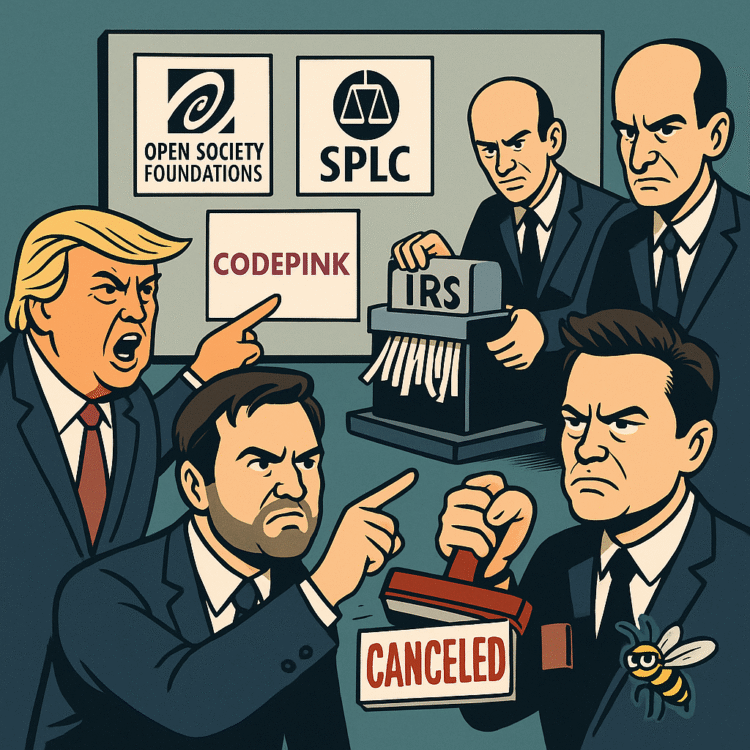
The White House didn’t bother with subtlety. House Freedom Caucus members pressed for a select committee to probe NGOs, demanding names and funders like children trading baseball cards. Groups named—Open Society Foundations, the Southern Poverty Law Center, Codepink—reported they’d received no outreach from law enforcement, no requests for evidence, no explanation for why they were in the crosshairs. What they had received was a trial-by-press-conference, which in today’s America counts for conviction.
Passport to Nowhere
The paranoia escalated into absurdity. Buried in a State Department authorization bill was a proposal to let the Secretary of State revoke U.S. passports over alleged “material support.” Think about that. Not proof. Not conviction. Allegation. Imagine losing your passport because someone claimed you donated $50 to the wrong organization.
The clause survived only long enough to be noticed. Once exposed, it was yanked—not out of principle, but embarrassment. The terrifying part wasn’t that it died. The terrifying part was that it existed at all.
The Convenient Villains
Let’s pause to appreciate the neatness of the narrative. A conservative activist is killed. The suspect is caught. Motive remains under investigation. But before any evidence surfaces, the administration declares the killers are, in fact, abstract “radical networks” conveniently embodied by their favorite punching bags: Soros, SPLC, Codepink.
It’s efficient politics. You don’t need facts if you already have enemies. And enemies are most useful when they can be blamed for everything.
What Happens When Evidence Doesn’t Matter
In Utah, prosecutors charged Tyler Robinson with aggravated murder. His hearing date is set. That’s the legal process. Boring, tedious, but at least recognizable. The problem is that the administration doesn’t seem interested in courts. Courts require evidence. Evidence requires patience. Patience doesn’t trend on Fox News.
Instead, we’re getting the faster, cheaper alternative: rhetoric. Miller promises annihilation of networks he won’t name with proof he won’t provide. Trump thunders about radicals without citing an arrest. Vance plays radio host from the White House as though executive authority is just another Twitch stream.
This is governance by accusation. It’s politics as fan fiction: reality doesn’t matter as long as the story feels right.
Free Speech on the Butcher Block
The danger is obvious. If the DOJ and DHS become tools to “identify, disrupt, dismantle and destroy” any nonprofit tagged as left-wing, we no longer have civil society. We have an enemies list with letterhead.
Open Society Foundations fund democracy programs worldwide. The SPLC tracks hate groups. Codepink stages disruptive but legal protests. None of these groups has been charged with a crime. Yet in the current climate, that’s irrelevant. The point isn’t what they did—it’s who they are.
In this model, free speech isn’t protected. It’s evidence. Dissent isn’t tolerated. It’s probable cause.
The Hypocrisy of Cancel Culture
And here’s where the hypocrisy becomes unbearable. For years, the right’s favorite word was “woke.” Every complaint about inclusion, diversity, or accountability was dismissed as left-wing cancellation. Elon Musk practically branded himself the “free speech absolutist,” buying platforms and ranting endlessly about how dangerous it was to silence voices.
Now? Those same crusaders are gleefully sharpening knives to cancel entire organizations. Not just individuals who said something offensive. Entire institutions that provide legal aid, advocacy, or protest coordination. If cancel culture was once a scourge, it’s now a government policy plank. Musk himself has turned from screaming about being shadow-banned to openly embracing the idea that dissenting groups should be investigated, stripped of funding, and erased.
This isn’t anti-woke. It’s anti-freedom. And it proves what was always true: “cancel culture” was never the problem. The problem was who held the power to cancel.
The Ritual of Blame
Notice the ritual here:
- A tragedy occurs.
- The administration expresses fleeting condolences.
- The tragedy is reframed as an attack by “radicals.”
- Old enemies are named.
- New powers are proposed.
- The Constitution is treated as an optional appendix.
This isn’t justice. It’s choreography.
The Backdrop of Escalation
And all of it happens against a backdrop of escalating polarization. Remember: Trump pardoned 1,500 January 6 participants earlier this year. Vance has openly called for “retribution.” The Kirk assassination is tragic, but it’s being used as pretext to escalate rather than de-escalate. Every match lights another pile of kindling.
The irony is grotesque. Leaders claim they’re fighting violence by inflaming it. They denounce political bloodshed while rewarding their own side’s offenders. They call for unity while branding half the country as enemies.
The Media as Megaphone
Fox & Friends got the exclusive. Vance turned Kirk’s show into a government broadcast. Miller delivers his threats on cue. This isn’t information—it’s theater. And like all good theater, it requires villains.
The villains are not the man on trial in Utah. They are abstractions, networks, philanthropists, protest groups. They are, conveniently, anyone who already annoyed the administration.
Why This Matters
It would be easy to dismiss this as bluster. Trump and Miller bluster every day. But bluster matters when it shapes institutions. Bluster backed by DOJ subpoenas and DHS task forces becomes policy. Bluster written into bills becomes law.
The passport clause already proved that. Even when proposals die, they reveal intent. And intent, repeated often enough, normalizes the unimaginable.
Lessons From the Past
The “McCarthy era” comparison isn’t lazy. It’s accurate. In the 1950s, careers were destroyed on suspicion alone. Families were ruined. Dissent was criminalized. The difference today is speed. McCarthy had hearings. Trump has hashtags. Miller has DHS. Vance has a podcast studio in the West Wing.
Technology accelerates repression. A blacklist can trend in seconds. A rumor becomes a talking point before fact-checkers can log on. And every repetition cements it deeper into public imagination.
The Opposition Response
Progressive groups issued statements, condemning the rhetoric and warning of authoritarian drift. Civil-liberties lawyers are preparing lawsuits. Editorial boards raised alarms.
But notice the asymmetry. Trump’s team acts. The opposition reacts. One side sets the agenda; the other scrambles to block it. In politics, initiative is power. And right now, initiative belongs to the people weaponizing grief.
What Comes Next
If history is guide, the Kirk assassination will continue to be invoked long after Robinson’s trial fades. It will be shorthand for “leftist violence” regardless of evidence. It will be justification for new committees, new investigations, new restrictions.
And if civil-society groups resist? They will be cast as proof. Refusing to cooperate becomes “hiding something.” Demanding evidence becomes “sympathizing with radicals.”
It’s a trap built on circular logic: if you defend yourself, you prove guilt. If you stay silent, you confirm guilt.
The Cost of Believing Nothing
The larger cost is trust. Americans already doubt institutions. When the White House names villains without evidence, it corrodes what little faith remains. When DOJ and DHS become tools of political vengeance, due process is just a slogan.
And once trust is gone, even legitimate investigations will be dismissed as political theater. Every subpoena becomes suspect. Every trial becomes propaganda. We won’t just lose faith in this administration—we’ll lose faith in the system itself.
Satire’s Tragedy
The irony writes itself, but it’s a grim irony. Satire thrives on exaggeration. But what do you exaggerate when the administration already proposes revoking passports by allegation? When Miller already promises annihilation of networks? When a memorial show in the White House already sounds like parody?
This is the tragedy of the moment: reality has collapsed into self-parody. The only way to satirize it is to repeat it verbatim and hope readers recognize the absurdity.
Summary: Grief Repackaged as Witch Hunt
The assassination of Charlie Kirk has become less a matter of criminal justice and more a pretext for political theater. Trump and Vance transformed mourning into a witch hunt, with Miller vowing to “destroy” left-wing networks and House Freedom Caucus members demanding select committees. Groups named as villains—Open Society Foundations, SPLC, Codepink—report no law-enforcement contact, but truth is irrelevant. Even the proposal to revoke passports over alleged “material support” revealed the authoritarian ambition behind the rhetoric. Meanwhile, prosecutors in Utah pursue the actual suspect, Tyler Robinson, in court. The contrast is stark: law pursues evidence, while politics pursues enemies. Worse, the same figures who once mocked “cancel culture” now embrace it, with Elon Musk and his anti-woke allies suddenly fine with canceling whole organizations when it suits them. The cost is free speech, nonprofit independence, and public trust. In today’s America, mourning isn’t about the dead—it’s about who gets blamed next.