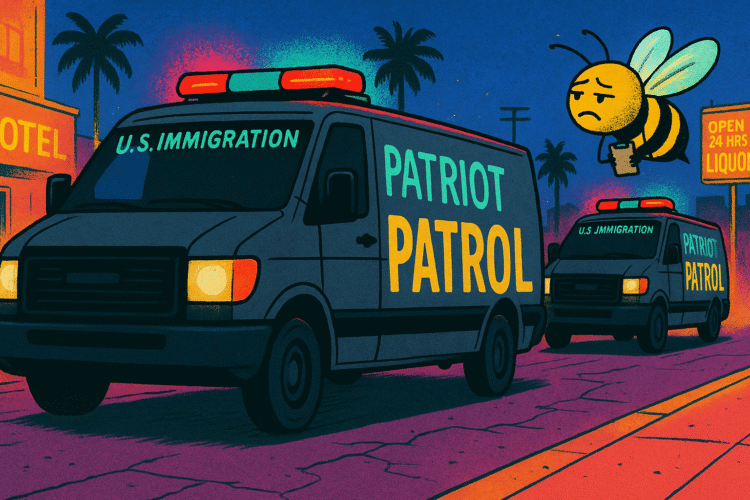
The U.S. Supreme Court once again demonstrated its uncanny ability to treat the Bill of Rights like IKEA instructions: skimmed, misread, and discarded in the recycling bin because who has time for nuance when there are “emergency dockets” to clear.
In a 6–3 order, the Court stayed a Los Angeles federal judge’s restraining order that had paused “roving patrol” immigration sweeps. Translation: agents can now resume stopping people based on the holy trinity of profiling—workplace, language, and perceived ethnicity. Or as it’s better known: the “you look foreign enough” standard.
Sotomayor, Kagan, and Jackson dissented, reminding the nation that the Constitution exists. The majority responded, effectively: “Not on the emergency docket, it doesn’t.”
The Emergency Docket: Governance by Panic Button
The emergency docket has become the Court’s fast-food drive-thru: quick, greasy, and guaranteed to leave you with constitutional indigestion. No oral arguments, no detailed opinions—just a quick order that rewrites the daily lives of millions.
Imagine a judge who doesn’t bother with trials, just slides verdicts across the counter with a side of fries. That’s our Supreme Court. And on September 8, they handed immigration agents carte blanche to treat Southern California like a mall Santa line: “Speak Spanish? Step aside. Working construction? Come with us. Wrong skin tone in the wrong zip code? Congratulations, you just won a federal stop.”
Flooding the Zone (with Fear)
Federal agencies wasted no time promising to “flood the zone.” It’s a chilling phrase. Normally used in sports. Now applied to human beings. The strategy isn’t complicated: overwhelm communities with so much enforcement that fear itself does the work.
Don’t go to the grocery store. Don’t show up for your shift. Don’t drive your kid to soccer. Stay invisible.
This is how you weaponize exhaustion. The point isn’t to deport everyone—it’s to make people so afraid of being mistaken for “the other” that they disappear into their homes and shadows.
Citizens, Beware
Evidence already shows these sweeps have caught U.S. citizens. But don’t worry, officials assure us, it’s all a misunderstanding. A little wrongful detention never hurt anyone, right? Just a paperwork glitch, like forgetting your Costco card at checkout.
But here’s the problem: when the state gets to decide who “looks” American, no one is safe. Not the citizen born in Boyle Heights. Not the veteran in East L.A. Not the teenager who happens to speak Spanish to their grandmother at the bus stop.
The line between “immigrant” and “suspicious person” is thin enough to vanish under fluorescent lights.
One in Three
Los Angeles County is one-third foreign-born. Which means these sweeps aren’t incidental. They’re systemic. You don’t sweep in L.A. without sweeping everyone. You don’t raid in L.A. without raiding neighborhoods, schools, workplaces, entire communities built on decades of migration.
In a city where diversity isn’t an adjective but a fact, “roving patrols” are not targeted—they are blank checks.
The Irony of Civil Liberties
The case at hand is a Fourth Amendment question: unlawful search and seizure. Remember that one? The amendment that says you can’t be stopped without probable cause? The one that’s supposed to prevent precisely this kind of profiling?
Apparently, the Constitution is conditional now. If your English isn’t perfect or your job involves manual labor, probable cause is baked into your existence.
Freedom is universal, except when it isn’t.
The Dissent That Will Be Quoted in History
Sotomayor, Kagan, and Jackson dissented. They reminded the Court that constitutional protections aren’t suggestions. That profiling isn’t a law-enforcement strategy, it’s state-sanctioned discrimination.
History will quote them. But history doesn’t protect people in stairwells listening for boots.
The Politics of Spectacle
The timing, of course, isn’t random. Immigration enforcement is the Trump administration’s stagecraft. Every raid, every sweep, every patrol is a message to his base: We’re tough. We’re in control. We’re not solving anything, but look at the show.
This is governance as performance art. And the Supreme Court just handed the stage crew the pyrotechnics.
Community as Collateral
Civil-rights groups in California vow to keep pressing the case. Local officials swear they’ll resist. Communities protest. But the machinery grinds on. Because the machinery was never about justice. It was about optics.
In the meantime, children walk to school wondering if their backpacks make them look suspicious. Parents debate whether to risk a shift at work. Entire neighborhoods shrink back into invisibility.
Community is the collateral damage of political theater.
The Racial Optics
Let’s not pretend this isn’t about race. The “factors” allowed for stops—workplace, language, ethnicity—are dog whistles dressed up as criteria.
It’s not “randomized enforcement.” It’s “speak Spanish and see what happens.” It’s “brown skin equals probable cause.” It’s legalized paranoia with badges and vans.
The Court didn’t just greenlight enforcement. It greenlit suspicion as policy.
A Country of Glitches
The rhetoric is always the same: we’re only targeting the “worst of the worst.” Criminals. Threats.
But early Boston sweeps—paused by courts before this order—picked up people with no records, no charges, no cause. Because the “worst of the worst” is a slogan, not a strategy.
What we actually have is a country where citizenship itself is vulnerable to glitches. Where you can be detained for speaking the wrong language, in the wrong place, to the wrong officer.
That’s not safety. That’s a system daring you to prove your existence.
The Cruelty as the Point
There’s a temptation to believe these sweeps are clumsy attempts at policy. That they’re misguided. That if only the right arguments were made, the Court would see the light.
But cruelty is the point. The spectacle of raids, the fear of patrols, the exhaustion of uncertainty—these aren’t side effects. They’re the deliverables.
Because nothing galvanizes a political base like fear. And nothing sustains fear like the sight of armored agents detaining someone who looks like your neighbor.
The Normalization of Exception
Emergency dockets. Emergency orders. Emergency raids.
Everything now is an exception. A temporary measure. A one-time thing. Until the exception becomes the rule. Until the emergency is permanent.
The normalization of exception is how liberties disappear—not in a single blow, but in a thousand temporary measures.
On September 8, 2025, the Supreme Court didn’t just stay a lower court’s order. It stayed the idea that the Constitution protects everyone equally. It stayed the illusion that probable cause still matters. It stayed the fragile hope that rights are rights, not privileges meted out by appearance.
The haunting truth is this: civil liberties don’t vanish in headlines. They vanish in stairwells, in workplaces, in whispered conversations about whether it’s safe to leave the house. They vanish in the quiet calculations of people deciding if they can risk visibility.
And when the Court tells agents to “flood the zone,” it’s not law enforcement. It’s fear as governance. It’s suspicion as policy. It’s a reminder that in America, justice doesn’t always depend on what you’ve done. Sometimes it just depends on how you look.