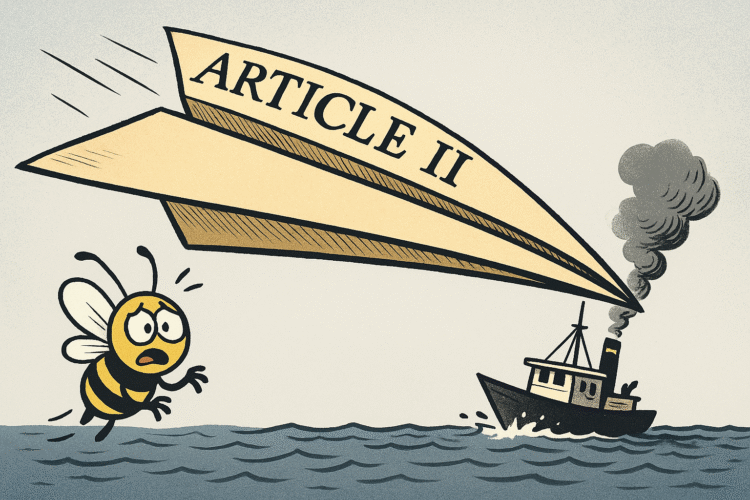
America has always had a complicated relationship with international law. We like to write it, we like to invoke it, and—when convenient—we like to fold it into a paper airplane and see how far it flies before bursting into flames over someone else’s territorial waters. On September 3, 2025, U.S. forces killed 11 people in a strike on a Venezuelan vessel in the Caribbean. President Trump’s War Powers report—48 hours late and 48 pages short—offered the constitutional equivalent of a shrug: Article II self-defense.
In case you’ve misplaced your pocket Constitution, Article II is the section that says presidents get to execute the laws and command the military. It is not a golden ticket for “kill who you want, where you want, no questions asked.” But the Trump administration has treated Article II like it’s the “unlimited breadsticks” section at Olive Garden: infinite, bottomless, and available at all hours.
JD Vance: Extrajudicial Killing, But Make It Populist
Vice President JD Vance did not bother with euphemisms. On September 6, he doubled down, declaring that “killing cartel members” was “the highest and best use of our military,” adding the kind of casual sneer you usually hear from men at gas stations who just discovered TikTok.
“I don’t give a s— what you call it,” Vance said, turning international law into an episode of Duck Dynasty. This was not a policy argument. This was vibes-based warfare, the foreign-policy equivalent of an unlicensed fireworks display in a drought.
Rand Paul’s Lone Clapback
Senator Rand Paul, the Senate’s perennial Cassandra of constitutionalism, called the move “despicable.” He is not wrong. A U.S. president cannot lawfully authorize summary executions of foreign nationals outside a recognized armed conflict or statutory authorization. That’s not me editorializing; that’s the law, written by America itself and codified in treaties we used to wave around like receipts.
But the Trump administration’s posture is clear: laws are for other people. Article II, in their hands, is not a constitutional provision. It’s a Ouija board.
Self-Defense as an All-You-Can-Eat Buffet
The “self-defense” rationale is particularly rich. International law does recognize a state’s right to defend itself from imminent threats. What it does not recognize is a state’s right to vaporize boats in international waters because someone whispered the word “cartel.”
Self-defense, in this new telling, is whatever the president wakes up thinking about after a cheeseburger. Today, cartel boat. Tomorrow, drone strike on a coffee shop in Paris because someone once sold fentanyl near a Starbucks.
When everything is self-defense, nothing is. It’s not a doctrine; it’s a blank check.
Pandora’s Box, Opened with a Drone Strike
The problem isn’t just this one incident. It’s the precedent. If the United States normalizes extrajudicial killings of noncombatants outside a battlefield, it invites every other government to do the same.
Picture it: China claims the right to kill “separatists” in San Francisco. Russia claims the right to kill “fascists” in Berlin. Turkey claims the right to kill “terrorists” in Stockholm. Everyone suddenly has Article II, or its local equivalent, and the world becomes a giant open-air Hunger Games with less dignity and worse CGI.
By opening this Pandora’s box, the Trump administration is not just endangering foreign nationals. It is endangering Americans everywhere. Once you break the norm, you don’t get to control who uses the shards.
The War Powers Act: RIP (Again)
The War Powers Resolution of 1973 was supposed to stop presidents from unilaterally launching military actions without congressional approval. Every president since has treated it like the terms and conditions on an iTunes update: click “agree,” then ignore it completely.
Trump’s Article II letter is just the latest and most blatant insult. Congress didn’t authorize war in Venezuela. Congress didn’t authorize extrajudicial executions. Congress didn’t authorize anything. And yet, Congress—at least the majority—is shrugging. Because partisanship is stronger than principle, and because “support the troops” has become shorthand for “don’t ask what they’re actually doing.”
A Bipartisan Disease
Let’s be clear: Trump didn’t invent this. Obama normalized drone strikes in Pakistan and Yemen. Bush normalized preemptive war in Iraq. Clinton normalized bombing campaigns in the Balkans. Reagan normalized proxy wars in Central America. The disease is bipartisan; Trump’s genius, if you can call it that, is stripping away the euphemisms.
Obama called it “targeted killing.” Trump calls it “I don’t give a s—.” The continuity is more disturbing than the contrast.
Congress, Missing in Action
Rand Paul aside, Congress has shown no appetite for reclaiming its war powers. Democrats offer sternly worded press releases. Republicans offer standing ovations. The institutional cowardice is staggering. Legislators are supposed to be jealous guardians of their constitutional prerogatives. Instead, they’ve become stagehands in a one-man show.
And the public? Too exhausted to care. The national conversation about military overreach is drowned out by the algorithm’s preferred distractions: celebrity divorces, viral sandwiches, the latest AI that can compose limericks about your cat.
The Cost of Impunity
Here’s what gets lost in the abstraction: eleven people are dead. We don’t know their names. We don’t know if they were cartel members, fishermen, or teenagers whose only crime was being on the wrong boat in the wrong waters. They will be remembered, if at all, as statistics.
That is the ultimate obscenity of extrajudicial killing: the erasure of human beings into “targets.” Bureaucracy reduces lives to acronyms, talking points, and excuses. And the more normalized it becomes, the less anyone notices.
The Authoritarian Drift
This is not just bad policy. It is authoritarian drift. The president claims the unilateral power to kill anyone, anywhere, without oversight, transparency, or accountability. That is the very definition of tyranny.
What we are witnessing is not an aberration. It is the logical endpoint of decades of bipartisan erosion of checks and balances. The unitary executive theory has metastasized into the unitary execution theory.
And the scariest part is how banal it feels. How little outrage it provokes. How quickly “self-defense” becomes a magic word that excuses everything.
International Law as a Punchline
Imagine explaining this to a first-year law student in The Hague. The U.S. killed 11 Venezuelans in international waters. The justification was “Article II self-defense.” The vice president said “I don’t give a s— what you call it.” The Senate mostly nodded.
It would sound like satire. Except it’s not. It’s just America, 2025.
International law only works if powerful nations pretend to respect it. When the most powerful nation on earth decides to treat it as improv comedy, the whole system collapses.
Why It Matters
Maybe you don’t care about international law. Maybe you think “cartel members” deserve whatever they get. Fine. But remember this: norms are reciprocal. If the United States reserves the right to kill suspects abroad, other countries will reserve the right to kill suspects here.
If due process doesn’t matter for Venezuelans, it doesn’t matter for you either. Once the precedent is set, the only protection left is power. And power is fickle.
The Liberal Bottom Line
The jobs of Congress, the courts, and civil society are simple: stop this drift. Reclaim war powers. Reassert due process. Reaffirm international law. Otherwise, we are sleepwalking into a future where assassination is policy, war is a permanent background hum, and presidents wield Article II like a scythe.
This is not about Venezuela. This is about whether law still constrains power in America. Right now, the answer is no.
We live in an era where a president can authorize the killing of eleven people on a boat, justify it with a single phrase, and move on to his next rally. The deaths are incidental. The law is incidental. The only thing that matters is whether the spectacle polls well.
The haunting truth is that authoritarianism doesn’t arrive with tanks in the streets. It arrives with shrugs in the Senate, sneers from the vice president, and Article II letters no one bothers to read. It arrives when extrajudicial killing becomes just another headline in a week already too full.
And by the time the precedent comes home—by the time another nation claims the same right, by the time Americans learn what reciprocity really means—it will be too late to pretend we didn’t see this coming.