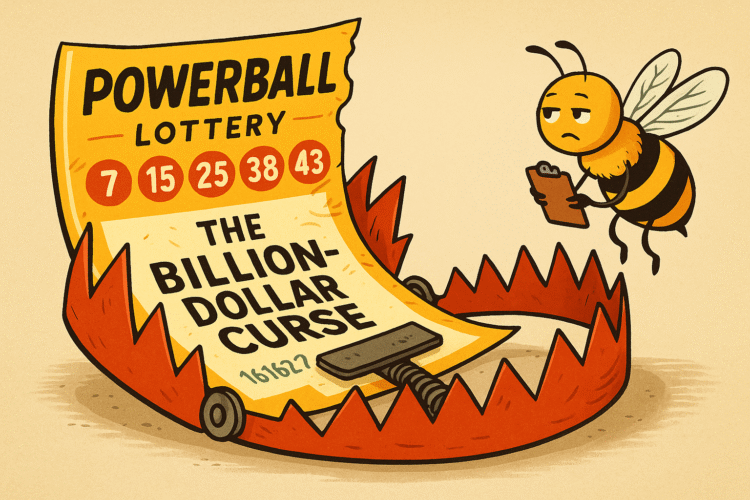
The Powerball jackpot is back in the headlines, bloated to an eye-watering $1.8 billion—the second-largest in U.S. history. Cable anchors are giddy, bodega clerks are rolling their eyes, and somewhere in the distance you can hear Dave Ramsey prepping a sermon about why you should’ve invested that $2 instead.
But let’s say you buy the ticket. Let’s say fate, or math’s cruel sense of humor, decides you’re the chosen one. Congratulations, you are now America’s new lottery messiah. Prepare for miracles, plagues, and betrayal, because winning Powerball is less a payday than a biblical test of character.
The experts call it a “playbook.” I call it a horror novel in bullet points.
Step One: Secure the Ticket Like It’s the Nuclear Codes
If you’ve won, the first thing you’re told is don’t tell anyone. Not your spouse, not your kids, not the guy at Starbucks. Just silently tuck that golden rectangle into a safe and pretend you’ve never known joy.
Some states even warn you not to sign it right away—because lawyers want to set up a trust that will shield you from the human locusts about to descend. Imagine that: you’re too rich to even write your own name. You have to hire someone else to do it.
So you make copies, stash the ticket in a safe-deposit box, and guard it like it’s the One Ring. Which, in a way, it is.
Step Two: Build Your A-Team
Every guide says the same thing: lawyer, CPA, financial adviser. But the list grows once the real horror sets in. Security consultant. Therapist. Publicist. Maybe even a food taster, depending on how many cousins you’ve angered.
The point is clear: the second you win, you stop being a person and start being a vulnerable asset. You’re no longer “you.” You’re a bundle of risks that must be managed. Your new identity is one part celebrity, one part fortress, and three parts ATM.
And don’t forget the therapist. Because nothing scrambles the human brain like suddenly realizing you could buy and sell your hometown before lunch.
Step Three: Disappear Yourself
Check your state’s rules. Can you remain anonymous? How long do you have to claim? If you can, form a trust with a fake name like “The Prosperity Fund” so that when reporters ask who won, the lottery commission has to shrug and mutter “Prosperity.”
Meanwhile, change your phone. Change your email. Lock down your social media. Ghost your high school friends. Basically, become a witness-protection participant—but the thing you witnessed was your own absurd luck.
Because here’s the truth: you’re not just rich. You’re bait. And the scammers are already sharpening their hooks.
Step Four: Lump Sum vs. Annuity (a.k.a. Your First Fight With the IRS)
Here’s where the math gets ugly. The headline number is $1.8 billion, but the lump sum is roughly half. That’s before the federal government politely removes another 24% upfront—and maybe more come tax time. Some states will slice off a piece, too.
The annuity option stretches over 30 years, with installments designed to tempt you into patience. The lump sum dares you to blow it all before your next colonoscopy.
This is the part where every “wealth expert” leans in with warnings about “behavioral finance.” Translation: humans are bad at money. If you take the lump sum, you’ll buy six Ferraris and a giraffe before the ink dries. If you take the annuity, you’ll spend 30 years resenting yourself.
Pick your poison.
Step Five: The Estate Plan Nobody Asked For
Congratulations, you are now an estate. You’ll need wills, trusts, charitable foundations, insurance policies, and—if your lawyer is really creative—offshore vehicles with names like “Blue Horizon Holdings.”
The idea is to protect your billions from the IRS and your extended family. The estate plan isn’t just about taxes. It’s about boundaries. About making sure that when your second cousin asks for $80,000 to start a kombucha brewery, you can politely say, “Sorry, the foundation doesn’t cover beverages.”
Step Six: Prepare for the Locusts
The experts warn of scammers, and they’re right. You’ll be hit with fake charities, fake investment pitches, fake relatives. But the real danger isn’t strangers. It’s the people you know.
Your phone will buzz with texts from childhood acquaintances suddenly nostalgic for the time you shared a Capri Sun. Your inbox will swell with “opportunities.” Churches will pray for your generosity. Politicians will pray for your endorsement.
You’ll discover that “cousin” is less a family title and more a fundraising strategy.
Step Seven: Lifestyle Creep
The guides all emphasize restraint. Pay off your debts. Buy a modest home. Maybe a reliable car. Then invest boringly—index funds, municipal bonds, maybe a sprinkle of real estate.
This is the part where they tell you “no” is a complete sentence. Where they urge you to resist the siren call of supercars, yachts, and Vegas residencies.
But let’s be real: you’re going to creep. The human brain wasn’t built to resist a new fridge when it has $900 million in the bank. And soon that fridge becomes a kitchen, becomes a mansion, becomes a jet.
The “lottery curse” isn’t voodoo. It’s math plus ego plus Target runs.
Step Eight: Face the IRS Like a Gladiator
No matter how carefully you plan, the IRS will come for you. They will audit you. They will audit your foundation. They will audit your shoebox of receipts.
The experts’ advice is always the same: be boring. File on time. Overpay if you must. Treat the IRS like a bear: don’t make sudden moves, and never, ever run.
Because nothing ruins a fairy tale faster than a $600 million tax bill.
Step Nine: The Loneliness Dividend
This is the part nobody mentions. Winning Powerball doesn’t just make you rich. It makes you lonely.
Your old friends will vanish if you don’t give them money. Your new friends will vanish if you stop giving them money. Family becomes an obstacle course. Romance becomes suspect. Every interaction is clouded by the possibility that you’re just a wallet with shoes.
You will learn to ask yourself the question billionaires dread: “Would they still love me if I were broke?” And you will never like the answer.
The Comedy of Warnings
Every article about lottery winnings sounds the same: “Hire a lawyer, hire an accountant, hire a therapist.” It’s all correct, and all depressingly joyless. Winning the lottery is framed not as liberation but as the start of a new, exhausting job.
The absurdity writes itself: you finally escape the grind of punching a clock, only to chain yourself to an even worse grind of asset management. You wanted freedom. You got quarterly tax prep.
The Irony of Luck
Americans worship luck. We frame it as destiny, as divine blessing, as proof of moral worth. Yet the people who actually win the lottery are instantly told not to trust anyone, not to spend anything, and not to believe the fairy tale.
The cultural narrative flips in an instant. Yesterday you were a dreamer. Today you’re a liability. Yesterday you were blessed. Today you’re cursed.
This is the American dream at its purest: we celebrate luck until it actually happens, then we punish the lucky for not knowing what to do with it.
The Haunting Close
So here’s the truth about the Powerball jackpot. Yes, it’s $1.8 billion. Yes, someone will win. But the real jackpot isn’t money. It’s anonymity. It’s being the person who didn’t win, who still buys their groceries without a bodyguard, who still answers the phone without fear it’s another “cousin.”
Winning the lottery doesn’t free you. It cages you. It makes you prey. It replaces your future with accountants and your friends with beggars.
The haunting truth is this: the garage full of supercars isn’t the curse. The curse is the silence. The paranoia. The loneliness. The knowledge that the moment fate smiled at you was the last time anyone did so without an agenda.