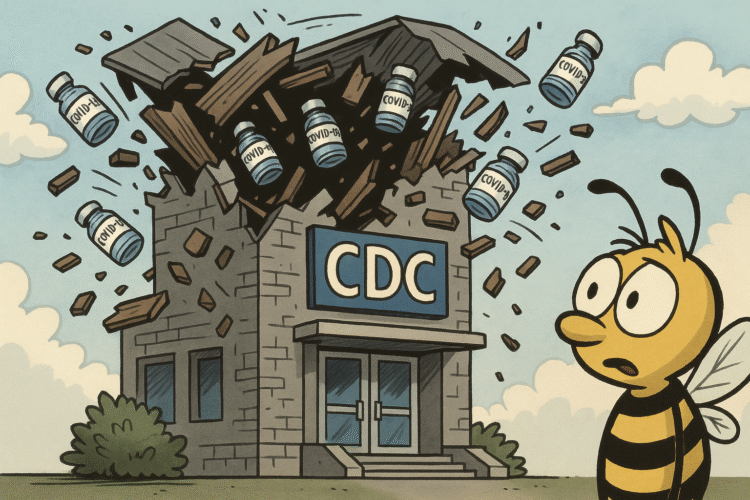
On September 4, 2025, Robert F. Kennedy Jr.—yes, that Kennedy, now moonlighting as the nation’s Health and Human Services Secretary—sat before the Senate Finance Committee for a grilling so blistering it should’ve required SPF 100. What unfolded was three hours of bipartisan carnage, a hearing less about policy than about the collective horror of watching a man tasked with safeguarding public health dismantle it live on C-SPAN.
For once, Democrats and Republicans were united, though not in the warm, bipartisan sense civics textbooks pretend exists. They were united in disbelief—staring across the dais at a secretary who, in a matter of months, had turned the CDC into a case study in demolition politics.
The CDC Director Who Barely Unpacked
The first act of Kennedy’s tenure was to fire CDC Director Susan Monarez. Not after scandals, not after failures—just weeks into her job. Monarez barely had time to learn where the bathrooms were before being escorted out.
This one decision sparked a mass resignation cascade. Senior staff fled in droves, leaving the nation’s premier disease-control agency looking less like a fortress of expertise and more like an empty Applebee’s at 10 a.m. on a Tuesday.
When senators pressed him—why sack a scientist before she could even hang her diplomas?—Kennedy shrugged with the confidence of a man explaining his juice cleanse. “She wasn’t aligned with the new vision,” he said, as if “vision” were a synonym for “gutting credibility in the middle of flu season.”
The Vaccine Panel Purge
But why stop at the director? Kennedy went deeper, ripping out the CDC’s vaccine advisory panel and replacing it with skeptics. Imagine a smoke-detector advisory board stacked with people who think smoke is a government hoax. That’s the new CDC brain trust.
Federal vaccine recommendations shrank overnight. Shots for healthy kids? Optional. Pregnant people? “Do your own research.” Public clinics that once doubled as lifelines quietly shuttered, leaving communities—especially rural and low-income—scrambling to find doses that used to be as accessible as aspirin.
Kennedy defended the changes with a surreal flourish: “We’re restoring trust.” In other words: the best way to rebuild public confidence is to set fire to the very scaffolding of evidence.
The Pandemic Amnesia Tour
Kennedy’s evasions on basic pandemic facts became their own performance art. Asked about COVID mortality data, he questioned definitions. Pressed on vaccine efficacy, he dodged into rhetoric about “alternative health paradigms.” Senators requested answers; he provided vibes.
This wasn’t testimony. It was a TED Talk at Burning Man, delivered in the key of doubt. The hearing was supposed to clarify public health policy. Instead, it clarified only that the nation’s top health official treats facts like gluten: best avoided.
Warp Speed Without the Data
The contradictions piled higher than the Senate’s paper stacks. Kennedy lauded Trump’s Operation Warp Speed, calling it “a model of government efficiency.” But then, in the same breath, he cast doubt on the vaccines Warp Speed produced.
This is akin to praising the invention of the fire extinguisher while questioning whether it really puts out flames. The senators noticed. Even GOP physicians like Sen. Bill Cassidy, who has built his career on politely not panicking, looked visibly ill.
“Your policies are effectively denying vaccines to constituents,” Cassidy warned, channeling the frustration of a doctor watching his patient Google themselves into organ failure.
The Senate Goes Bipartisan—Briefly
It takes a lot to unite Chuck Schumer and Mitt Romney. But Kennedy managed it. Democrats accused him of “weaponizing” public health, turning the CDC into an ideological playground. Republicans accused him of—well, basically the same thing, but with the added injury of explaining to their voters why vaccines suddenly disappeared from clinics.
Multiple senators floated resignation. Kennedy, naturally, smirked. The White House, naturally, stood by him. And the country, naturally, remained confused about whether it should trust the man with the microphone or the doctors leaving en masse.
Science vs. Vibes
This is what it’s come to: evidence-based medicine versus vibes-based governance. One side offers peer-reviewed data; the other offers anecdotes wrapped in skepticism, packaged in the rhetoric of “freedom.” One side tracks epidemiology; the other tracks engagement metrics.
Kennedy’s public health philosophy can be summarized in one sentence: If you can’t convince them, confuse them. His Senate testimony followed the formula perfectly. Facts blurred. Certainty evaporated. Doubt lingered.
This is not incompetence. It’s strategy. Confusion is its own form of control.
The CDC, Hollowed
The agency that once coordinated the eradication of smallpox is now struggling to coordinate Zoom meetings. Years of institutional expertise have been hollowed out in months. The advisory boards meant to guide parents and physicians now resemble comment sections curated by Facebook algorithms.
Every resignation letter is a warning flare. Every absent expert is a reminder that public health isn’t being debated—it’s being deleted.
The Satirical Core
The satire is cruel and undeniable:
- A health secretary praises Warp Speed while doubting warp-speed vaccines.
- A CDC meant to be apolitical is now stacked with vaccine skeptics.
- A government meant to protect health is actively undermining it.
- Senators who normally can’t agree on lunch found unity only in horror.
It is not funny in the sense of laughter. It is funny in the sense of absurdity, the way you laugh when the plane suddenly drops 10,000 feet.
The Haunting Observation
The September 4 hearing wasn’t just a snapshot of one man’s chaos. It was a portrait of a country deciding, in real time, whether science is optional. A CDC reeling from purges. A Senate unsure whether it was interrogating policy or watching performance art. A White House determined to defend a man who confuses leadership with sabotage.
The haunting truth is this: America has lived through pandemics before. It will live through them again. But never before has the nation’s survival depended on choosing between data and denial, medicine and myth, science and vibes.
And if the Senate hearing is any indication, the vibes are winning.