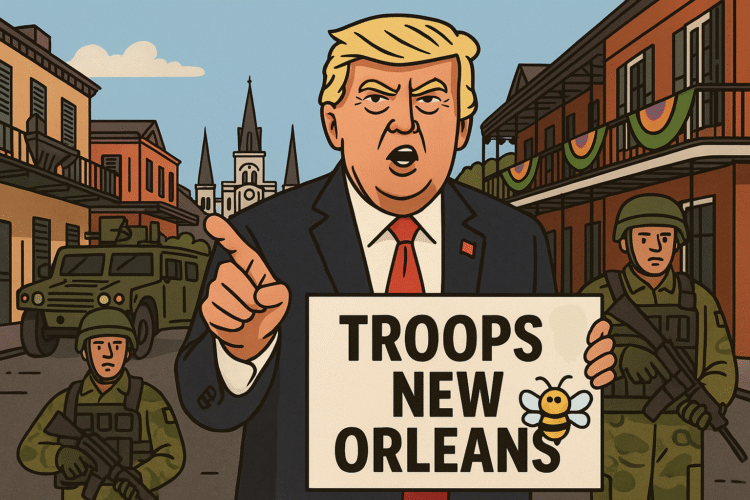
On September 3, 2025, President Trump announced that New Orleans—yes, the city of brass bands, beignets, and waterlines nobody can forget—was next on his federal “law-and-order” tour. Fresh off threatening Chicago with “National Guard domination” and still basking in the glow of his unprecedented takeover of Washington, D.C.’s police force, Trump pivoted south, declaring that the Crescent City would be “straightened out in two weeks, tops.” Nothing says American governance like a presidential roadshow of urban crackdowns.
The pitch was simple: deploy National Guard troops, federal strike teams, and a fresh layer of surveillance to curb crime in New Orleans. The timing was complicated: homicides were already down 27% in 2025, though the city still carried one of the worst per-capita murder rates from 2024 (34.2 per 100,000). But in this White House, falling crime rates are not a solution. They’re an obstacle to the spectacle.
Optics Over Outcomes
Let’s be clear: Trump is not hunting crime data. He’s hunting optics. Chicago was the warm-up. Washington, D.C. was the test balloon. Now, with Louisiana Gov. Jeff Landry signaling cooperation, New Orleans becomes the stage.
Never mind that constitutional scholars are screaming about Posse Comitatus, the Insurrection Act, and federalism tripwires. Never mind that a recent court ruling already clipped the wings of Guard-in-law-enforcement stunts. Trump’s calculation is simpler: militarized optics beat statistical nuance. You can’t televise a 27% crime drop, but you can televise Humvees rolling down Bourbon Street.
The Mardi Gras of Militarization
The absurdity practically writes itself. Imagine National Guard troops posted between frozen daiquiri machines. ICE agents shoulder to shoulder with brass bands, marching in 4/4 time. DHS strike teams raiding potholes instead of cartels.
This is not about crime. It’s about staging a Mardi Gras of militarization, where the floats carry assault rifles and the beads are subpoenas. A presidency obsessed with television knows the difference between a chart showing crime decline and a made-for-TV crackdown with flashing sirens. One is boring. The other trends.
Blue Cities in Red States
The pattern is obvious. Chicago, D.C., now New Orleans—blue cities in contested or red states. It’s not law-and-order. It’s electoral cartography with a tactical vest.
Trump doesn’t need to “fix” New Orleans. He needs to be seen fixing it. And what better way to show strength than to take on a majority-Black city with a long history of police-community tensions, a fragile trust still cracked from Katrina, and a governor eager to prove fealty? This isn’t governance. It’s a scripted conflict designed for reruns.
The Kristi Noem Factor
DHS chief Kristi Noem has already vowed to expand ICE operations nationwide. Picture it: ICE agents doubling as beat cops, “sanctuary” policies treated as insurgencies, immigrant neighborhoods as “zones of exception.” New Orleans, with its deep immigrant history and cultural crosscurrents, becomes the perfect canvas for the Noem doctrine: paint every problem in the color of enforcement.
In this framework, ICE doesn’t deport. It patrols. The Guard doesn’t defend. It polices. Federalism isn’t respected. It’s suspended. All under the banner of “safety.”
Constitutional Tripwires, Ignored
Legal scholars keep waving their hands: state consent, federal overreach, the minefield of the Posse Comitatus Act. They point out that militarized domestic policing has been smacked down in courts before. But this White House reads the Constitution like a cafeteria menu: pick what looks tasty, ignore the rest, claim executive privilege when the bill arrives.
The judiciary may check these moves eventually. But in the meantime, the footage will have aired, the optics will have solidified, and the presidency will claim victory. Governance is slow. Spectacle is immediate.
Data, the Inconvenient Party Guest
The greatest irony is that New Orleans is, by the numbers, already improving. Homicides down 27% in 2025. Violent crime trending downward. But crime reduction is not the point. Crisis is the point.
You can’t march federal troops into a city and declare “nothing to see here.” You need the enemy, the chaos, the disorder. If it doesn’t exist, you emphasize the past—last year’s homicide rate, last decade’s reputation. You talk about “hellholes” and “American carnage.” You make the case that even good news is suspicious. Falling crime is either “fake” or proof that “our threats are working.” Either way, the show goes on.
Televised Crackdowns as National Branding
America has a tradition of televised spectacles—moon landings, presidential debates, even the O.J. car chase. Trump’s contribution is the televised crackdown. A presidency defined by optics needs moving pictures of order being imposed. The trucks. The troops. The flashing lights. The stern warnings.
Forget “community policing.” Forget “evidence-based strategies.” Forget “root causes.” None of those fit into a chyron. What fits into a chyron is: “Trump Sends Troops to New Orleans.”
Civil Rights as Collateral Damage
The collateral damage is predictable. A majority-Black city, already scarred by Katrina’s militarized aftermath, will once again see soldiers patrolling streets. Federal officers will claim jurisdiction they don’t fully have. Civil liberties will fray under the weight of “two weeks to straighten out.”
Critics call it political theater. But theater has real consequences. The props are people. The stage is their city. The script is written without their consent.
The Two-Week Promise
Trump promised to “straighten out” New Orleans in two weeks. This isn’t policy. It’s reality television scheduling. You could almost hear the producer in his ear: “Two weeks is perfect, sir. Tight, dramatic, bingeable.”
Two weeks of troops, raids, checkpoints, photo ops. Then the administration declares victory, withdraws, and leaves the city to pick up the pieces. It’s the military equivalent of a home makeover show. The living room looks great on camera. The plumbing still leaks.
The Haunting Close
So here we are. New Orleans, a city of jazz and resilience, becomes the next backdrop in a presidency’s obsession with optics. Homicides are already falling, but that doesn’t matter. Federalism is fragile, but that doesn’t matter. Civil liberties are at stake, but that doesn’t matter.
What matters is the image: trucks rolling, troops patrolling, a president declaring victory over chaos, even when the chaos is receding on its own.
The haunting truth is this: America no longer governs by data. It governs by theater. And when theater is the law of the land, every city is a potential stage, every citizen a potential prop, and every crackdown just another season in a show that refuses to end.