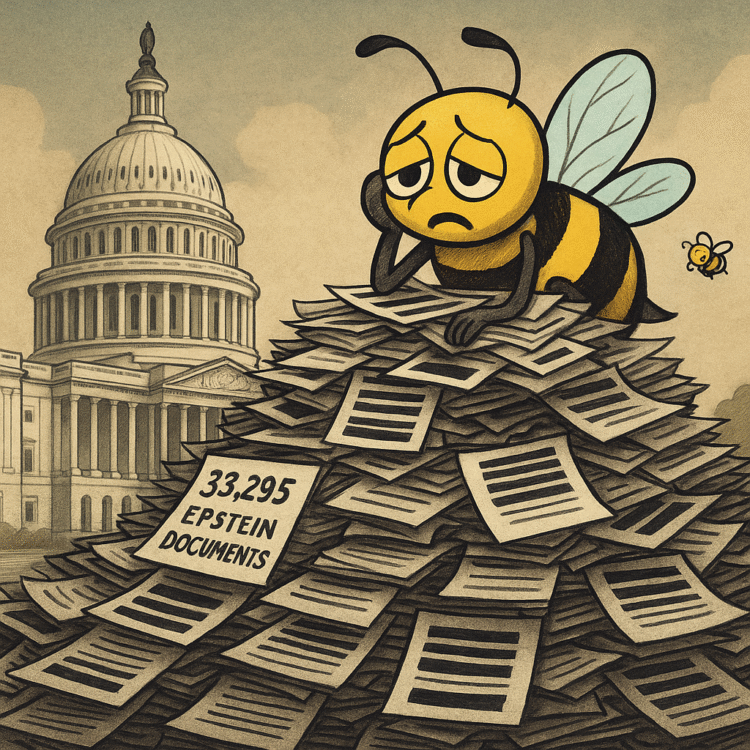
Transparency, we are told, is democracy’s disinfectant. Shine light on the secrets, cleanse the rot, and let citizens bask in the glow of accountability. On September 2, 2025, Chairman James Comer’s GOP-led House Oversight Committee took that adage and set it on fire, dumping 33,295 pages of Jeffrey Epstein–related records into the public sphere. Thirty-three thousand pages. A tower of paperwork so immense it should come with a forklift.
Comer called it “transparency.” Democrats like Ranking Member Robert Garcia called it what it was: 97% recycled, heavily redacted, already-public material. A bureaucratic infinity mirror. A filing cabinet vomiting itself onto C-SPAN.
Thirty-Three Thousand Pages, Three Percent Truth
Let’s pause and sit with the number. 33,295. That’s more than War and Peace. More than Infinite Jest. It’s the kind of page count that makes grad students cry. The promise is that inside this Everest of PDFs lies revelation. The reality is that inside lies mostly black bars.
Page after page reads like a Mad Libs where the only word allowed is [REDACTED]. Names? Redacted. Locations? Redacted. Phone numbers? Redacted. One can only assume “Epstein” himself survived redaction by sheer name recognition.
Democrats aren’t exaggerating when they call this recycled. 97% of the documents had already been available in some form, often in court filings. The difference now is that Congress stapled them together, called it “historic,” and expected applause.
Survivors’ Testimony: Raw vs. Stage-Managed
The true heart of this story isn’t in the PDFs. It’s in the survivors’ raw, closed-door testimony that accompanied the push for disclosure. Women who were silenced for decades told members of Congress, face-to-face, what Epstein and his network did to them.
Yet even here, the spectacle intruded. The same committee that can’t spell “unredacted” staged press conferences like awards shows, touting the “bravery” of survivors while simultaneously drowning their truth in a dump truck of redacted pages. The performance of empathy without the substance of justice.
The Discharge Petition Circus
Enter Rep. Thomas Massie, a libertarian Republican, teaming with Democrat Ro Khanna to file a discharge petition. The goal: force a floor vote to compel full disclosure of Epstein files. In a rare show of cross-aisle courage, they declared: enough with the trickle-out releases, enough with the curated outrage.
Of course, in today’s Congress, bipartisan courage looks like handing a squirt gun to a five-alarm fire. The Speaker, Mike Johnson, immediately called the petition “unnecessary,” parroting White House lines about “victim privacy.” Because nothing says “respect for privacy” like releasing 33,295 pages of heavily redacted material no one can parse.
Marjorie Taylor Greene’s Pledge of Support
And then there’s Marjorie Taylor Greene, promising to back the petition. Imagine explaining to survivors that their liberation depends on a coalition featuring Thomas Massie, Ro Khanna, and MTG. Imagine telling them justice is coming—carried on the same train that tweets space-laser theories. It’s like asking clowns to build the gallows.
But here we are.
Stage-Managed Outrage
Comer’s release was less about justice and more about optics. The purpose wasn’t to answer questions about who enabled Epstein, who flew on his planes, who opened doors to power. The purpose was to stage outrage. To dump paperwork so massive that the act itself became the story.
Transparency as performance art. Accountability as theater. Thirty-three thousand pages of nothing, designed to look like everything.
The Ghost of Alex Acosta
Hovering over all this is the 2008 non-prosecution deal Epstein struck with then–U.S. Attorney Alex Acosta. That sweetheart deal, granting immunity to “potential co-conspirators,” remains the most glaring proof that accountability was never the point. Revisiting it should be a bipartisan cause. Instead, it’s background noise, drowned in the flood of paper.
Every black bar in Comer’s release is a reminder: Acosta’s deal still shields elites. The names we need aren’t missing by accident. They’re missing by design.
The Myth of Transparency
Here’s the satire baked into the system: America fetishizes transparency while simultaneously weaponizing redaction. We celebrate the dump, not the data. We measure transparency by the pound, not by the truth.
Thirty-three thousand pages doesn’t mean thirty-three thousand answers. It means thirty-three thousand distractions. The math is designed to overwhelm, to lull citizens into equating volume with honesty.
This isn’t transparency. It’s bureaucratic gaslighting.
The Knife Fight
Naturally, the dump became a partisan knife fight. Republicans framed it as proof they’re tough on elites, Democrats framed it as proof Republicans are protecting elites. Both are correct, in their own way. Neither is willing to fully expose the complicity that likely spans both parties.
The joke is that Epstein’s web wasn’t partisan. His Rolodex had no ideology. He courted power, money, access—red or blue, it didn’t matter. Which is why real transparency terrifies both sides.
Survivors Lost in the Shuffle
The tragedy is that survivors remain pawns in this political theater. Their testimony is invoked, their pain displayed, their bravery celebrated. But their actual demand—exposure of the full truth—is buried under paperwork and partisanship.
Every press release is another reminder that survivors are props in someone else’s performance. Their healing requires light. Congress gave them shadows.
The Satirical Core
This is America’s Epstein problem in miniature: outrage without action, transparency without truth, accountability without consequence. Thirty-three thousand pages symbolize everything wrong with our politics: performative, bloated, opaque.
The committee’s dump isn’t about Epstein. It’s about Congress. About proving, once again, that theater will always trump truth.
The Haunting Observation
On September 2, James Comer’s Oversight Committee didn’t expose the Epstein network. They exposed Congress. They showed us a body that cannot tell the truth without first laundering it, cannot face corruption without first staging it, cannot honor survivors without first using them.
The 33,295 pages aren’t revelation. They’re confession. Not of names or crimes, but of a system so invested in its own preservation that it will bury truth under mountains of paper rather than face it.
And that is the final irony: Epstein’s greatest protectors may no longer be lawyers, prosecutors, or secret deals. They may be the very institutions now claiming to expose him.
Because in America, even transparency comes with redactions.