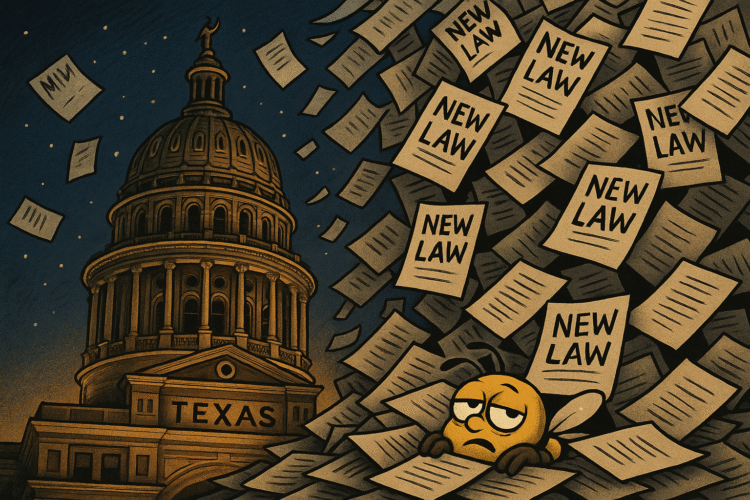
Texas loves a spectacle. Rodeos, Friday night lights, the eternal battle between Whataburger and In-N-Out. But nothing captures the state’s flair for drama like September 1, 2025, when 835 new laws took effect at the stroke of midnight. Not one or two. Not even a tidy fifty. Eight hundred and thirty-five. If democracy is usually a drip, Texas decided to open the floodgates and see how many citizens they could drown.
The result is a landscape where your child’s classroom wall, your water bill, your housing lot size, and even your medical marijuana vape pen are now subject to the whims of lawmakers who describe all this as “Texas values.” It’s not so much governance as it is a midnight mass—an overwhelming sermon of statutes delivered at once, leaving citizens blinking under the fluorescent light of a new morning where everything is suddenly illegal, mandatory, or both.
The Budget Bribe
First up: money. SB 1, a $338 billion two-year budget, aims to cushion property-tax cuts while sprinkling cash across energy, broadband, and water projects. This is the legislative equivalent of putting frosting on a rock. Texans are promised relief on their taxes (translation: a brief reprieve before appraisals skyrocket again), plus “investment” in infrastructure that should have been addressed a generation ago. Broadband expansion in 2025 feels less like progress and more like a sheepish admission that maybe it’s time rural students stopped submitting homework by carrier pigeon.
The energy funding is pitched as a bulwark against future blackouts. Translation: maybe, just maybe, when the next storm hits, Texans won’t be forced to boil snow on propane stoves while state officials appear on Fox News insisting everything is fine.
The Voucher Fantasy
Then there’s SB 2: Texas’ plan to launch one of the nation’s largest school voucher programs in 2026–27. On paper, parents get “choice.” In reality, public schools get gutted while wealthy families pocket taxpayer-funded discounts at private academies with Latin mottos and lacrosse teams.
The irony here is structural: the same lawmakers demanding accountability and test scores for public schools are funneling billions into private institutions with no transparency at all. If your neighborhood school fails, that’s socialism. If your voucher-funded private school fails, that’s “innovation.”
But don’t worry—HB 2 throws $8.5 billion at public schools alongside teacher pay boosts. It’s a consolation prize, the legislative equivalent of offering flowers to someone you just ran over.
The Ten Commandments, Now in Poster Form
SB 10 requires classrooms to display the Ten Commandments on donated 16×20 posters. It’s hard to decide what’s more absurd: legislating poster size or pretending this isn’t a violation of church-state separation.
A federal judge already blocked the rule in nearly a dozen districts, but the symbolism sticks. Students struggling with algebra will now gaze up and find not multiplication tables but Thou Shalt Not Commit Adultery. Because nothing improves standardized test scores like reminding eleven-year-olds to avoid coveting their neighbor’s ox.
DEI, Dead on Arrival
SB 12 extends Texas’ ban on diversity, equity, and inclusion initiatives into K-12 schools. It also curtails instruction and clubs about sexual orientation or gender identity. Translation: Texas has legislated the closet back into existence.
Critics call it discrimination. Lawmakers call it “protecting children.” Protecting them from what, exactly? The knowledge that gay people exist? The fact that trans kids are already in their classrooms? The irony here is as thick as barbecue smoke: the same politicians screaming about parental rights are now banning parents from supporting their kids in public school clubs.
Book Bans for the Whole Family
SB 13 hands parents and school boards expanded powers to pull library books. We’ve entered a golden age of censorship where the Bible, filled with violence and sex, is safe, but a novel about two boys holding hands is dangerous. The joy of SB 13 is that it empowers every parent to act as de facto cultural police. One offended PTA mom can erase an entire shelf.
This isn’t education. It’s whack-a-mole with literature.
Universities on a Leash
SB 37 shifts more authority to politically appointed university regents. Because what academia really needs is less independence and more micromanagement from donors and governors whose last brush with scholarship was plagiarizing campaign speeches.
The message is clear: Texas universities will now teach what Austin says they can teach. Academic freedom is a footnote, soon to be deleted.
Uvalde’s Shadow
HB 33 requires annual joint active-shooter planning and after-action reports. On the surface, this looks like progress: accountability, transparency, preparation. But the cynicism runs deep. After Uvalde, Texans learned the horrifying truth: plans don’t save lives when law enforcement refuses to act. Now, legislators are mandating more plans, more binders, more reports—paper shields against bullets.
The children who crouch under desks don’t need reports. They need action. But in Texas, paperwork is always easier than policy.
The Water Fund
SB 7 (plus a November ballot measure) seeds a multi-billion-dollar Texas Water Fund. It’s pitched as long-term investment: reservoirs, pipelines, infrastructure. The same state that couldn’t keep the lights on now promises to keep the faucets running.
Water is the new oil, but Texas is trying to legislate it like it’s still a limitless spigot. The real joke is that lawmakers who deny climate change are now budgeting for climate collapse without ever saying the words out loud.
Housing: Tiny Lots, Big Government
SB 15 forces big cities to allow smaller-lot single-family homes. This is pitched as solving the housing crisis. In reality, it’s a developer’s dream: cram more homes on less land, watch the profits rise. The irony is delicious: the same Republicans who scream about “local control” are now dictating zoning policy to cities. Apparently, government overreach is fine as long as it benefits real estate.
Foreign Land Ban
SB 17 bans land purchases by governments, companies, and individuals tied to China, Russia, Iran, and North Korea. The measure is marketed as national security, but in practice it’s legal discrimination dressed up as patriotism. A Korean American family wanting to buy a farm? Better prepare for paperwork. The state has essentially decided your surname is a security risk.
Abortion, Out of Bounds
SB 33 forbids cities and counties from using public funds for abortion travel. So even in places where local leaders want to help residents access healthcare, the state steps in to say no. It’s one thing to ban abortion statewide. It’s another to criminalize compassion.
Weed, Finally, Sort of
HB 46 expands the medical marijuana program to include chronic pain, traumatic brain injury, and Crohn’s disease. It also legalizes vape and aerosol delivery. Texans can now treat suffering with cannabis—provided they navigate the labyrinth of medical bureaucracy first.
The irony: the same lawmakers who pass draconian punishments for recreational weed now pat themselves on the back for allowing the sick to inhale medicine. Progress moves slower than a line at Buc-ee’s.
The Women’s Bill of Rights
HB 229, the so-called “Women’s Bill of Rights,” fixes state records to biological-sex definitions. It’s a polite way of saying trans Texans don’t exist on paper. The cruelty is bureaucratic: your ID, your health records, your school documents—all must reflect what lawmakers decided in a committee room, not who you are.
This isn’t rights. It’s erasure.
Breaking NDAs
SB 835 voids non-disclosure agreements in sexual-assault and trafficking cases. This is one of the few unambiguously good laws in the pile. Survivors can now speak without fear of lawsuits. Transparency will replace silence. Which raises the question: why bury this in a midnight mass of 835 laws? Probably because it’s the one reform that doesn’t fit the “Texas values” branding, so it needed camouflage.
The Midnight Mass
This avalanche of statutes is pitched as parental rights, security, and “Texas values.” Critics call it church-state violation, censorship, and discrimination. Both are correct.
Texas didn’t just pass laws. It legislated culture. It turned governance into theater, codified fear into statute, and delivered it all in one night so the sheer scale would make resistance feel impossible. It’s like being buried under legislative rubble—by the time you dig through one law, there are 834 more waiting.
The Satirical Core
The irony is woven into every statute. The state that screams about liberty now mandates religious posters in classrooms. The state that touts parental rights bans certain parents from supporting their kids. The state that brags about local control micromanages zoning policy. The state that claims to hate bureaucracy forces annual binders of active-shooter plans.
Texas is the nation’s greatest producer of contradictions. Oil, beef, culture wars, and hypocrisy—exported at scale.
The Haunting Observation
On September 1, 2025, Texas didn’t just flip the switch on 835 laws. It flipped the switch on a new reality where governance is indistinguishable from ideology. Where your classroom wall doubles as a church pew. Where your bookshelf doubles as a battlefield. Where your housing lot, your water supply, your ID card, and even your medical cannabis pen are scripted by lawmakers chasing “values” rather than solutions.
And that is the danger: once a state realizes it can legislate culture wholesale, midnight becomes the perfect time for revolution. Not the revolution of liberty, but of control. Not freedom from government, but freedom for government—to decide, decree, and dominate.
Texans woke up on September 1 to discover they weren’t just living in Texas anymore. They were living in someone else’s sermon, written into law.
And sermons, unlike statutes, don’t expire. They echo. They command. They demand obedience. Until someone finally dares to walk out of the church.