The Trump administration has a way of treating cities like wayward children—Chicago most of all. For decades, conservative politicians have invoked it as shorthand for chaos, crime, and everything wrong with “blue America.” To them, Chicago is less a place where millions of people live, work, and build lives, and more a stage for proving toughness. It is the Gotham of their imagination: broken, corrupt, and waiting for a strongman to arrive. On August 31, 2025, that fantasy moved a step closer to reality when Homeland Security Secretary Kristi Noem announced an expansion of ICE operations into the city.
Chicago, in other words, has officially become the administration’s laboratory for fear.
The Base at the Center of the Storm
The plan began with whispers: DHS quietly asking Naval Station Great Lakes for logistical support. This wasn’t about immigrants crossing Lake Michigan on inflatable rafts—it was about optics. Naval bases are imposing. They look like order. They look like control. They look like the kind of place where something serious is happening, even if the serious thing is just paperwork in uniform.
Then came the announcement: ICE will surge agents and resources into Chicago. “We haven’t taken anything off the table,” Noem said, sounding less like a cabinet secretary and more like a parent deciding whether to ground the kids or burn the house down. Other cities, she hinted, could be next.
The framing is familiar. Supporters insist the expansion targets “violent offenders” and “trafficking rings.” The words conjure images of Hollywood villains smuggled straight from Sicario—dangerous men in SUVs with tinted windows, plotting crimes in alleyways. What it actually means is raids, checkpoints, workplace sweeps, and communities terrorized for looking “suspicious.”
The Mayor and the Governor Push Back
Chicago’s mayor, Brandon Johnson, immediately issued an executive order barring city police from assisting civil immigration enforcement. This was less a gesture of compassion and more a legal survival tactic. If local cops become extensions of ICE, the city not only alienates immigrant communities but also exposes itself to lawsuits that could drain budgets faster than potholes in February.
Governor J.B. Pritzker followed suit, warning of legal challenges. In Illinois, sanctuary policies aren’t fringe—they’re foundational. The state has carved out its reputation as a place where immigrant rights are woven into local governance. The federal government knows this, which is exactly why they picked Chicago as ground zero.
Protest and Fear
Protests erupted near Great Lakes and across the city. Families carried signs. Organizers blasted megaphones. Students marched. The chants echoed the same message: immigration enforcement is not crime prevention—it’s intimidation.
Meanwhile, immigrant neighborhoods braced for raids. Parents kept kids home from school. Grocery stores saw fewer shoppers. Workers skipped shifts rather than risk checkpoints. The fear isn’t theoretical—it’s lived, immediate, and suffocating.
This is the strategy: create enough fear that people self-deport in silence. That’s always been the unspoken efficiency of ICE—not deportations themselves, but the way communities hollow out under constant surveillance.
Kristi Noem, Secretary of Homeland Theater
Kristi Noem is an odd choice to lead Homeland Security, though perhaps “odd” has lost meaning in Trump’s second administration. Noem made her name as governor of South Dakota, famous for tourism ads so bizarre they felt like Tim and Eric sketches. (“Meth: We’re on it.”) Now she is in charge of coordinating one of the largest federal agencies in the country.
Her announcement carried the performance of toughness without the detail of governance. “We haven’t taken anything off the table,” she said, leaving the table itself suspiciously empty. What is on the table? Curfews? Detention centers? Federal troops marching down Michigan Avenue? No one knows, which is the point. Ambiguity itself becomes intimidation.
The Chicago Mythology
Chicago is always the punchline in conservative politics. It’s shorthand for crime. It’s shorthand for failure. It’s shorthand for “look what happens when Democrats are in charge.” Never mind that violent crime in Chicago has been falling. Never mind that 2024 saw a significant drop in shootings. Facts rarely make it past the myth.
The myth is convenient. It allows Republicans to posture as saviors while ignoring the actual problems of their own states. Mississippi has higher murder rates. Louisiana has worse infrastructure. West Virginia’s opioid epidemic is catastrophic. But none of those places make good cable news. Chicago does. It’s iconic. It’s visual. It’s the perfect scapegoat.
So when Trump and Noem declare ICE will “fix” Chicago, they’re not speaking to the city’s residents. They’re speaking to their base, promising dominance over a city they’ve always treated as enemy territory.
Federal Overreach, Again
The constitutional problem is obvious: elections belong to states, and immigration enforcement has limits. Trump’s earlier executive orders already triggered court battles. This one sets up another. Can the federal government coerce local police into becoming ICE deputies? Can it commandeer state resources to enforce civil immigration law?
Courts will say no. They’ve said no before. But that doesn’t matter. The administration’s tactic isn’t to win legally—it’s to win rhetorically. They don’t need victory in court. They need headlines: “Trump Fights for Safety, Democrats Resist.” They need the narrative of chaos and lawlessness. They need their base to see Chicago as proof that only Trump can impose order.
The Theater of Safety
It’s worth pausing to ask: what does safety actually look like here?
To the administration, safety is ICE agents in tactical gear patrolling neighborhoods, papering grocery stores, and interrogating day laborers. Safety is a base on the edge of the city, humming with federal vehicles, humming with authority. Safety is the projection of power, not the presence of peace.
But to residents, safety looks different. Safety is being able to drop your kids at school without fear of deportation. Safety is going to work without worrying about checkpoints. Safety is knowing that calling the police for help won’t also mean getting your immigration status scrutinized. Safety isn’t boots and badges. Safety is trust.
And trust is the first thing federal raids destroy.
The Protest Signs Don’t Lie
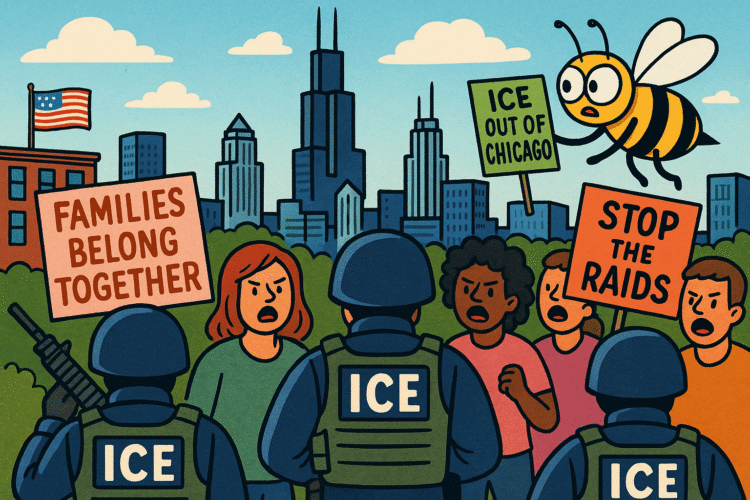
Outside the Naval Station, one sign read: Families Belong Together. Another: ICE Out of Chicago. Another: Stop the Raids. It’s easy to dismiss protest slogans as clichés, but they’re shorthand for deeper truths. Families are being torn apart. Communities are under siege. People are afraid to live their daily lives.
That fear doesn’t stop crime. It breeds it. It makes communities less safe, not more. And that, of course, is the real irony: in the name of safety, the administration is manufacturing danger.
A Constitutional Showdown
This is headed for a constitutional collision. Chicago’s sanctuary policies aren’t just municipal quirks—they’re state-backed, legally defended, and popular with residents. Trump and Noem are betting that brute force will win the day. Illinois is betting on the courts. The result will be chaos: lawsuits, injunctions, protests, headlines. And all of it will serve the same goal: to make Chicago a cautionary tale in the 2026 midterms.
The show doesn’t need resolution. It only needs tension. As long as the fight drags on, the White House gets to posture as warrior-in-chief against “lawless cities.”
The Satire of It All
The irony is brutal. The administration insists this is about violent offenders and trafficking rings, but the first wave of arrests is always dishwashers, construction workers, landscapers—the people who keep cities functioning invisibly. It’s about punishing the powerless to project strength.
ICE raids don’t fix systemic problems. They stage them. They are theater, designed to look like action, while leaving real issues untouched. It’s less about crime than about optics, less about justice than about intimidation. Chicago is just the latest stage.
The Haunting Observation
What happens in Chicago won’t stay in Chicago. The administration has already signaled it will expand the plan. Los Angeles. New York. Houston. Sanctuary cities everywhere are on the list.
But here’s the haunting truth: safety and fear can’t coexist. You can flood a city with agents, line its streets with checkpoints, and fill its skies with drones, but if residents are terrified to live their lives, you haven’t made them safe—you’ve made them prisoners.
The real danger isn’t immigrants. It isn’t crime statistics. It isn’t the mythology of Chicago. The real danger is a government that confuses control with security, that believes fear itself is law and order.
And when fear is the policy, everyone loses—even the people who thought they were the ones being protected.