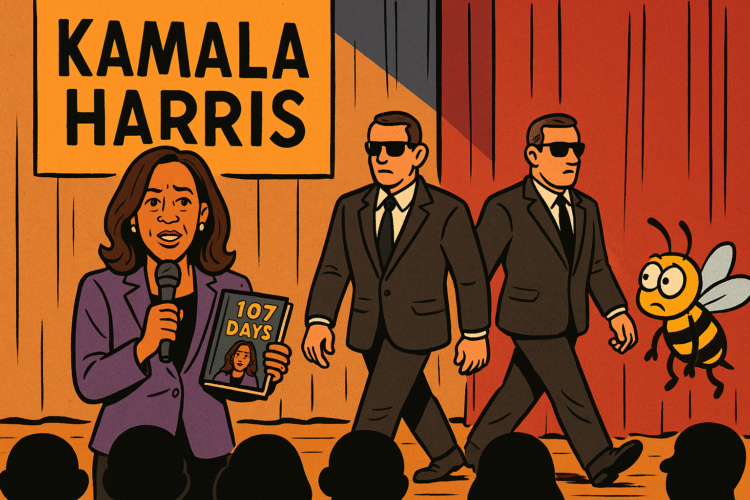
On August 29, 2025, President Donald J. Trump did something both petty and perilous, which, to be fair, is his governing style. He revoked the Secret Service protection of former Vice President Kamala Harris—effective September 1—just as she prepares to launch her 107 Days book tour.
The timing is not coincidence. It is choreography.
Harris had been granted the customary one-year extension of security by President Biden, an unremarkable courtesy for high-ranking former officials. But the Trump White House saw fit to scrap it, citing no new threats, no security assessments, no budget shortfalls. Just an executive decision that reads less like governance and more like a middle-school feud.
In Los Angeles, where Harris is set to kick off her tour, city officials slammed the move as reckless. Critics called it dangerous, unprecedented, vindictive. Trump supporters called it Tuesday.
The Politics of Removal
Secret Service protection for former leaders is not a luxury. It is recognition that once you ascend to the second-highest office in the country, you carry a permanent target on your back.
The revocation isn’t about policy. It’s about humiliation. It’s about stripping away the armor, leaving Harris exposed as she enters bookstores, theaters, college auditoriums. It is the optics of vulnerability, broadcast to friend and foe alike.
Trump has long practiced politics as subtraction. Remove protections. Remove funding. Remove dignity. And then declare victory over the vacuum you’ve created.
The Book Tour as Battleground
The title 107 Days is already loaded. The book promises a chronicle of Harris’s final months in office, a meditation on power, decline, and unfinished business. Now, thanks to the White House, it doubles as a countdown clock for her physical safety.
Every event on her tour is now a security question. Will local police fill the gap? Will campaign-style private security be deployed? How much risk can be outsourced to universities and bookstores suddenly responsible for crowd control against armed agitators?
It is one thing to debate Harris’s political legacy. It is another to debate whether she can safely walk into a Barnes & Noble.
The Structural Irony of Protection Politics
The structural irony is suffocating.
Donald Trump, a man with more legal cases orbiting him than moons around Jupiter, will never know a day in his life without Secret Service protection. His adult children, some with no public role whatsoever, retain protection details at taxpayer expense. Golf carts in Florida are still flanked by agents. Mar-a-Lago remains a fortress.
And yet Kamala Harris, who faced racist threats throughout her tenure, who remains a symbol of diversity and visibility in American politics, is told her security is optional.
The man who incited an insurrection is shielded. The woman who presided over the Senate is stripped bare. That is not coincidence. That is structural irony in authoritarian ink.
Mock Formality: Definitions of Safety
Secret Service Protection — A security detail designed to prevent the assassination of political figures, unless rescinded to score points against adversaries, in which case safety becomes a partisan luxury item.
Presidential Courtesy — The practice of extending basic dignity to predecessors or opponents, abolished under the current administration in favor of gladiatorial combat.
Public Safety — A phrase weaponized to justify troop deployments in peaceful cities, but abandoned entirely when it comes to safeguarding political opponents at book signings.
The Spite Presidency
There is a pattern here. Trump does not govern by agenda so much as vendetta. Protection stripped from adversaries. Funding slashed for blue states. Military parades staged to honor loyalty. A worldview where every act of subtraction is proof of dominance.
In that context, revoking Harris’s protection is not shocking. It is the logical extension of a presidency addicted to spite. If democracy is a dinner table, Trump is the host who invites you over only to eat your food and throw your chair out the window.
The Dangerous Normalization
The danger is not just the physical vulnerability. It is the normalization of weaponizing protection. Today it is Harris. Tomorrow it could be governors, mayors, journalists, judges. Anyone deemed an adversary can be reclassified as unworthy of state safeguarding.
This is how authoritarian regimes evolve. Protection becomes conditional, doled out to loyalists and revoked for dissenters. The state becomes not a guardian of all, but a bodyguard for some.
The Shadow of 1968
History is whispering. America has lived through political assassinations: Martin Luther King Jr., Robert F. Kennedy. Those killings reshaped the nation’s trajectory, carved wounds that never healed.
Revoking protection in this climate is reckless to the point of nihilism. It toys with fate. It tempts history to repeat itself. It tells the country that political violence is not a lesson learned but a risk reprised.
The Haunting Optics
Picture the first stop of Harris’s book tour: a stage, a microphone, a packed auditorium. Instead of Secret Service agents in discreet earpieces, there are local police, underpaid security guards, maybe a few campaign staffers doing double duty. The risk is palpable. The message is unmistakable: this former Vice President is now on her own.
This is not just unsafe. It is undignified. It reduces a stateswoman to a target of convenience.
Sarcasm as Survival
Perhaps this is America’s new model. A revolving door of protection, tied not to office but to presidential mood swings. If you play nice, you get the earpiece and the armored SUV. If you publish a book, you get a pat on the back and a bus ticket.
Why stop with Harris? Imagine the savings if we revoked security for every inconvenient politician. Secret Service could be rebranded as Loyalty Patrol, their resources redeployed to escort rallies instead of leaders. The message: safety is not a right; it is a reward.
The Bookstores as Battlefields
The absurdity of this policy is clearest in the details. We now rely on Barnes & Noble managers and indie bookstore volunteers to provide the security once guaranteed by the state. Book tours, those quaint rituals of democracy where citizens hear from former leaders, are recast as potential flashpoints. The line between literature and live ammunition is suddenly uncomfortably thin.
What should be a celebration of civic dialogue is now a test of whether America can keep its former leaders alive when their protection is politicized away.
The Real Emergency
This is not about Kamala Harris alone. It is about precedent. The precedent that protection is partisan. That security is a luxury. That safety can be revoked as punishment.
Once that precedent hardens, every future administration inherits it. Today it is Harris. Tomorrow it could be Pence. The day after, perhaps a governor who challenged a pandemic mandate, or a senator who crossed the aisle. No one is safe if safety itself is reclassified as optional.
The Haunting Observation
Kamala Harris begins her 107 Days tour without the shield that office should have guaranteed. She will step into auditoriums and bookstores, her presence now a test of whether America values her safety more than Trump values his spite.
The haunting truth is that this isn’t just about Harris’s tour. It is about whether America believes its former leaders should live without fear, or whether we are content to roll the dice for the sake of a petty victory lap.
If the unthinkable were to happen, the country will pretend to be shocked. But the shock will be theater. The warning is already written. The protection was already revoked. The choice was already made.
And one day, when the history books recount these 107 days, the question will not be how many copies Harris sold. The question will be why we treated her safety as expendable.