In the latest American remake of Night of the Long Knives, the White House traded soldiers for scientists and staged the firing of CDC Director Susan Monarez like it was an HR issue instead of a constitutional one. On August 27, 2025, less than a month into her tenure, Monarez was dismissed for the crime of being insufficiently enthusiastic about dismantling vaccine recommendations. She had been Senate-confirmed just weeks earlier—an actual legal protection meant to prevent precisely this kind of whimsy—but she was booted anyway, a decision reportedly delivered more like a “You’re not a fit for our team” text message than an act of governance.
The ouster unleashed the predictable cascade. Debra Houry, Daniel Jernigan, Demetre Daskalakis, and Jennifer Layden followed her out the door, resigning in protest and citing the now-standard phrase, “the weaponization of public health.” Each resignation letter read less like a bureaucratic memo and more like a scream into the void: warning that science was being smothered under ideology, that careers built on outbreaks and prevention were being reduced to collateral damage in a political stunt.
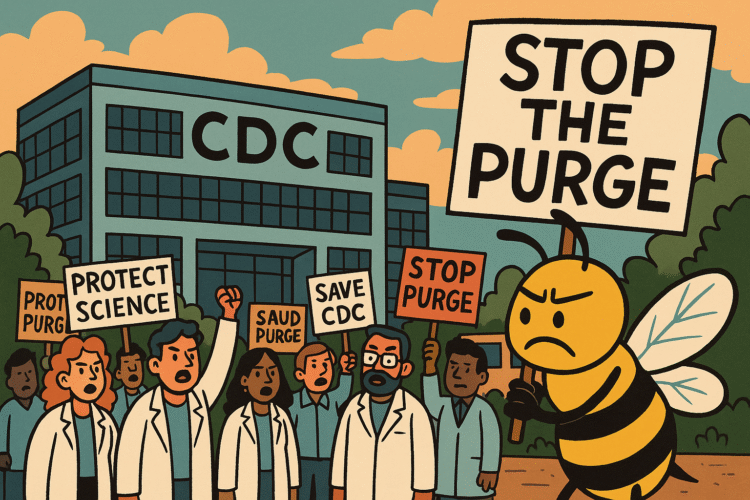
What played out in Atlanta wasn’t a quiet shake-up. It was a spectacle. Legal teams bickered over whether a Senate-confirmed director could actually be fired by a Cabinet secretary without presidential approval. Protesters marched outside CDC headquarters holding handmade signs that read “Protect Science” and “Stop the Purge.” Inside the building, staffers packed up labs and offices while clutching their phones, unsure whether to refresh Slack, email, or Twitter for updates on who still technically had a job.
The Guardian’s coverage read like a eulogy. The Daily Beast wrote it like a scandal recap. Wikipedia added the resignation list within minutes, citing sources with the efficiency of a public obituary. What united the coverage was its tone of disbelief: the premier disease-fighting agency in the United States, the institutional memory of polio, measles, HIV, and COVID, had been turned into an expendable cast member in a reality show about vaccine paranoia.
The logic of the purge was clear. Secretary Robert F. Kennedy Jr., armed with decades of anti-vaccine activism, finally gained an office where his suspicions about “Big Pharma” could become formal guidance. Within weeks of taking over, vaccine recommendations for pregnant people and healthy children were revised into question marks. The advisory committee that had once represented independent scientific consensus was disbanded and repopulated with voices friendlier to Kennedy’s skepticism. The CDC, once accused of moving too slowly, was now accused of moving only when nudged by ideology.
The phrase “weaponization of public health” landed with the kind of resonance you don’t get from a think tank—it came from inside the building. Scientists who had devoted decades to flu surveillance, HIV prevention, and outbreak forecasting weren’t merely resigning because of policy disagreements. They were resigning because the entire premise of their work—evidence guiding action—was being rewritten. They knew what the public didn’t yet grasp: that when you replace science with politics in a disease control agency, you don’t just jeopardize careers. You jeopardize lives.
Picture the scene: Susan Monarez, weeks into her dream job, reading a letter that tells her she’s been removed. Not by the president, who technically has to do it, but by a secretary with an axe to grind and a press team ready to frame her as disloyal. Imagine the career trajectory: a lifetime in biodefense and emergency preparedness culminating in being labeled “difficult” for not endorsing pseudo-scientific vaccine rollbacks. It is the bureaucratic equivalent of a surgeon being fired for washing their hands too often.
Then imagine the staff in Atlanta, where the CDC headquarters became ground zero for protest. Employees marched with signs, chanted against interference, stood outside the building that had endured everything from anthrax scares to gunfire in recent years, and asked aloud whether science itself was still allowed inside. Some wore lab coats in solidarity; others simply taped paper messages to their office windows. For a moment, CDC staff joined the protest tradition usually reserved for coal miners and teachers, which says something about how deep the rot has gone.
The legality of Monarez’s firing now hangs like a bureaucratic sword. Her attorneys argue she remains the lawful director, since only the president can terminate a Senate-confirmed appointee. The administration counters that her refusal to resign made termination inevitable. What we’re left with is a paradox: a director who insists she hasn’t been legally removed, and an administration that insists she no longer exists. It’s governance by Schrödinger’s firing—she is both director and not director, depending on which cable network you ask.
This is not how disease control is supposed to work. Outbreaks don’t pause for legal disputes. Measles doesn’t wait for the president’s signature. Polio doesn’t care whether Robert F. Kennedy Jr. or Susan Monarez is technically in charge. Science, stripped of authority, becomes a spectator in its own arena.
The resignations tell their own story. Demetre Daskalakis, best known to the public for his blunt HIV prevention work and leather harness at a White House event, did not mince words. He called out the “weaponizing of public health,” a phrase destined to appear in future textbooks describing this era. Debra Houry, who had long warned of the growing toll of misinformation, left after seeing it crowned as policy. Daniel Jernigan and Jennifer Layden quietly stepped down, their decades of epidemiological expertise reduced to inconvenient background noise.
When four of your most seasoned leaders walk out within hours of your director being fired, it is not a coincidence. It is a coordinated obituary. And what it leaves behind is not a functioning agency, but a hollow one.
The purge is part of a longer unraveling. Earlier in 2025, the CDC eliminated references to gender, pregnancy, LGBTQ health, and climate change from its language. Hundreds of employees were let go in what was described as “streamlining.” The MMWR, the CDC’s bedrock weekly report, faced delays and “editorial adjustments.” Data systems were dismantled or privatized. Even after an armed attack at CDC headquarters earlier in the year, the focus was less on staff safety than on controlling narrative.
Taken together, these aren’t isolated policy changes. They’re a blueprint. A new CDC is being built—not as a public health agency, but as a political communications arm. Disease prevention becomes optional. Science becomes advisory, in the old-fashioned sense of the word: advice you can ignore. What matters is optics, not outcomes.
The irony here is layered. For decades, the CDC was accused of being too bureaucratic, too slow, too cautious. Now it’s being gutted for not moving fast enough to match political directives. Once derided for “hiding the truth” during crises, it’s now punished for speaking it. We are witnessing the conversion of a scientific body into a reality show prop, where the prize is not preventing outbreaks but controlling the story.
It is also grotesquely absurd. Protesters outside the Atlanta headquarters carried signs as if chanting could bring back the vaccine advisory committee. Inside, staff whispered about whether the flu season would be tracked at all. The scene read less like a public health agency and more like a workplace after a union-busting campaign—except the stakes here are literal pandemics, not holiday pay.
The media narrative has already taken shape. The Guardian framed it as a “weaponization” moment. The Daily Beast leaned into the chaos. Wikipedia, ever efficient, updated the timeline before the ink dried. What matters isn’t the angle—it’s the consensus: that a once-stable institution is now an active battlefield, its credibility shredded not by external attacks but by its own overseers.
For the average American, this meltdown registers as distant noise. But for those who remember 2020, the warning is unmistakable. Public health agencies gutted by politics do not quietly heal. They fester. And when the next outbreak inevitably arrives—be it influenza, Ebola, or something novel—the absence of expertise will not be abstract. It will be measured in deaths.
The haunting truth is that the CDC is not just an agency. It is memory. It is the cumulative experience of decades of outbreaks, the mistakes catalogued and the lessons learned. Strip it of leadership, replace science with ideology, and you erase that memory. You become a country that has to relearn the same lessons, this time with higher stakes.
So yes, the protests in Atlanta matter. The resignations matter. The legal fight over Monarez’s job title matters. But what matters most is the silence that follows. The absence of voices that once spoke for evidence, for prevention, for lives. That silence will not be filled by slogans. It will be filled by consequences.
And that is what makes this moment more terrifying than any headline. The CDC did not simply lose its leaders. America lost its memory.