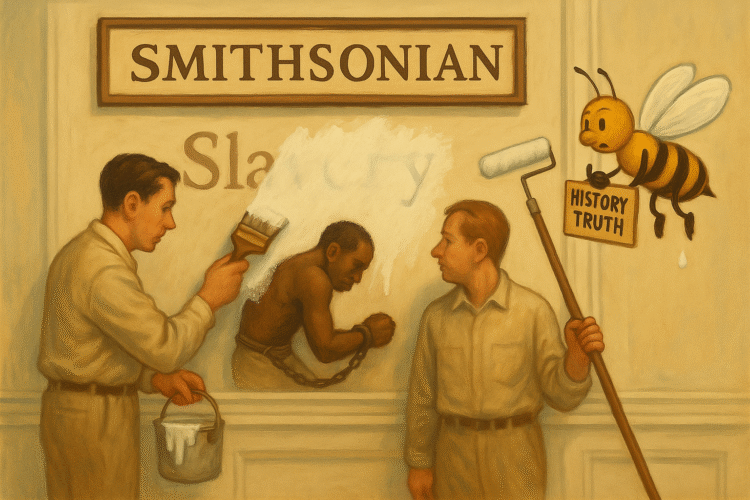
On August 22, 2025, The Guardian ran Francine Prose’s surgical essay on President Trump’s newest culture-war bonfire: Smithsonian museums, and specifically his complaint that they focus “too much on how bad slavery was.” Imagine saying that in 2025, after four centuries of systemic exploitation, while standing on a marble floor your ancestors never had to scrub.
Prose connects the dots: this isn’t just a tossed-off quip. It’s the front page of the administration’s playbook to reshape museums into theme parks of patriotic uplift—exhibits that say less about shackles and whips, more about “unity” and “heritage.” The administration calls it “positive storytelling.” Historians call it propaganda. And you should call it what it is: the state muzzling fact in favor of flattery.
Museums as Battlefield
The Smithsonian—those staid temples of fossils, art, rockets, and American history—have suddenly become trench warfare in Trump’s campaign to neuter reality. On the surface, this looks laughable. The president known for slapping his name on steaks and casinos now wants editorial control over placards in the National Museum of African American History and Culture. But laughter is exactly the distraction. Behind the absurdity is an attempt to reorder the nation’s memory.
The “content review push” is bureaucratese for censorship. Exhibits that document slavery’s brutality, Jim Crow’s persistence, or the daily humiliations of segregation? Too “divisive.” Displays that highlight civil rights movements, mass incarceration, systemic racism? “Unbalanced.” What will replace them? A curated fantasy: Harriet Tubman smiling in soft pastels, Frederick Douglass as an inspirational influencer, plantations with better landscaping.
How to Politely Erase Atrocities
Here’s the genius of it: the administration isn’t openly banning history. It’s asking museums to “balance” it. To present slavery as not just chains and auctions but also “the skills enslaved people learned,” “the architecture they left behind,” “the lessons for today’s workers.” This is the rhetoric of balance when one side of the scale is a body in a coffin.
Imagine visiting an exhibit on the Holocaust where the placards remind you that German engineering was impressive. Or a 9/11 memorial that emphasizes how the attackers were very organized. This is what “balance” means in Trump’s America.
Francine Prose and the Warning Bell
Prose’s essay is more than critique; it’s alarm. When museums soften documented atrocities, they don’t just fail their mission. They become engines of disinformation. The administration frames it as patriotism, but patriotism without truth is just marketing. The United States doesn’t need museums to unify it with feel-good stories. It needs museums to remind it how fragile “unity” really is—and who’s been excluded from it.
By pressing institutions to recast slavery as a footnote, the state isn’t just shaping curation. It’s shaping citizens. Visitors walk away with a memory that flatters power instead of challenging it. That’s not neutral. That’s indoctrination.
The Museum Gift Shop of Tomorrow
Picture this:
- At the National Museum of American History, the cotton gin is displayed without mention of the enslaved people who picked the cotton.
- At the Air and Space Museum, Tuskegee Airmen are renamed “Sky Pioneers” with no reference to the racism they fought.
- At the Museum of Natural History, dioramas of African tribes are reframed as “examples of happy cultural exchange.”
And in every gift shop, new mugs emblazoned: “Don’t Dwell on the Bad Stuff.”
The Pattern
This fits into the larger Trump pattern:
- Schools: Ban DEI programs, rewrite curricula to emphasize “Western heritage.”
- Agencies: Shrink advisory committees, fire experts who bring inconvenient truths.
- Museums: Demand content that unifies, meaning content that doesn’t indict.
It’s the same authoritarian instinct in different packaging. Rewrite the record so the past flatters the present, the present flatters the leader, and the leader flatters himself.
Why This Matters (Even if You Don’t Visit Museums)
You may never wander into the Smithsonian. You may never read the placard about the Middle Passage or stand in front of Harriet Tubman’s shawl. But the way a nation tells its history is the way it understands its future. If you erase slavery’s brutality, you erase systemic racism. If you erase systemic racism, you erase the justification for civil rights. If you erase civil rights, you erase democracy itself.
Museums are not neutral archives. They are civic classrooms. And when those classrooms are told to “go easy on the bad stuff,” the graduates are citizens trained in willful ignorance.
Satire Collapses into Reality
If this were merely satire, we’d write a script:
Scene: Smithsonian exhibit.
A family stares at a mural. The placard reads:
“Slavery: Not All That Bad! Many learned useful trades, and look at this cheerful banjo.”The gift shop sells chains as novelty keychains.
But satire collapses when reality is already this grotesque. Trump literally said museums dwell “too much on how bad slavery was.” What’s left to parody?
The Bee’s-Eye View
Our cartoon bee flutters through the Smithsonian. It pauses at an empty placard where text once described a whipping post. Now it reads: “Temporarily Removed for Balance.”
The bee sighs, holds up a protest sign: “History Isn’t Positive or Negative. It’s True.” Nobody notices. Visitors are too busy snapping selfies in front of a sanitized plantation kitchen labeled “American Ingenuity.”
The Closing Sting
Francine Prose is right: this isn’t throwaway rhetoric. It’s the soft-focus lens of authoritarian memory. Trump’s content review push isn’t about efficiency, patriotism, or unity. It’s about control. Control over how Americans remember slavery, which means control over how Americans understand race, which means control over how Americans vote.
Museums are not just about fossils and fine art. They are about power. And the minute they become propaganda, the republic itself is in a glass case, labeled: “For Historical Purposes Only.”