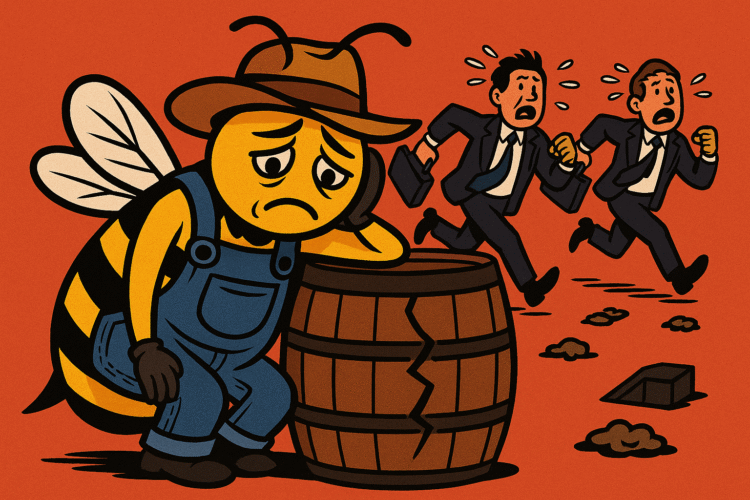
There are breakups that shake families. There are divorces that fracture communities. And then there’s Cracker Barrel firing Uncle Herschel from its logo, which—according to Wall Street—destroyed nearly $200 million in value before the breakfast crowd even finished their biscuits.
On August 21, Cracker Barrel’s stock tanked 7.2%, closing at $54.80 and wiping out about $94 million in market cap, with intraday lows slicing nearly $200 million from the ledger. The trigger wasn’t bankruptcy or food poisoning litigation. It wasn’t even a new cholesterol study. It was a logo. Specifically, a logo that no longer features a man in overalls leaning against a barrel.
Meet the most expensive rebrand in corporate history: The Disappearance of Uncle Herschel.
Uncle Herschel’s Disappearance Act
For 55 years, Cracker Barrel has served pancakes, fried okra, and racial nostalgia under the watchful gaze of a man in overalls propped lazily against a barrel. Internally, they called him Uncle Herschel. Externally, he was shorthand for “this restaurant serves comfort food and Confederate fantasy in equal parts.”
But this August, CEO Julie Felss Masino—whose tenure has been about “refresh”—announced that Herschel is retiring from the logo. He’ll still be “front and center” in stores, menus, and marketing. Just not the corporate face. In his place? A cleaner wordmark, rooted in the barrel itself. Marketing pros called it “generic.” Culture warriors called it “woke.” Investors called it “expensive.”
Wall Street’s collective shriek: how dare you tamper with a brand icon recognizable to both NASCAR dads and road-tripping vegans alike? Removing Herschel from the logo is like Chick-fil-A removing the cow, or Olive Garden ditching the endless breadsticks. It’s messing with the mythos.
Nostalgia as Capital
The stock didn’t plunge because fonts have intrinsic economic power. It plunged because Uncle Herschel isn’t just clip art. He’s symbolic equity. He’s every road trip exit. Every “Country Boy Breakfast.” Every gift shop rocking chair. Every gift-wrapped jar of apple butter purchased in shame. Herschel was stability—one of the last surviving cultural relics where overalls weren’t ironic and barrels weren’t ironic either.
Now? Now the brand looks like a regional insurance company. Investors know one truth: nobody pays $15 for pancakes unless they feel vaguely soothed by a folksy mascot in denim.
Julie Felss Masino vs. The Barrel
Masino framed this as modernization. She’s been updating menus, décor, and strategy. Which makes sense—restaurants that smell like mothballs are not the path to Gen Z loyalty. But modernization is delicate. You can offer oat milk; you cannot kill Uncle Herschel.
It’s the paradox of legacy branding: evolve and you’re accused of betrayal. Stand still and you’re accused of decay. Cracker Barrel is trying to do both—freshen the face while insisting the soul is intact. Herschel may be off the letterhead, but he’ll still watch you from the fireplace mantle, reminding you to buy another tchotchke at checkout.
This is corporate necromancy: kill the man, keep the ghost.
Right-Wing Backlash: Herschel as Martyr
Predictably, the culture war machine spun up faster than a biscuit cutter. Commentators fumed that removing Herschel was yet another example of “erasing tradition.” Never mind that Herschel is not a founding father or even a real person; he is, apparently, the Rosa Parks of country breakfast logos.
Fox affiliates ran montages of the “classic Herschel.” X users declared “Boycott the Barrel.” A few posted edits of Herschel weeping in overalls, whispering “They took my barrel.” Because in 2025, every rebrand is a culture war and every corporate logo is a referendum on national identity.
Wall Street’s Weirdness
Here’s the weird part: logos don’t usually move stock like this. A font change doesn’t erase $94 million in a morning. But Cracker Barrel’s plunge was real. Investors saw the logo as a proxy for management’s judgment. If the new look says “generic mid-market diner,” then maybe leadership doesn’t understand the core product at all.
Think about it: Herschel was Southern kitsch personified. Removing him risks repositioning the chain as “Applebee’s with rocking chairs.” If Herschel was a guardian of identity, then his deletion signals identity drift—and identity drift is the most unforgivable crime on Wall Street, which prizes predictable sameness above all.
The Logo Economy: Fonts as Futures
This moment exposes the absurdity of capitalism’s fetish for logos. Wall Street invests not in food quality, not in supply chains, but in vibes. The vibe Herschel radiated was stability. Remove him, and suddenly the sausage gravy looks thinner.
Rebrands fail when they misunderstand that logos are talismans. Herschel wasn’t aesthetic; he was ritual. Shareholders lost $94 million not because the eggs got worse, but because the faith cracked.
The Ghost of Herschel Will Haunt
Masino promises Herschel isn’t gone. He’ll still appear on menus and in-store visuals. Which is somehow worse. He becomes ghostly, haunting the physical restaurant while being exorcised from the corporate crest. Herschel is Schrodinger’s farmer: dead in the logo, alive in the gift shop.
This liminal status pleases no one. The right sees betrayal. Marketing experts see cowardice. Customers see confusion. Wall Street sees decline. Herschel, meanwhile, stares blankly into the middle distance, whispering, “This isn’t what the barrel promised.”
The Cultural Punchline
In truth, Herschel’s exit is small potatoes. Restaurants rise and fall not by logos but by rent, wages, food costs, and trends. But in America, optics are economics. The logo is the soul. Herschel was never about design. He was about trust. Trust that when you pull off the highway and enter a Cracker Barrel, you are stepping into a time warp where chicken-fried steak is forever and Uncle Herschel waits patiently by the barrel to welcome you.
Now? Now the time warp feels broken.
Satirical Sting
What we’ve learned is this: America is so fragile that the removal of a cartoon farmer can erase $200 million in a morning. Cracker Barrel wanted to look modern. Instead, it looked lost. Herschel’s ghost hovers over the wreckage, watching as investors flee and culture warriors sharpen hashtags.
In the end, Herschel wasn’t a man. He was a promise. And when that promise was cropped out of the logo, so was $94 million in market value.
Closing Observation
Every empire has its collapse moment. Rome had lead pipes. France had bread shortages. Cracker Barrel had a logo refresh. Uncle Herschel leaning on his barrel was the last myth binding Wall Street, diners, and culture warriors together. Now he’s gone, replaced by a sanitized barrel and sans-serif text.
America isn’t falling apart because of climate or war. It’s falling apart because even the barrel is empty.