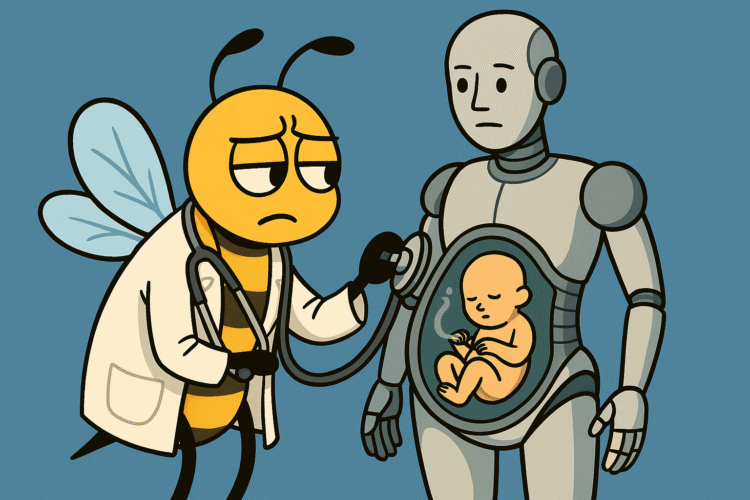
Imagine a world where babies aren’t born from mothers but delivered by robots—in a literal tin womb. Welcome to 2026, Chinese-style, where scientists at Kaiwa Technology promise to debut the world’s first humanoid “pregnancy robot,” complete with an artificial womb embedded in its abdomen. It’s billed as a technological marvel for struggling parents—but if that isn’t enough to set your moral compass spinning, wait till you taste the dystopia on the menu.
At the 2025 World Robot Conference in Beijing, Dr. Zhang Qifeng dropped this drop-the-mic announcement: a robot designed to carry a fetus for an entire 10-month term, with synthetic amniotic fluid, nutrient tubes, and—spoiler alert—a price tag of under $14,000. That’s about five times less than U.S. surrogacy costs. It’s a bargain if you’re outrunning regulations, crocodile tears, or the patient whispers of a late-term cervix. The Times of India+9The Economic Times+9The Economic Times+9www.ndtv.com+9Interesting Engineering+9New York Post+9
Let’s unpack this mechanical miracle with the kind of politically precise sarcasm it deserves.
The Genesis of the Bot That Birthed a Storm
Look, artificial wombs aren’t entirely science fiction. Labs have kept premature lambs alive in “biobags” since 2017, giving them wool instead of tears. But that was pre-term; now imagine stretching that to all of gestation, but replace the ewe with a steel-and-silicone shell. The Economic Times+6Wikipedia+6The Economic Times+6
Dr. Zhang’s team assures us the science is “mature.” They’ve cleared the lab stage and are now sewing the womb into a humanoid body. Which means a prototype may arrive in 2026—right around the corner from our worst nightmares. Motherly+6The Economic Times+6India Today+6
For Infertile Couples? Or for the Industrialization of Birth?
Advertised as a tool for infertile couples, the robot carries a pitch that echoes “women’s liberation.” But if “liberation” means replacing a living, breathing gestational ecosystem with wires and Randian ideology, count me out.
Yes, it reduces the burden of pregnancy. But it also reduces pregnancy to a market commodity. There’s zero mention of consent, ethics, or what canned maternal instincts taste like once bottled. The Economic TimesMotherly
The Quiet Part We’re Screaming: What Are We Actually Doing?
Here’s where satire meets dismay: on social media, some folks cheer that women “no longer have to suffer.” But a few honest whispers worry about what it means to eradicate the physical, emotional, and hormonal intimacy of pregnancy.
Do we want humanity’s future to be born from empathy or from surgical tubing and industrial cycles? It’s a rhetorical question until your womb is generating quarterly profit margins.Motherly+2The Economic Times+2
The Legal and Ethical Brambles
Of course, Dr. Zhang’s team isn’t barreling into this alone—they’re in “ethical and policy” talks with Guangdong authorities. Because nothing says precaution like launching robot pregnancies and, then deciding how to regulate them. The Times of India+6India Today+6www.ndtv.com+6
They’ve got a list of questions: Who’s the parent? How do you bond with a robot-born baby? Where’s the womb going to black-market false uteruses for richer couples? Should the robots get parental leave? The questions are endless.
Welcome to Trump’s America—But Make It Chinese Robotics
If this doesn’t feel like an expansion of a regime that already commodifies bodies and reproduction, wait till the PR drones spin this as feminist. Let’s not forget that in Trump’s America, misogyny became policy, abortions became battlegrounds, and patriarchy got a self-checkout line. Here comes China, offering mechanical motherhood to the masses, and proudly.
Replace “women” with “labor units,” “gestation” with “Gantt chart,” and you’ve got the flavor: robot pregnancy as reproductive capitalism.
Why This Hits Close to Home
The root isn’t fertility or innovation—it’s estrangement. Once pregnancy happens in wires, who’s left to feel it? If your child came from a robot, does the phrase “you are part of me” lose meaning? If every scar, every hormone surge, every midnight vomiting is replaced by sterile tech, who are we?
The robot births babies without mothers. That’s a headline drenched in existential dread.WikipediaThe Economic Times
From Philosophy to Post-Roe Echoes
Ectogenesis—the concept of forward-gestation outside the body—is an idea born in 1924. Its revival now could be a slippery track toward rewriting abortion law, birthing rights, and gender politics. Disconnected birth might mean disconnected human rights.Wikipedia
Feminist Shulamith Firestone argued exactly this: artificial wombs could free women from reproduction, but they could also be surveillance devices. We’re now auditing what that freedom costs.The Economic Times+3Wikipedia+3The Economic Times+3
Only Satire Can Keep the Tears at Bay
If we can’t laugh at a dystopia where babies come from bots, what can we laugh at? The robot delivering the baby is the irony’s mascot—ready to answer your IVF hummus tab and substitute your hormonal breakdown with an Ethernet port.
Human wombs bleed. Robot wombs don’t. And when society opts for the latter, the only thing bleeding is our humanity.
Final Thought: The Womb, The Robot, The Unwritten Code
So let’s sum it up: China plans a robot-womb hybrid that literally gestates life by 2026. It costs less than a surrogacy ring, but costs more than our moral clarity. It promises science fiction… and delivers a hint that the future of birth is about to be dehumanized in epic, mechanized fashion.
If we don’t interrogate it, witness it, and satirize it, what’s next? Babies delivered by drones? Full-term artificial womb factories in prisons? Maybe the return of Victorian white gloves—worn not for mothers, but for disembodied gestation tanks?
We deserve a world where liberation includes flesh, not just wires. Where motherhood isn’t optional—but neither are human roots. And where the future of birth belongs to humanity… not just to the engineers who tinker with it.