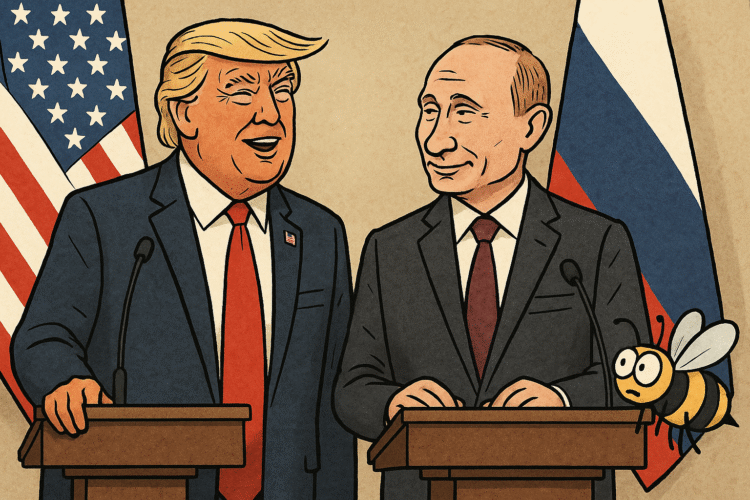
The American presidency has always been a stage play. Sometimes it’s Shakespearean tragedy, sometimes slapstick comedy, and sometimes—like this week’s Trump-Putin summit—it’s improv theater gone wrong, starring two men who mistake ominous foreshadowing for witty banter.
They met. They smiled. They congratulated themselves. And then, in classic political anti-climax, they announced to the world that… absolutely nothing had happened. No ceasefire. No framework. No actual deal. Just vague “progress” and a throwaway line from Trump: “Next time in Moscow.”
The sentence landed with all the grace of a drunk uncle promising to “make things happen” after his fifth whiskey. The crowd laughed nervously. MSNBC clipped it for TikTok. And the rest of us remembered that the American president has an oddly romantic way of talking about dictators—like a man rehearsing his vows to the wrong groom.
The Art of No Deal
Trump framed the talks as “very productive.” That phrase is Washington-speak for “we talked about lunch for three hours and decided not to order.” Putin echoed the sentiment, managing to sound both menacing and bored, the way only an ex-KGB officer can. The message: there may be “progress,” but don’t get in the way, Europe. Translation: keep quiet while Dad and Stepdad negotiate who gets custody of the living room.
Meanwhile, Zelenskyy—whose country is the actual battleground—wasn’t even in the room. Trump made a point to clarify he wasn’t negotiating on Kyiv’s behalf, which is diplomatic code for: I’m just here to try on the crown, not to wear it.
What we witnessed wasn’t statesmanship. It was two men playing poker with someone else’s chips, congratulating themselves for not flipping the table.
Optics Over Outcomes
The event was designed for optics, not substance. No questions were taken from the press. No specifics were shared. It was political dinner theater where the menu said “Peace Agreement” but the waiter delivered a plate of air garnished with parsley.
And then came the real soundbite: “Next time in Moscow.” That wasn’t just a line—it was a Hallmark card from one strongman-in-waiting to another. Imagine the applause in the Kremlin, the fireworks in Russian state media, the goosebumps of every NATO diplomat trying to hold down their lunch.
It’s not that Trump wants to be Putin’s equal. It’s that he wants to be Putin’s understudy, the one practicing monologues in the mirror: Tough. Smart. In power for decades. Audience on their knees. Bravo.
The Bromance of Despots
Let’s be honest: Trump doesn’t admire dictators despite their despotism. He admires them because of it. When he praises Aliyev for 22 years in power, he’s not horrified by the authoritarianism; he’s taking notes like a teenager at a Taylor Swift concert.
To Trump, “dictator” isn’t an insult. It’s a résumé builder. Why win elections when you can just delete them? Why share power when you can hoard it? Why answer questions when you can declare that the questions don’t exist?
Putin knows this. That’s why he leans back during these meetings, playing the part of the experienced husband watching his eager apprentice fumble with the car keys.
Europe’s Eyebrow Problem
Putin’s warning to Europe not to “obstruct” outcomes was less a statement and more a mafia whisper. Translation: stay in your lane, don’t meddle, and maybe you’ll get to keep your energy contracts. Western allies raised eyebrows, which is the diplomatic equivalent of screaming into a pillow.
The EU, of course, is stuck in the eternal purgatory of watching America flirt with authoritarianism while also begging for NATO commitments. They know Trump’s definition of “progress” is “Putin didn’t annex another country during the meeting.” That bar is lower than the one at your cousin’s wedding.
What It Really Means
This summit revealed nothing new, except that the American presidency has become a reality show crossover event: The Apprentice: Despot Edition. Trump gets the optics of global relevance, Putin gets the optics of legitimacy, and the rest of us get indigestion.
The tragedy isn’t that nothing was achieved. It’s that nothing was supposed to be achieved. The goal was spectacle, and in that sense, the mission was wildly successful. Two men stood behind a podium, congratulated themselves, and left the world to imagine what “understandings” had been exchanged in private.
Was there an actual plan? No. Was there an actual deal? No. Was there an actual agenda? No. But was there a bromide-soaked soundbite tailor-made for campaign ads, state propaganda reels, and Twitter meltdowns? Absolutely.
“Next time in Moscow.”
It’s less a diplomatic statement than a campaign slogan. A promise that the next episode of this tragicomedy will be set in Red Square, complete with military parades, synchronized applause, and Trump practicing Cyrillic with flashcards.
Closing Stinger
The American dream used to be about freedom, democracy, and self-determination. Now it’s about whether two aging strongmen can cosplay geopolitics while the real war grinds on. If there was ever proof that the circus has replaced the Senate, it’s this summit.
The world doesn’t need another season of Despot Idol. What it needs is leadership that sees peace as more than a photo op and democracy as more than an inconvenience. Until then, we’ll keep tuning in—not because we trust the performance, but because the stage lights are so damn bright.
And when the curtain falls, we’ll remember the only real line from the whole act:
“Next time in Moscow.”
Because nothing says “America First” like promising to make Moscow great again.