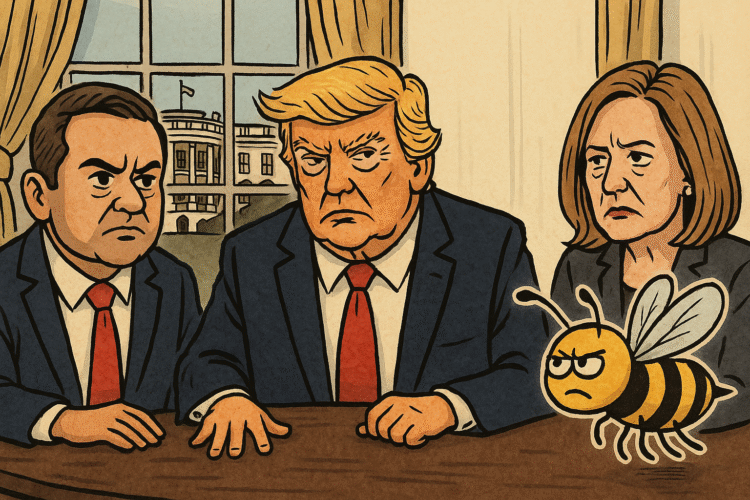
Washington has seen its share of “nothing to see here” moments, but this week’s gathering in the West Wing might be the new gold standard. Picture it: Vice President J.D. Vance, former Florida Attorney General Pam Bondi, and loyalist-turned-FBI-director Kash Patel huddled together under the genteel glow of White House sconces, plotting a strategy to contain Donald Trump’s Jeffrey Epstein problem.
They could have chosen a nondescript hotel conference room, a back booth at Old Ebbitt Grill, or even the obligatory undisclosed location. But why bother with subtlety when you can hold the meeting where the nuclear codes live?
A Meeting That Never Happened… Until It Did
Officially, it didn’t happen. That’s the kind of magic trick this administration excels at—vanishing events while they’re still in progress. There’s no easier way to erase reality than to have three high-profile officials swear nothing occurred, then return to their offices smelling faintly of the same coffee and moral corrosion.
Jen Psaki, ever the calm archivist of chaos, confirmed that yes, the meeting took place—proving once again that denials in this administration work like a coupon code that’s already expired.
The Guest List Reads Like an Impeachment Mad Lib
J.D. Vance: The freshly minted VP whose political instincts are so raw you can still hear them mooing.
Pam Bondi: The Floridian legal bulldog who never met a conflict of interest she couldn’t French kiss.
Kash Patel: The FBI director whose tenure has redefined “impartial” as “serving at the pleasure of a man who live-tweets grand jury testimony.”
And the agenda? Simple: turn an Epstein scandal into a story about something—anything—else before the Sunday shows.
Principles Are for Other People
In any other era, the combination of an active DOJ matter, executive branch meddling, and personal legal stakes would cause staff attorneys to faint like Southern belles in July. But in this West Wing, the absence of principles is a feature, not a bug. Without them, there’s no pesky separation of powers to slow down the spin cycle.
Here, the Justice Department isn’t an independent institution—it’s a subsidiary. And the subsidiary’s new motto? Justice: Now Available in Political Cherry and Vanilla Fudge.
Damage Control as Performance Art
From leaked outlines, the meeting played more like a writers’ room for an off-brand Netflix political thriller:
- Scene 1: “What if we call it Fake News but in Latin?”
- Scene 2: “Can we retroactively claim he was doing charity work on the island?”
- Scene 3: “What’s the statute of limitations on friendship?”
The creative tension was electric—equal parts panic, opportunism, and the faint rustle of non-disclosure agreements being prepared.
Why Bother Hiding It?
Once upon a time, political operatives knew how to work in the shadows. But in an administration where discretion is seen as weakness, the point isn’t to hide the scandal—it’s to dare you to call it what it is. A little flex for the base, a reminder that they can do whatever they want and still make the six o’clock news for an entirely different reason.
Because if you say the meeting’s about “judicial priorities,” half the country will nod along, and the other half will be too busy rage-scrolling to stop it.
Final Thought:
In D.C., meetings like this aren’t about truth—they’re about narrative. And when you have enough power, narrative isn’t what happened. Narrative is whatever you say while the cameras are rolling. Somewhere between the coffee service and the exit door, the Epstein scandal was no longer about Epstein at all—it was just another loyalty test, and everyone in the room passed.