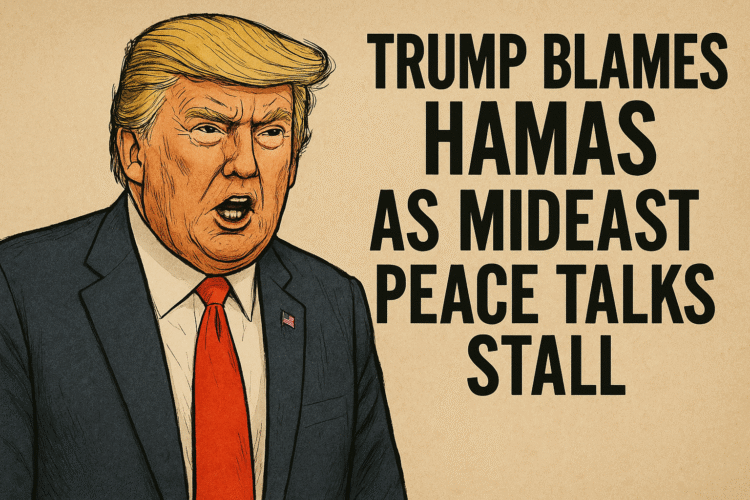
In what political historians will one day refer to as either a diplomatic low point or Tuesday, President Donald J. Trump announced that Hamas is to blame for the breakdown of ceasefire negotiations in Gaza, citing their “lack of seriousness” and “terrible negotiation posture”—two critiques he’s famously allergic to applying domestically.
With peace talks collapsing faster than one of his casinos, the administration promptly recalled its negotiation team from Doha last week, citing “non-constructive replies” and the general vibe of being ghosted by a warlord.
Trump, naturally, took to the microphone with all the solemnity of a man reviewing appetizers. “We had a great deal. Tremendous deal. All Hamas had to do was be reasonable, return the hostages, stop the violence, and accept my conditions unconditionally. But they didn’t. Sad!”
And just like that, the United States—once considered a neutral-ish peace broker—has repositioned itself as that guy in a bar fight who shows up late, punches someone’s drink, and then demands credit for attempting de-escalation.
Let’s be clear: Trump blaming Hamas for the collapse of peace talks is like blaming the hurricane for not shaking hands with the insurance adjuster. Hamas is, functionally, a militant organization with no incentive structure for polite diplomacy—and yet Trump seems stunned they didn’t respond to his PowerPoint proposal with a fruit basket and a tearful thank-you note.
Reports from inside the White House suggest Trump believed his personal charisma would “shift the tone.” He reportedly sent over a team of negotiators, a three-page draft ceasefire agreement, and a Sharpie-altered map of Gaza that he drew himself while waiting for his Diet Coke refill.
One unnamed official admitted that the entire deal hinged on Hamas agreeing to a prisoner exchange, permanent ceasefire, and the ceremonial renaming of Gaza’s central square to “Trump Peace Plaza.” When asked if this was realistic, the source simply sighed and said, “He thought it worked with Kim Jong-un.”
To be fair, Hamas did respond—to say they found the terms vague, coercive, and constructed primarily for American optics. This, in diplomatic terms, is what’s known as “a pretty accurate summary.”
So the administration did what it does best: pulled out entirely, blamed the brown people, and declared moral victory. Secretary of State-by-default Jared Kushner released a short statement expressing “profound disappointment,” while adjusting his cufflinks and quietly googling how far Gaza is from Mar-a-Lago.
Meanwhile, back in D.C., the president told reporters, “If they really wanted peace, they’d act like it. They’d listen. They’d negotiate properly. Like I do—with strength, with clarity, with the full knowledge that I’m always right.”
This is rich coming from a man whose conflict resolution strategy includes threatening NATO allies on Twitter and calling war criminals “my kind of guy.”
What’s truly stunning, though, is how every time diplomacy fails, Trump acts like the other side just doesn’t get him. As if geopolitics is an episode of The Apprentice, and Hamas failed the branding challenge.
In fact, sources say Trump was so incensed by the stalled talks that he nearly canceled his appearance at the Middle East Peace and Pancake Breakfast hosted by Mike Lindell and the ghost of Henry Kissinger.
Final Thought:
When your diplomacy handbook is just a crumpled printout of your own press releases, peace was never the goal—performance was. And blaming Hamas for not taking Trump seriously is like blaming the moon for not returning your texts. At some point, you have to ask yourself: was the peace plan ever real, or was it just another rally speech with a ceasefire emoji stapled to it?