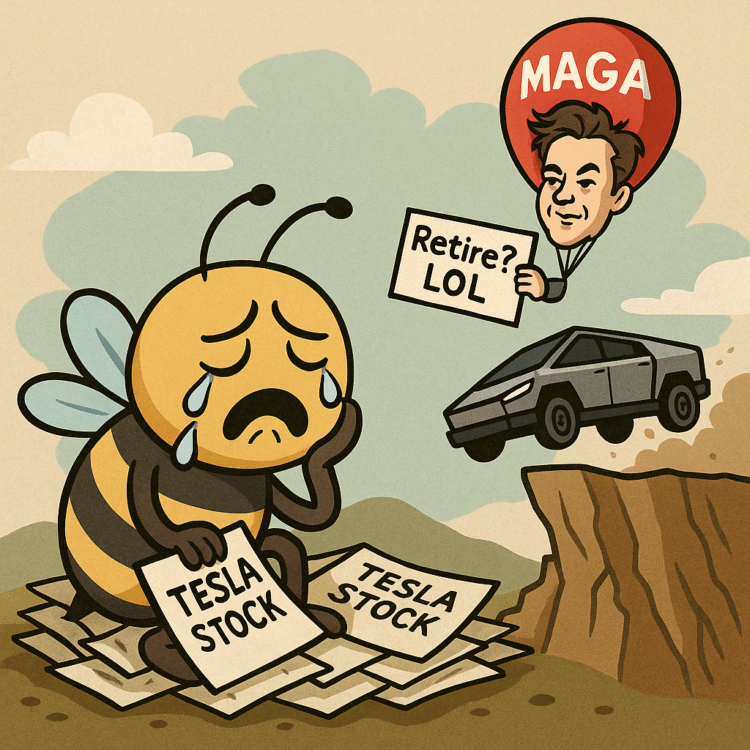
Let’s be clear: I didn’t invest in Tesla because I thought Elon Musk was a genius. I invested because I thought he was shameless.
Here was a man who could sit in a press conference sounding like a malfunctioning TED Talk chatbot, then turn around and wink at Trump and watch the stock price soar. I didn’t see innovation—I saw influence. Not a futurist, but a future opportunist.
And so, like a fool with Wi-Fi and a gut full of cynicism, I moved a not-small portion of my retirement into Tesla stock. Because while I didn’t trust Elon Musk to deliver affordable robotaxis or solve climate change, I absolutely trusted him to work every backchannel in Mar-a-Lago like a fundraising telethon.
I was betting on the grift. And somehow, he still fumbled the bag.
The Numbers Don’t Lie (But Elon Does Sometimes)
Tesla just posted its second straight quarter of falling revenue and profits. That’s Wall Street-speak for: “Oops.” Demand is down. Profit margins are slipping. Shareholders are skittish. And the Cybertruck still looks like a toaster with PTSD.
At the last earnings call, Elon tried to sound upbeat, but the vibe was less “Silicon Valley visionary” and more “mall kiosk manager explaining why the massage chair store is losing money.”
There was talk of “long-term strategy,” “macro pressures,” and other phrases you say when you’ve got no short-term wins and your fanbase is busy rage-tweeting at the Department of Energy.
My Investment Thesis: Bad, but Not Wrong
Here was my logic: Elon doesn’t need to innovate. He just needs to play nice with whoever’s holding the nuclear codes. Trump likes chaos, Elon is chaos with a VPN—that’s synergy, baby.
And sure enough, Elon did his part: he laughed at the right memes, nodded at the right dog whistles, and promised things like “free speech” and “neural equality,” which don’t mean anything but sound incredible on conservative talk radio.
For a while, it worked. The stock soared. I felt smug. I was this close to learning what an index fund actually does.
But then reality hit. The grift stopped grifting. Trump got indicted. Elon started livestreaming himself playing Diablo IV. The self-driving demo turned into a liability lawsuit. And suddenly, the man who could charm a MAGA rally and a VC pitch deck in the same day couldn’t even keep Model Y delivery numbers up.
Elon’s Pivot: From Trump Whisperer to Thread Poster
At some point, Musk went from cozying up to power to cosplaying as it. He bought Twitter—sorry, “X”—and immediately transformed it into a digital Mad Max trailer park. He made memes his business strategy. He started beef with the ADL. He began quoting war crime philosophers like it was a Reddit AMA.
Meanwhile, Tesla—the thing that was supposed to be “the future”—got buried under recalls, supply chain issues, and whatever “cybernetic humanoid assistant” he’s pretending is one intern in a wetsuit.
Where’s My Money, Elon?
I don’t need a Mars colony. I don’t need robot butlers or brain chips or flamethrowers that double as political statements.
I just wanted a stock that moved up and to the right every time Elon did his best “I’m totally not a Republican, but…” dance. I was playing the game behind the game.
But now?
My retirement plan is a part-time job and a hope that Social Security survives the next presidential debate.
Final Thought from the Ashes of My IRA
I didn’t believe in Elon Musk the man. I believed in Elon Musk the market manipulator. The strategist. The political chameleon who could wink at Tucker Carlson while collecting carbon credits from the Biden administration.
And somehow, he let me down.
I gambled on the grift. But the grift, it seems, had other priorities. Like naming his kid after a CAPTCHA and streaming himself zoning out mid-sentence on an earnings call.
So here I am, clutching the charred remnants of my Tesla portfolio and whispering the only three words I have left:
“Sad face emoji.”