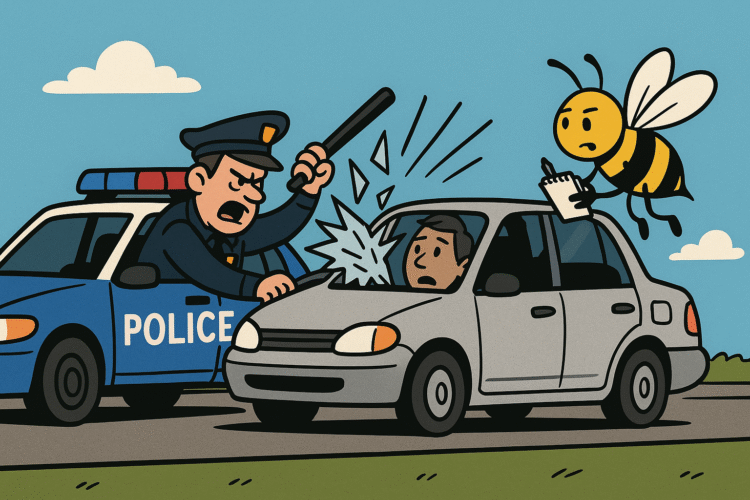
Some people get pulled over and drive away with a warning. Others ask, “Why do I need my headlights on in daylight?” and end up with a shattered window and a fist in the face.
In Jacksonville, Florida—where the humidity is thick and the patience for questions is thin—22-year-old William McNeil Jr. learned the hard way that “routine traffic stop” is often just a polite synonym for “constitutional grey area.”
His crime? Allegedly not wearing a seatbelt and failing to turn on his headlights in a light drizzle. His mistake? Asking why. And in America, asking why is dangerously close to resisting.
The Bodycam That Launched a Thousand Podcasts
The encounter escalated from “license and registration” to “open your door or we’ll break it” in under two minutes. McNeil, calm and seated, requested a supervisor. The officers, displaying all the patience of a dad trying to assemble IKEA furniture with a hangover, responded with a window punch, a face punch, and a dragging that would make a nightclub bouncer blush.
One officer claimed McNeil reached for a knife. The bodycam footage shows him reaching for the nearest synonym of “not today.” Hands up. Words clear. Demeanor calm. All of which were met with the kind of tactical response typically reserved for hostage situations—or, apparently, confused young Black men asking follow-up questions.
The Aftermath: What’s a Little Blood Between Civilians and the State?
McNeil walked away from the encounter with a chipped tooth, a concussion, and the distinct sense that things might’ve gone differently if he were, say, not Black, not calm, and not asking questions.
The sheriff’s office insists people shouldn’t “rush to judgment.” Because nothing says transparency like immediately blaming the victim and promising internal reviews with the urgency of a DMV line.
McNeil’s attorney, on the other hand, is suing the department, calling the use of force “unprovoked and excessive.” In response, the department is reviewing the footage and considering a six-week vacation for the officer. Or maybe a new desk chair. Accountability is fluid these days.
Meanwhile, On The Internet…
The video has been viewed millions of times. TikTok detectives have slowed it down frame-by-frame. Podcasters are mid-season deep-dive. Subreddits have already reached consensus and full emotional burnout. Somewhere, a minor celebrity is preparing a heartfelt Instagram caption with their favorite quote about justice and exactly one candle emoji.
And in a few weeks, it will all fade—pushed down the feed by the next shocking clip, the next preventable horror, the next viral injustice served with two sides of algorithm.
American Justice, Now Available in HD
The truth is, this wasn’t about a seatbelt or headlights. It was about control. The idea that calm defiance, polite questioning, or simply existing too confidently in your own skin can be perceived as provocation.
Because when law enforcement operates with impunity, silence isn’t safety—it’s strategy.
And when someone speaks—however softly, however calmly—they get told, not shown, how little their words weigh against a badge.
Closing Argument (with a Stinger)
In a better country, McNeil would be giving a TED Talk on civic engagement. Instead, he’s recovering from a concussion and navigating trauma, while the officers involved are being “administratively reviewed,” which is legalese for “we’re hoping this blows over.”
So here we are. Another young man bloodied. Another city in damage control. Another moment of clarity flattened by the sound of glass breaking and fists flying.
And all of it, over headlights.