This week, reality got redacted, deepfaked, and re-released as a partisan reboot.
Newly declassified documents—courtesy of Director of National Intelligence Tulsi Gabbard, who has apparently pivoted from anti-war progressive to cosplay intelligence officer—suggest that elements of the Obama administration allegedly ‘manufactured’ intelligence to justify the Trump-Russia probe in 2016. The documents are already being hailed by the far right as the “smoking gun,” though they read less like a gun and more like a smudged Post-it taped to a fever dream.
Naturally, Donald Trump did what any man of dignity would do in response:
He posted AI-generated arrest photos of Barack Obama.
That’s right. In this economy, we’re outsourcing revenge fantasies to Midjourney.
The images feature the former president being handcuffed, frog-marched, and solemnly gazing into the middle distance like a GQ model moments before arraignment. One image shows Obama flanked by Secret Service agents looking suspiciously like extras from a Hallmark movie. Another depicts him in a jail cell, lit like a Renaissance painting, complete with shadows of betrayal and righteousness playing across his cheekbones.
Trump’s caption?
“NOW DO OBAMA. #TREASON.”
Because nothing says “truth” like sharing CGI of your predecessor in cuffs while yelling “justice!” into a ring light.
To be fair, this is not Trump’s first foray into art direction. His original AI arrest imagery—of himself—set the tone: orange jumpsuits, windswept mugshots, all the gravitas of a true crime Netflix doc trailer. But this time, he’s upgraded. We’re no longer watching Trump’s persecution complex in the mirror. We’re watching his revenge fantasy come to life, one render at a time.
In some circles, these images are being treated as proof—not of guilt, but of narrative dominance. Forget due process. Forget evidence. The future of politics is vibes and visuals, and Trump is determined to own both.
Because here’s the thing: when declassified intelligence documents drop and your first move is to AI-generate Obama in jail, you’re not engaging in a debate. You’re producing a season finale.
And while the newly released documents do raise questions—about the origin of the Russia investigation, about intelligence politicization, and yes, about the tangled mess of 2016—they also don’t include anything remotely close to a warrant, charge, or even actionable memo suggesting Obama personally planted evidence. But in MAGAland, “Tulsi declassified something” is now sufficient grounds for a digital execution.
In other news, Barack Obama is still golfing, still not arrested, and still aging like the protagonist of an Oscar-winning biopic. But sure—let’s make him the villain of your AI short film.
Let’s be clear: we are witnessing the Photoshopification of political consequence. AI doesn’t just generate images—it generates mythologies. Trump isn’t just spreading misinformation. He’s producing propaganda renderings for a base that prefers moral clarity to legal nuance.
It’s not “innocent until proven guilty.” It’s “rendered until retweeted.”
And Tulsi Gabbard—whose entire political career could now be subtitled From Anti-Establishment to Algorithmic Exceptionalist—has become the latest weapon in this theater of performative vindication. Her declassified revelations are already being repackaged as proof of a deep state conspiracy, despite the fine print reading more like “internal concern about sourcing procedures” than “Obama orchestrated a coup from a lava lamp.”
Still, in the court of public delusion, the burden of proof is as light as a Stable Diffusion prompt. And Trump, ever the showman, knows exactly how to dress his paranoia in pixels.
So what now?
- The left points out the AI images are fake.
- The right says, “So were the Steele Dossier claims.”
- Independents scroll past and wonder when The Bear comes back.
Truth, meanwhile, sits in a storage unit somewhere, wedged between a subpoena and a ring light, quietly wondering if anyone will notice it hasn’t been invited to the narrative.
Because the new political process isn’t litigation. It’s aesthetics.
Not due process, but drip process.
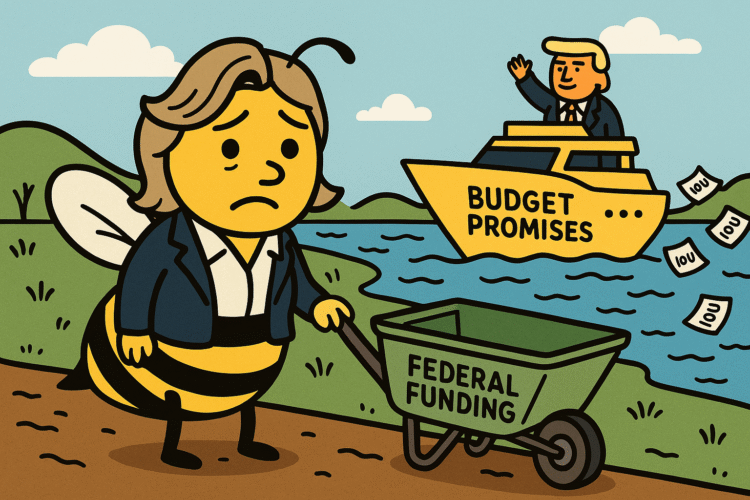
And somewhere, a cartoon bee in a trench coat is watching all of this unfold, sipping stale lobby coffee, and muttering:
“Of course that’s what they did. What could possibly go wrong?”