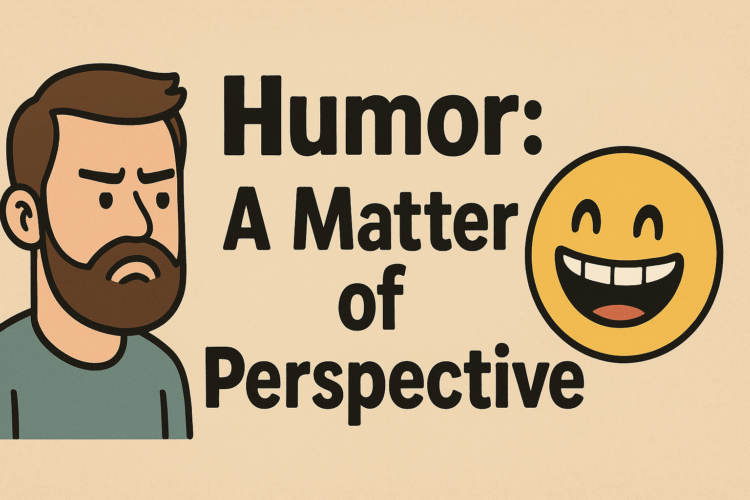
Comedy is subjective. That’s the politically correct way of saying, “I laughed, you were offended, and now we’re both awkwardly sipping iced coffee like nothing happened.” What one person sees as brilliant satire, another calls childish, tasteless, or “the reason society is collapsing.” And sometimes, all of those are true—at the same time.
You can think of humor like cologne: everyone wears something, most of it’s awful, and if you apply too much, someone’s going to cry in an elevator. Some people want a dry, cerebral wit that sparkles with irony and restraint. Others want a man to trip over a goat while yelling “yeehaw!” in a pirate costume. Guess what? Both are valid. And also slightly terrifying.
I grew up laughing at things I probably shouldn’t have. The awkward pauses in church sermons. The way people say “moist.” Anything involving the word “butt.” And yet, I’ve also howled at complex, layered satire that skewers systems of oppression with surgical precision. Sometimes I laugh because something is clever. Other times I laugh because a bird pooped on a senator. Humor doesn’t ask for credentials. It just hits—or it doesn’t.
The problem is that we’ve collectively forgotten that not everything is for everyone. There’s a difference between “that’s not funny to me” and “that shouldn’t exist.” But thanks to algorithms and egos, we now treat comedy like a political platform. A joke isn’t just a joke—it’s a referendum on your morality, intelligence, and whether or not you’re allowed to be seen in public without a helmet.
One man’s satire is another man’s cancellation threat. You say “absurdist commentary,” I say “why are the Muppets twerking?” You say “biting critique of capitalism,” I say “why is this clown yelling about NFTs at my family BBQ?” We’re not watching different shows. We’re just watching the same show on wildly different frequencies.
There are people who think The Office is the pinnacle of comedy. There are also people who think The Office is the emotional equivalent of eating drywall. Some folks cry laughing at puns, while others hear one and consider calling the FBI. I once made a joke about ghosting being the modern version of the Irish Goodbye and someone responded with a 500-word comment explaining the political unrest of 1921. That’s the internet. That’s comedy. That’s life.
People often confuse tone with intent. Just because a joke is dry doesn’t mean it’s deep. Just because it’s loud doesn’t mean it’s dumb. A fart joke can be layered. A satirical takedown can be annoying. It’s not about what you say—it’s about whether someone’s brain lights up in the same strange spot yours does. Spoiler: most don’t.
We spend so much time deciding what counts as “good” humor. But who decides that? The same guy who thought The Emoji Movie was worth $50 million? The person who retweets minions in sombreros with “wine o’clock” captions? People laugh at Big Bang Theory. People laugh at Bo Burnham. People laugh when someone drops a taco in the shower. None of them are wrong. Some of them are just your uncle.
And then there’s offensive humor—the nuclear weapon of the comedy discourse. Some jokes punch up. Some jokes punch down. Some jokes punch themselves in the face and fall off a stage. I’m not here to say all comedy should be defended, but I am saying your trauma doesn’t come with universal veto power over someone else’s punchline. If we canceled every comic because their jokes didn’t land for everyone, we’d be left with silence—and maybe an interpretive dance about taxes.
The reality is: comedy is how many of us survive. It’s how we talk about grief without sobbing into a gas station croissant. It’s how we process bigotry, betrayal, burnout, and brain fog. It’s how we scream in lowercase. Not every joke has to be groundbreaking. Sometimes it just has to be there.
I’ve written things people said were “too dark,” “too mean,” or “not funny at all.” Sometimes they were right. Sometimes they just didn’t get it. But that’s the risk of being funny—you’re always balancing on a line that only half the audience agrees even exists. You can’t write a joke that’s universally funny. You can’t even write a joke that’s funny to yourself on two different days. Ask me what I laughed at yesterday, and I’ll say “a TikTok of a duck throwing bread at a child.” Ask me again tomorrow, and it’ll be “an article about Mark Zuckerberg trying to explain the metaverse with dead eyes.”
People often say, “You can’t joke about that,” whatever “that” is. But usually, you can. You just can’t joke about it poorly. The difference between a comedian and a sociopath is delivery. The difference between satire and slander is self-awareness. If your joke has the comedic energy of a tax audit, maybe the problem isn’t the audience. Maybe you’re just… not funny. And that’s okay. We can’t all be hilarious. Some of us have to be insurance adjusters.
At the end of the day, not everyone will laugh at your joke. Some people won’t even smile. Some will squint at you like you’re explaining TikTok to their cat. But that doesn’t mean the joke didn’t have value. It just means humor is weird, wild, and unapologetically personal.
So go ahead—laugh at what you love. Embrace the cringe. Quote that one dumb meme that still makes you cackle three years later. And if someone looks at you like you’re childish for finding farts funny? Just tell them your sense of humor is sophisticated, actually. It’s called post-ironic body satire, and it’s not your fault they don’t get it.