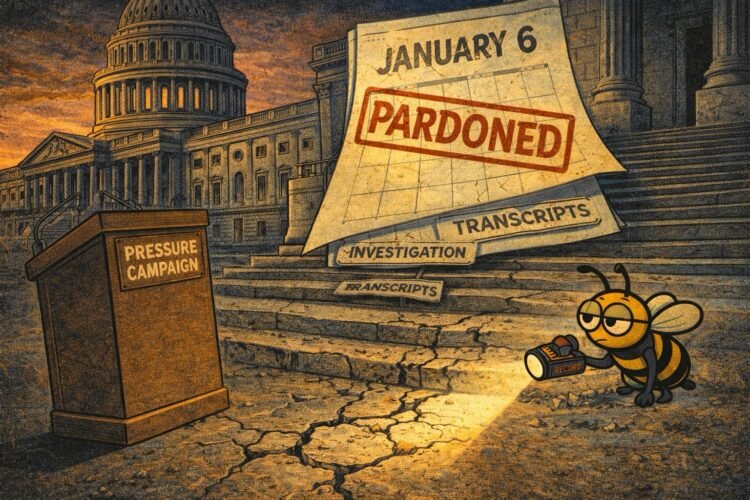
How a pressure campaign became a pardon program, and why the transcripts matter now.
Five years on, January 6 is no longer debated as a misunderstanding. It has been processed, sanded down, rebranded, and finally monetized as a loyalty signal. The most dangerous thing about the anniversary is not that people disagree about what happened. It is that the disagreement has hardened into policy.
The insurrection is no longer denied. It is defended.
What changed between the first anniversary and the fifth is not the evidence. It is the posture of power. The evidence kept accumulating. The posture flipped.
The closed door investigation transcripts released just before the New Year, drawn from the special counsel’s work, do not add shock. They add precision. They show a sustained pressure campaign that began with election lies, matured through institutional intimidation, and culminated in a violent attempt to stop certification, followed by a calculated effort to launder the event into myth.
This was not a riot that got out of hand. It was a plan that got out of control and then got rewarded.
The transcripts matter because they lock in what had been argued for years and remove the last excuse of ambiguity. They document warnings delivered in advance about the risk of violence. They record internal discussions that treated January 6 as a leverage point, not a protest. They capture the resistance to calling off the crowd once the building was breached. They show how delay was not accidental, how responsibility was passed like a hot coal, how the clock ran while the mob advanced.
The pressure campaign did not start on the morning of January 6. It started months earlier with a message repeated until it became doctrine. If defeat occurred, it was fraud. If courts rejected claims, they were corrupt. If officials refused to comply, they were traitors. “Stop the Steal” was not a slogan for yard signs. It was a mobilization strategy.
The transcripts trace how that strategy moved through channels of power. State officials were pressured to “find” votes. The Justice Department was pushed to announce fraud without evidence. The vice president was targeted with a theory of authority that did not exist, amplified anyway, and then enforced through public shaming. Each refusal escalated the rhetoric. Each boundary hardened the resolve to break the next one.
The day itself followed the script.
Supporters were summoned to Washington. The timing was deliberate. The target was explicit. The language was inflammatory. When the crowd marched, it went where it had been aimed. When barriers fell and windows shattered, calls went out for intervention.
The transcripts show what happened next. Warnings from aides. Alarms from security officials. Requests to speak, to act, to deescalate. And then resistance. Not confusion. Resistance.
Hours passed.
During those hours, the pressure campaign did not pause. It pivoted. The building was invaded, but the objective remained. Stop certification. Force delay. Keep options alive. The physical breach was one tool among many. When it stalled, procedural sabotage took over.
This is where the transcripts are unforgiving. They record efforts to keep the coup breathing after the smoke cleared. Pressure on the vice president continued. Pressure on lawmakers intensified. Pressure on the Justice Department persisted. The building was cleared, but the plan did not end. It adapted.
Afterward came the rewrite.
The transcripts document the immediate turn toward minimization. The talking points shifted from denial to distraction. The violence was reframed as protest. The participants were recast as tourists. The attack on the constitutional process was shrunk to a public relations inconvenience. Lawmakers who had sheltered returned to their seats and voted against accountability. Procedural cowardice became a survival tactic.
This is where the transaction completed.
The investigation led by the special counsel was methodical. It assembled evidence, testimony, and timelines that made intent unmistakable. It did not rely on vibes or clips. It relied on sworn statements, contemporaneous messages, and corroborated warnings. The transcripts show a former president aware of the risk, resistant to intervention, and invested in the outcome.
Then the election happened again.
As soon as Donald Trump was reelected, the message changed from minimization to absolution. Pardons were issued. More were promised. The people who had assaulted police officers, smashed windows, and hunted lawmakers through the halls of Congress were transformed from defendants into symbols. Criminal acts against democracy became loyalty badges.
This was not a side effect. It was the point.
Pardons did not merely end cases. They rewrote meaning. They told future actors that violence in service of power is forgivable. They told institutions that accountability is optional if the perpetrator wins. They told the base that loyalty will be rewarded retroactively, no matter the cost to the system.
The moral rot was completed in public.
Five years after January 6, the danger is no longer that people do not know what happened. It is that they have been trained to accept it. The insurrection has been normalized, merchandised, and folded into campaign mythology. The anniversary is not marked by reckoning or unity. It is marked by applause lines and grievance nostalgia.
This is how republics fail without collapsing.
The transcripts matter because they foreclose the lie that this was a spontaneous riot. They show coordination failures that were allowed to persist. They show warnings that were ignored. They show a refusal to act that carried consequences measured in broken bones and breached doors. They show a president who did not merely fail to stop the violence, but benefited from its pressure.
They also show how accountability was obstructed after the fact. Messaging strategies were coordinated. Investigations were delayed. Memory was contested. The goal was not truth. It was time.
Time worked.
By the fifth anniversary, the narrative had flipped. The attempted overthrow was no longer treated as an attack. It was treated as a rally that ran long. The victims were mocked. The process was ridiculed. The rule of law was recast as weakness.
The pardons sealed it.
When a leader pardons those who attacked the constitutional process, he is not healing division. He is teaching a lesson. He is teaching that violence is a viable political tool. He is teaching that elections are conditional. He is teaching that losing is optional if you are willing to burn enough norms.
That lesson does not expire.
It becomes precedent.
Some people still argue that focusing on January 6 is divisive. The transcripts answer that too. Division was the strategy. Pressure was the method. Violence was the accelerant. The refusal to intervene was the choice. The pardons were the reward.
Five years later, the republic faces a simpler question than the pundit class prefers. Do rules apply when they are inconvenient. Do oaths mean what they say. Does accountability survive victory.
The answer given so far is not encouraging.
January 6 was a test of institutions. Some held. Some cracked. Some adapted. The most important failure was not security. It was moral. The failure to impose consequences proportionate to the offense taught the wrong lesson. It taught that attempts can be rehearsals. It taught that denial can become doctrine.
The transcripts pulled the curtain back one last time. The pardons slammed it shut.
This anniversary should have been a reckoning. Instead, it is a warning. The pressure campaign never ended. It learned.