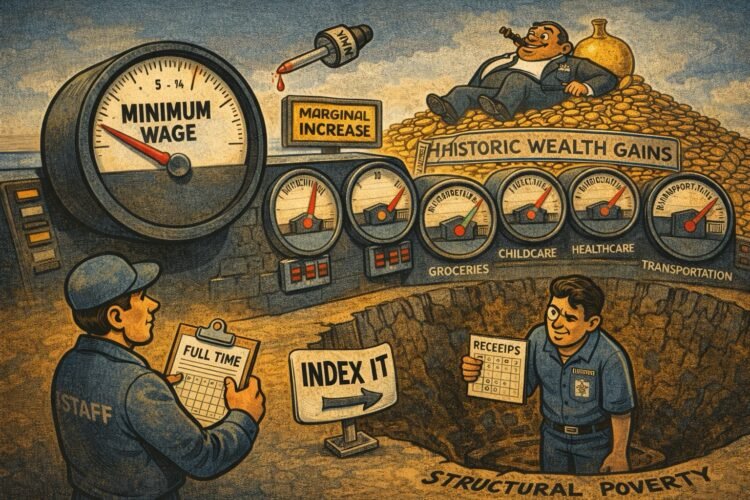
A minimum wage that can’t buy rent is not a wage. It’s a suggestion with a time clock.
America is in a strange phase of capitalism where we have decided inflation is a natural disaster but poverty is a personal flaw. We hold candlelight vigils for the price of eggs, then lecture full-time workers about “budgeting” like they’re blowing their paychecks on yachts and artisanal air. We watch rent climb like it’s training for the Olympics, watch childcare costs behave like a luxury brand, watch healthcare invoices arrive with the emotional tone of a ransom note, and then act surprised when people who work forty hours a week still live one broken transmission away from a spiral.
This is not an accident. It’s a design choice. It’s what happens when the minimum wage becomes a museum exhibit.
A national minimum wage of at least $25 an hour, indexed upward as needed, isn’t a radical idea. It’s the logical consequence of math. It’s the moral consequence of pretending “work ethic” can substitute for purchasing power. It’s the only honest response to an economy where the costs of being alive have fully decoupled from the wages we pay the people who keep everything running.
The current federal minimum wage is not just low. It’s obsolete. It is a number that exists mostly to prove we can keep a law on the books while stripping it of meaning. In many states, the floor is higher, but “higher” often means “still not enough to live.” A full-time worker making a low wage can do everything right, show up, stay sober, stay polite, clock in, clock out, and still end the month in a deficit. That’s not a labor market. That’s an extraction system with a motivational poster taped to it.
The core problem is simple: the minimum wage stopped moving with the country.
There was a time when minimum wages functioned more like a living policy than a dead artifact. They rose. They tracked, loosely, with the cost of living. They reflected a belief that if society demands full-time labor, society owes the worker a wage that keeps them out of destitution. Then politics discovered a neat trick: if you freeze a wage floor long enough, inflation does the pay cut for you. You don’t have to vote to slash worker pay. You just refuse to update the number and let rising prices quietly eat the value year after year.
That’s what we did. For decades.
The result is a system where “minimum wage job” no longer means a starter wage. It means a permanent cliff. It means the worker is subsidizing the economy with their instability. It means the public pays the hidden bill, through housing precarity, emergency healthcare, food assistance, and the slow social corrosion that comes from millions of people living in chronic stress.
Which is why piecemeal raises to $12 or $15 are not serious policy. They’re nostalgia politics.
They are the political equivalent of finding an old photograph of a wage that used to mean something and getting sentimental about it. They are presented as bold progress while being carefully calibrated to avoid upsetting anyone powerful enough to fund campaigns. They might reduce some hardship in some places for some time, but they are not a plan for the world we live in now, and they are definitely not a plan for the world that’s arriving fast.
Because the future is not just expensive. It’s unstable.
AI-driven labor displacement is no longer a distant possibility. It’s a set of incentives already reshaping decisions in boardrooms and budgets. Automation is not coming only for factory work. It’s coming for service work. It’s coming for clerical work. It’s coming for white-collar tasks that used to be treated as safe because they involved spreadsheets and jargon. The labor market is heading toward a world where stability is not guaranteed even for people who did everything the old economy told them to do. Degrees, credentials, experience, none of it is a shield if an algorithm can do your job faster and the company can call it “efficiency.”
In that environment, a higher wage floor isn’t just compassion. It’s a shock absorber.
If we’re going to ask workers to live inside an economy of disruption, then the least we can do is guarantee that full-time work still means something. A $25 minimum wage is not about luxury. It’s about preventing the floor from collapsing under people while we celebrate innovation with one side of our mouth and tell workers to “reskill” with the other.
Now let’s address the part people pretend is impossible until it becomes inevitable: funding.
A national minimum wage doesn’t require a magic money tree. It requires a decision about who carries the cost of a functional society. Right now, low wages shift costs onto workers and the public. Businesses pay less, workers struggle more, and taxpayers fund the consequences. That’s not a free market. That’s a subsidy system disguised as rugged individualism.
If we raise the wage floor, we can also finance the transition and cushion the shifts through targeted tax increases on the ultra-wealthy and ultra-high earners who have accumulated historic wealth gains while wages stagnated.
This is not a proposal to confiscate anyone’s livelihood. It’s a proposal to skim a little off the top of the most extreme wealth concentration in modern history, the kind of wealth that grows in the background while families argue about whether they can afford school supplies. For billionaires and ultra-high earners, modest marginal tax increases don’t meaningfully change lived standards. Their lives remain padded, insulated, and absurdly secure. Their grocery decisions are not affected by a slightly higher tax rate. Their rent does not suddenly become precarious. Their child does not suddenly lose childcare because the nanny quit. The pain is theoretical.
For millions of workers, the impact of a $25 wage floor is immediate and physical. It changes whether the lights stay on. It changes whether healthcare is delayed. It changes whether a car repair becomes a catastrophe. It changes whether a parent can miss one shift without losing a home. It changes whether people can plan instead of panic.
And when workers have predictable spending power, the benefits radiate outward in ways that are boring and powerful.
Consumer demand stabilizes, because people who have money spend it in their communities. Reliance on public assistance drops, because wages replace some of the gap that food programs and housing assistance are currently forced to fill. Emergency healthcare costs shrink, because people can afford preventative care and basic stability reduces stress-driven illness. Crime and housing precarity decline, because desperation becomes less common. Local economies strengthen, because the money goes to rent, groceries, repairs, childcare, and services, not into offshore accounts or speculative financial products.
This is what wage policy can do when it’s treated as infrastructure instead of charity.
Now, the objections. They always arrive on schedule, wearing the same worried expression.
We are told a higher wage will cause inflation. We are told small businesses will collapse. We are told jobs will vanish. We are told the market cannot handle it. We are told the economy will implode, as if capitalism is a delicate antique that shatters if you pay the people who hold it up.
The evidence from past wage hikes does not support that level of panic. In many cases, wage increases have shown minimal job loss, improved retention, reduced turnover costs, and pushed businesses toward productivity gains. When workers are paid more, they stay longer. When they stay longer, training costs drop. When training costs drop, service improves. When service improves, revenue can rise. When workers aren’t living in constant triage, they perform better. That is not ideology. That is basic management.
And yes, some prices can rise slightly in certain sectors, because labor is part of cost. But the real inflation story isn’t “workers got paid too much.” The real story is that many corporations have spent years raising prices and protecting margins while wages lag, then blaming workers for wanting a share of the prosperity they help create. If a business model requires poverty wages to survive, it’s not a business model. It’s a dependency on human desperation.
A $25 wage floor is not anti-business. It’s pro-market sanity.
A market can’t function if demand collapses. It can’t function if workers can’t afford the goods they produce and the services they provide. It can’t function if the economy turns into a pyramid where profits flow upward and stress flows downward. That’s not capitalism working. That’s oligarchy with customer service.
A higher wage floor is also a way to stop treating the public safety net as a private payroll subsidy. When employers pay wages too low to live on, taxpayers cover the difference through assistance programs. That means the public subsidizes low pay while profits remain private. If we’re serious about markets, we should be serious about ending that quiet subsidy. Pay people enough, and the public stops carrying so much of the slack.
There’s also a moral argument here that doesn’t require spreadsheets.
A society that demands full-time work owes full-time dignity. That does not mean everyone gets to live like a celebrity. It means they get to live like a human being who belongs. It means a job should provide stability, not just activity. It means work should not be a treadmill that keeps you alive only as long as you never stumble.
The word “minimum” is supposed to mean the baseline of decency. When the minimum wage cannot cover basic survival costs, the policy becomes a public confession that we are comfortable with structural poverty. It becomes a signal that we have normalized a system where millions of people work hard and still fail financially, not because they are lazy, but because the math was rigged against them.
Indexing the wage upward is non-negotiable if we don’t want to repeat the same political sabotage. A $25 minimum that stays flat for years becomes the next museum exhibit. Indexing is how you prevent future lawmakers from quietly cutting pay through inflation while pretending they did nothing. If the economy changes, the wage floor must change with it, automatically, without requiring a new moral debate every time rent rises.
This isn’t radical generosity. It’s a late correction.
We are not proposing a utopia. We are proposing to stop running the economy on a permanent emergency for workers. We are proposing to align the wage floor with the cost of living in a country that loves to preach about hard work while quietly ensuring hard work doesn’t pay. We are proposing to treat labor as a foundation, not a disposable input.
If the AI era is going to be defined by volatility, then the most rational policy is stability. A higher wage floor gives workers more resilience. It gives communities more reliable demand. It reduces the downstream costs of poverty. And it forces businesses and policymakers to confront an obvious truth: the economy is not healthy when it depends on millions of people being unable to afford their lives.
Pay people $25 an hour, index it, fund it with targeted taxes on extreme wealth, and watch the country look less like a stress test and more like a society.
Receipt Time: The Math Has Already Voted
A minimum wage that traps full-time workers in poverty is not a compromise, it’s an admission. It admits we built an economy where productivity and profit can soar while basic survival gets more expensive every year, and we call that normal. The $25 floor isn’t a gift. It’s the overdue price of pretending the system worked while workers carried the instability on their backs. If we can’t guarantee that full-time labor buys a dignified life, then the problem isn’t workers asking for too much. The problem is a country asking them to live on less than reality costs.