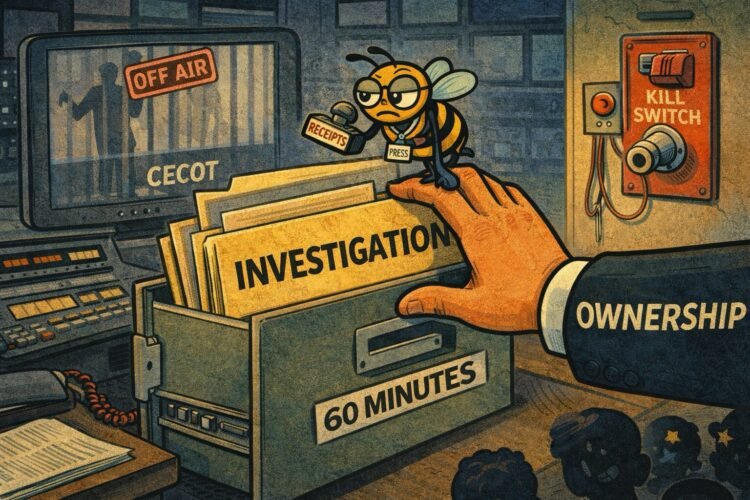
When corporate consolidation meets political fear, the investigative segment becomes a ghost.
There are two kinds of silence in American journalism. One is the ordinary kind, the necessary pause while reporters verify names, confirm documents, and wait for reluctant sources to stop pretending their phones are dead. The other kind arrives after a story has already cleared every hurdle, legal review, editorial approval, promotional rollout, and then vanishes anyway. Not because the facts collapsed, but because power flinched.
This week, CBS delivered the second kind.
A 60 Minutes investigative segment examining the Trump administration’s deportation of Venezuelan migrants to El Salvador’s notorious CECOT prison was abruptly pulled just before airing. The segment had already passed legal and editorial review. It had been promoted. Its existence had been acknowledged publicly. Then, hours before broadcast, it was shelved. Promotional materials were scrubbed. Pages disappeared. Viewers were told the network needed “additional reporting” and would run the story later.
Inside the newsroom, that explanation landed like an insult dressed as professionalism.
Correspondent Sharyn Alfonsi reportedly blasted the decision internally as political censorship, warning that shelving a vetted investigation because the administration refused to participate effectively hands the White House a “kill switch” over coverage. It’s a phrase that sticks because it describes a structural fear, not a tantrum. If a government can neutralize investigative journalism by simply declining comment, the watchdog role collapses into a courtesy call.
The pulled segment, titled “Inside CECOT,” wasn’t a theoretical policy debate. It included testimonies from released detainees describing brutal conditions inside the El Salvador prison, accounts that human rights advocates have long raised alarms about. The reporting raised direct questions about U.S. deportation policy, due process, and what responsibility the government bears for conditions people face after being removed from the country.
That is precisely the kind of story 60 Minutes was built to air.
Which is why pulling it at the last second reads less like caution and more like capitulation. Journalism does not require government cooperation to tell the truth. In fact, refusal to cooperate is often part of the story. When a network treats silence from power as a reason to silence itself, it’s no longer negotiating standards. It’s negotiating comfort.
The fallout would have been bad enough on its own. But this didn’t happen in a vacuum. It happened inside a newsroom undergoing a profound identity shift, driven by ownership changes, political pressure, and a growing fear of retaliation.
CBS News now sits under leadership installed through the acquisition of The Free Press by Paramount Skydance, a roughly $150 million deal that didn’t just buy a media property, it imported an editorial worldview. Bari Weiss, founder of The Free Press, was installed as CBS News editor-in-chief, a move supporters framed as modernization and critics saw as a rightward tilt inside a legacy institution that once prided itself on centrist independence.
You can argue ideology all day. What matters is power.
Once editorial authority becomes entangled with corporate strategy and political risk management, investigative journalism stops being about what’s true and starts being about what’s tolerable. That’s the tension at the heart of this moment. 60 Minutes is supposed to be the show that makes powerful people uncomfortable. That’s its cultural contract. But corporate consolidation doesn’t reward discomfort. It rewards stability, access, and predictability.
Pulling the CECOT segment sends a message that will outlast this news cycle. It tells producers and correspondents that a story can be killed even after it clears lawyers and standards. It tells them that the most dangerous part of reporting isn’t getting the facts wrong, it’s choosing a subject that invites retaliation. And it tells them that if a story threatens the wrong people at the wrong time, the safest move is delay.
Delay is the polite cousin of censorship.
CBS’s official line, that more reporting was needed, is not inherently illegitimate. Sometimes stories do require more time. Sometimes new facts emerge. Sometimes edits matter. But context matters too. This segment wasn’t pulled quietly weeks earlier. It was promoted, queued, and then erased. Viewers don’t experience that as editorial refinement. They experience it as disappearance.
And viewers are not stupid.
They understand what it looks like when a corporation tries to pretend a trailer never existed. They understand that “additional reporting” is a flexible phrase that can mean anything from genuine diligence to strategic retreat. Trust erodes not because people demand perfection, but because they recognize fear when they see it.
The subject matter only sharpens the concern. Deportations to CECOT sit at the intersection of immigration enforcement, human rights, and U.S. complicity in foreign detention systems. It’s politically explosive precisely because it forces the public to confront what “border security” actually looks like when it’s operationalized. It’s easier to talk about numbers and slogans than it is to hear people describe cages, isolation, and abuse.
That discomfort is the job.
But the environment around the job has changed. CBS’s corporate parent has already demonstrated a willingness to avoid prolonged conflict with the Trump administration. Earlier this year, Paramount agreed to a multimillion-dollar settlement with Trump over a 60 Minutes interview edit, a move widely criticized as capitulation even as the company insisted it admitted no wrongdoing. Money changed hands. A fight ended. A precedent was set.
Once a newsroom learns that lawsuits can be resolved with checks, every future story gets filtered through the question of whether it’s worth another one.
Ownership shifts make that calculus even sharper. Paramount Skydance is navigating regulatory scrutiny, political relationships, and a media market where broadcast news is already fighting for relevance. In that environment, antagonizing a sitting president isn’t just a journalistic decision. It’s a business risk.
That risk has consequences.
Trump’s own relationship with 60 Minutes fits neatly into this transactional framework. He praises ownership when he believes ownership will restrain coverage. He attacks the show when it doesn’t. He treats media not as an independent institution but as a venue to be pressured, rewarded, or punished. That’s not new behavior. What’s new is how often it seems to work.
When leadership responds to pressure by shelving stories, the lesson for power is simple: escalation pays.
This is why Alfonsi’s “kill switch” language matters. It names a mechanism, not a mood. A kill switch doesn’t require public orders or dramatic censorship. It operates quietly, through internal interventions, scheduling decisions, and corporate caution. No one has to say “don’t air this because the White House won’t like it.” You just create conditions where that outcome feels inevitable.
The danger is cumulative. Each delayed story makes the next one easier to delay. Each intervention rewrites newsroom norms. Over time, journalists internalize the boundaries without being told. They stop pitching certain investigations. They soften angles. They choose safer targets. Accountability reporting becomes less confrontational, more abstract, more polite.
At that point, the watchdog hasn’t been muzzled. It’s been trained.
The near-term consequences will show up in three places.
Inside CBS, staff will watch whether the CECOT segment ever airs, and whether it airs intact. They’ll watch how leadership handles dissent, whether whistleblowing is treated as professionalism or insubordination. They’ll watch which stories get greenlit next, and which ones quietly die in meetings.
Among viewers, trust will continue to fray. Broadcast news relies on credibility more than clicks. When audiences sense that coverage can be steered by ownership or political pressure, skepticism becomes default. That skepticism doesn’t stay neatly contained. It feeds the broader cynicism that already poisons the media landscape.
And among politicians, the lesson will be absorbed quickly. If refusing to cooperate can neutralize scrutiny, more refusals will follow. If lawsuits can chill reporting, more lawsuits will be filed. The tools that work will be reused.
That’s how journalism loses ground without losing a single First Amendment case.
The saddest irony is that the public loses the most. Investigative journalism exists to make power legible. It’s one of the few ways ordinary people can see what governments do beyond press releases and slogans. When those investigations are quietly sidelined, the public doesn’t just lose information. It loses leverage.
Deportations, detention, and prison conditions are not abstract debates. They are state actions with human consequences. If newsrooms become steerable by corporate interests and political fear, those consequences stay hidden, and accountability becomes theoretical.
The story here isn’t just about one pulled segment. It’s about a structural shift in how journalism relates to power. When a flagship like 60 Minutes starts acting as if it needs permission to be itself, something foundational has changed.
Receipt Time: The Vanishing Segment Trick
A story that clears legal review and disappears anyway isn’t a scheduling hiccup. It’s a signal. It tells journalists to anticipate power’s preferences. It tells viewers that silence can be engineered. And it tells governments that pressure works. Call it “additional reporting” if you want, but the audience can smell fear in the room. When investigative journalism becomes conditional, the public doesn’t just lose a segment. It loses a window.