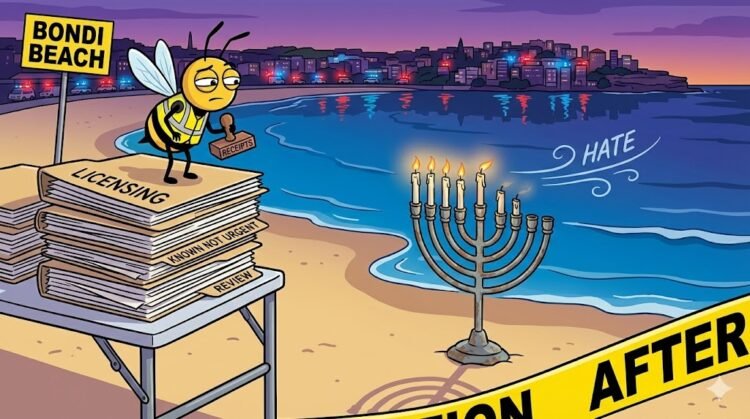
A terror attack, a nation in shock, and the familiar moment when everyone realizes the system worked exactly as designed, which is to say too late.
Bondi Beach is supposed to be the place Australia sends to the world as proof of ease. Sun, water, the soft promise that life can be simple if you stand close enough to the ocean. Instead, a Hanukkah celebration near the beach became the site of a deliberate antisemitic terror attack, and now the word “Bondi” carries a second meaning that no amount of postcards will erase.
Authorities say a father and son opened fire on the gathering, killing at least fifteen people, with some reporting putting the death toll at sixteen including a child, and injuring dozens more. Two police officers were among the wounded. Police shot and killed the older attacker at the scene. The younger was arrested and remains in critical condition. Firearms and explosive-related evidence were recovered. Raids followed across western Sydney. A celebration became a crime scene, then a national wound, then a briefing.
This is the moment when a country learns something about itself, not because the answers are new, but because the consequences are impossible to ignore. Australia has some of the strictest gun laws in the world. Australians are told, often with pride, that the system works. And then a mass-casualty attack happens anyway, and the system clears its throat and explains that technically, everything was compliant until it wasn’t.
A Holiday Turned Into a Stampede
Eyewitness accounts describe chaos in a crowded public space. People running across sand and pavement. Parents searching for children. Friends dragging friends away from danger because instinct moves faster than thought. The beach does not have hallways. It does not have doors to lock. It has open sky and nowhere to hide.
The choice of target matters. A Jewish holiday celebration in a public place is not random. It is a message delivered in the oldest language terror knows. You are not safe here. Not even here. Not even in daylight. Not even when the country tells itself this kind of thing does not happen.
Australia’s Jewish community already lives with the weight of rising antisemitic incidents since the Israel Gaza war began. This attack lands on that existing fear like a confirmation nobody asked for. Vigils followed quickly. So did police patrols outside synagogues and community centers, the quiet acknowledgment that protection is now necessary where belonging should have been enough.
Blood donation centers filled. Hospitals surged. Emergency responders did what emergency responders always do, which is show up and hold things together while the rest of the country watches from screens and feels helpless.
There are also reports of a bystander who tackled and disarmed one of the attackers despite being shot. That story will be told again and again, because people need something to hold onto that is not just horror. Courage matters. It always matters. But courage is not a policy. It is not a prevention strategy. It is not a substitute for systems that are supposed to stop this before a civilian has to bleed for it.
The Weapons and the Surprise Nobody Should Have Had
Authorities recovered multiple firearms and explosive-related materials. Reporting has cited a bolt-action rifle, a shotgun, additional weapons at the scene, and at least one improvised explosive device found during later searches. Linked addresses were raided. More weapons were found.
Then came the part of the story that always arrives with a thud, because it exposes the gap between law and reality. The older attacker reportedly held a firearms licence in categories that allow rifles and shotguns. He reportedly had multiple registered weapons, some held for years.
This is where the conversation shifts from grief to procedure, from mourning to the careful language of “review.” Officials talk about quantity limits, storage compliance, and vetting standards. The public hears the word “legal” and feels a specific kind of anger, the kind that comes from realizing legality is not the same thing as safety.
Australia’s gun laws are strict, but they are not magical. They rely on licensing, registration, storage requirements, and ongoing compliance. They assume good faith plus monitoring. They assume that once someone passes the gate, they will remain stable, nonviolent, and uninterested in turning their legally owned tools into instruments of terror.
That assumption is now on trial.
Known, But Not a Threat, Until It Was
Authorities have acknowledged that the younger suspect was known to security agencies dating back several years due to associations with people of extremist interest. Officials say there was no intelligence indicating an imminent plot. This is the phrase that should stop the room. Known, but not a threat. Known, but not urgent. Known, but not actionable.
This is not an indictment of any single officer or analyst. It is a structural problem that shows up again and again in modern counterterrorism. Intelligence exists. Signals are logged. Names appear in databases. But the threshold for intervention is calibrated to avoid overreach, to avoid false positives, to avoid acting without certainty. That calibration makes sense, until it doesn’t.
After the fact, certainty looks cheap. Before the fact, it is everything.
The accountability fight will center on information sharing, risk assessment, and the gap between awareness and action. What red flags were seen. Which ones were dismissed. Whether the father’s access to firearms should have triggered additional scrutiny given the son’s profile. Whether licensing systems talk to security assessments in real time or only in theory.
“Known but not a threat” is the phrase governments use when they want to be accurate and defensible. It is also the phrase that families hear as “we knew something and did nothing.”
The Comfort of Believing the System Is Finished
One of the most dangerous beliefs after a tragedy is the idea that passing a law means the work is done. Australia’s gun reforms after past massacres were real and effective. They reduced gun violence. They saved lives. They became a model.
But models age. Threats adapt. Extremism evolves. Systems that were designed to stop one kind of violence can be exploited by another. A licensing regime built around hunting and sport is not automatically equipped to detect radicalization, mental instability, or family networks that shift over time.
The uncomfortable truth is that regulation is not a static achievement. It is an ongoing practice. It requires updates, audits, and political will long after the cameras leave.
After Bondi, there will be calls for tougher national gun laws, tighter limits on stockpiling firearms, more rigorous mental health screening, better information sharing between licensing authorities and intelligence agencies. All of these conversations will sound familiar, because they always do. The question is not whether they happen. The question is whether they produce enforcement or just reassurance.
Antisemitism Does Not Need Ambiguity
Leaders at home and abroad have condemned the attack. They have named it what it appears to be. An antisemitic act of terror. That clarity matters. Euphemism is not neutrality. It is erasure.
Antisemitism thrives on denial, on the refusal to call things by their names, on the quiet suggestion that maybe it was something else, maybe we should wait, maybe context will soften it. Context does not soften a massacre. Context explains it. Naming the ideology behind the violence is not inflammatory. It is honest.
Australia, like many countries, is grappling with a rise in antisemitic incidents. This attack did not happen in a vacuum. It happened in an atmosphere where hateful rhetoric circulates freely, where conspiracy theories metastasize online, where grievance politics teaches people to see entire communities as enemies.
Security measures will increase. Police will stand outside places of worship. Bags will be checked. Concrete barriers will appear. All of that will be described as temporary. Anyone paying attention knows it rarely is.
The Ritual After the Tragedy
There is a predictable choreography after mass violence. First, shock. Then mourning. Then hero stories. Then briefings. Then promises. Then reviews. Then time passes.
The danger is not that leaders fail to say the right things. They usually do. The danger is that saying the right things becomes the end of the job. Press conferences replace policy. Reviews replace reform. Commitments fade once the immediate pressure lifts.
The phrase “lessons will be learned” has become a form of punctuation, a way to end a sentence without changing anything.
If Bondi becomes another entry in the long list of tragedies that produce a week of resolve and a decade of inertia, then the system will have done exactly what it is optimized to do. Absorb shock, distribute condolences, and return to baseline.
What Accountability Would Actually Look Like
Real accountability would mean confronting uncomfortable tradeoffs. It would mean revisiting how many firearms one person can legally possess and why. It would mean ensuring that licensing systems are not isolated from intelligence assessments. It would mean ongoing, not one-time, vetting. It would mean storage checks that are real, not theoretical. It would mean admitting that extremism screening cannot be frozen at the moment a licence is issued and forgotten thereafter.
It would also mean resisting the temptation to treat this as an anomaly. Terrorism does not announce itself as a trend until it has already happened more than once.
The hardest part is that none of this guarantees prevention. There is no policy that can promise zero risk. But there is a difference between zero risk and known risk that is tolerated because addressing it is complicated.
The Quiet Damage
Beyond the headlines, there is the quieter damage. Families who will never be the same. A community that now measures safety in patrol cars. Children who will associate a holiday with gunfire. A beach that will never feel quite as neutral again.
These are not abstract costs. They are lived. They accumulate. They change how people move through the world.
Terrorism aims for spectacle, but it settles for erosion. It erodes trust, ease, and the assumption that public life is shared. Every time a government responds with ritual instead of resolve, it helps that erosion along.
Receipt Time
Authorities say a father and son carried out a deliberate antisemitic terror attack at a Hanukkah celebration near Bondi Beach, killing at least fifteen people, possibly sixteen including a child, and injuring dozens before police shot and killed the father and arrested the son, with investigators recovering multiple firearms and explosive-related materials and conducting follow-up raids across Sydney, triggering a national reckoning over how legally licensed weapons were used in a mass casualty attack, how a suspect known to security agencies was assessed as not posing an imminent threat, and whether Australia’s gun licensing, monitoring, and intelligence-sharing systems are equipped to prevent modern extremist violence or merely explain it after the fact.