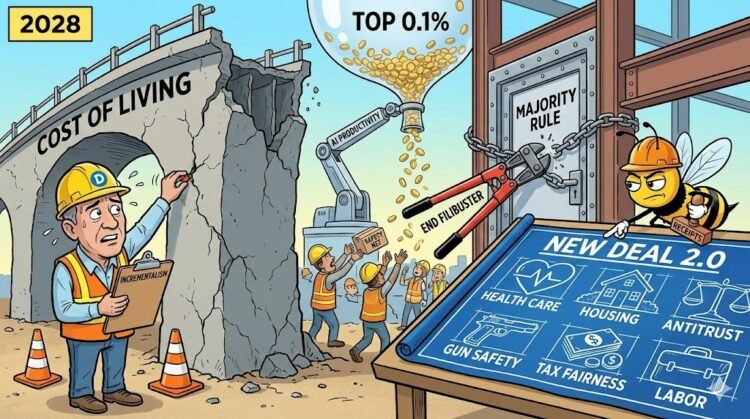
If the next pitch is “we will maintain the wiring,” voters are going to keep choosing the guy offering a flamethrower and calling it leadership.
By 2028, the Democratic Party has to decide whether it wants to be a governing party or a permanent incident-response team. The last decade has trained Democrats to behave like the cautious maintenance crew in a crumbling building, the people walking around with cones and laminated badges, calmly explaining that yes, the ceiling is leaking, but the important thing is we have a process for reporting leaks. Meanwhile, the country is living through an era where everything accelerates except relief. Prices jump. Rents surge. Algorithms eat jobs. Health care bills arrive like threats. Storms get louder. Billionaires collect applause for existing. And the party that claims to care keeps offering incrementalism dressed up as prudence.
Prudence has its place. It’s a good quality in a surgeon, a pilot, and a person handling fireworks. But if your political opponent is actively trying to dismantle democratic norms and build a government that functions like a personal loyalty program, “prudence” starts to look like surrender with nicer fonts.
The goal is not to run a campaign that says, “We will restore calm.” Calm is not an agenda. Calm is a mood. People want stability, but they also want movement. They want a government that can do things again, not just manage decline with polite apologies. By 2028, Democrats have to stop running as if their job is to keep the system from falling apart for one more quarter. They have to run as if their job is to build a new system that works for the people living in it.
That begins with a simple, uncomfortable truth: the Senate filibuster is a veto for gridlock, and it turns elections into theater. If you win, you still cannot govern. If you lose, you still get blamed for what the other side breaks. It’s the perfect machine for cynicism. It is also the easiest way to ensure the public keeps believing government cannot deliver.
So yes, abolish it. Not “reform it” into some complicated performance where the minority gets to keep the chokehold but now has to do a little more cardio. Abolish it. Majority rule is not radical. It’s the basic premise of democracy. If the voters put a majority in place, that majority should be able to pass legislation and be held accountable for results. The filibuster doesn’t protect democracy. It protects the people who benefit from paralysis.
Abolish the Filibuster and Let Elections Mean Something
The argument for keeping the filibuster always comes wrapped in a story about protecting minority rights. That story is emotionally appealing, and historically dishonest. The filibuster has been used to block civil rights, labor rights, and reform of systems that concentrate power. It has served, again and again, as a tool for entrenched interests. It does not protect vulnerable people. It protects vulnerable incumbents.
Democrats need to stop treating the filibuster like a sacred tradition. It is not the Constitution. It is a rule. It is a procedural weapon. It is a mechanism that allows a minority to veto popular policy. Keeping it because “norms matter” is like refusing to lock your door because you respect the neighborhood’s tradition of trusting strangers.
If Democrats want to win and govern, they need to promise real outcomes and build the machinery to deliver them. No more campaigning on what you would do if you had a magical Senate that functions in the real world. Voters are tired of the asterisk. They want the bill passed, the project built, the prescription affordable, the rent lower, the job safer. They want results.
So start there. Abolish the filibuster. Then do what you promised.
Universal Government-Backed Health Care: Stop Paying Ransom for Survival
Health care is the most obvious place where the party’s caution has become self-defeating. People do not experience health care as a policy debate. They experience it as a monthly panic. They experience it as a deductible that feels like a punishment. They experience it as a pharmacy counter where the price changes depending on whether your insurance is in a good mood that day. They experience it as medical debt, delayed treatment, and the quiet humiliation of negotiating with a billing department while sick.
Universal government-backed health care is not a utopian dream. It is a rational response to a system that forces people to treat survival as a luxury product. It should be the core of a governing vision because it is the clearest example of what government can do: pool risk, lower costs, guarantee access, and remove employment from the list of requirements for seeing a doctor.
Democrats have spent years playing defense, protecting pieces of a broken system. They need to go on offense. Health care should be framed as infrastructure for living, not a marketplace for profit extraction. The point is not to outlaw private insurance, the point is to guarantee that every person can walk into a clinic and get care without fear of financial ruin. If private companies want to sell supplemental products, they can. But the baseline should be coverage as a right, not a privilege.
People broadly agree on this more than political strategists admit. The obstacle is not public opinion. The obstacle is the industries that profit from complexity.
Aggressive Antitrust: Break the Monopoly Habit
The American economy has developed a monopoly addiction. We call it “efficiency” when a few companies dominate entire sectors. We call it “innovation” when consolidation produces higher prices and fewer choices. We call it “the market” when a handful of giants squeeze workers, suppliers, and consumers like it’s a business model. Antitrust enforcement used to be a point of pride in the American system. Now it’s treated like a quaint hobby for people who still believe competition is real.
Democrats should make antitrust a central pillar. Not because it is a niche policy. Because it is the skeleton key that unlocks so many other problems. Monopolies distort prices. They hollow out wages. They crush small businesses. They capture regulators. They turn politics into corporate customer service. If you want to reduce the wealth gap, you cannot do it while allowing oligarchic markets to keep extracting wealth upward.
This is where Democrats should stop speaking in timid phrases. They should talk about power. They should talk about concentrated power as a threat to freedom, because it is. And they should enforce antitrust like they mean it.
Modern Gun Safety Laws: Stop Treating Death as a Cultural Preference
Modern gun safety laws are popular. Not every detail, not every slogan, but the basic idea that the country should not be flooded with weapons designed for mass casualty is broadly supported. The problem is that the debate has been trapped in a loop where any attempt at regulation gets framed as tyranny, and Democrats respond by speaking in euphemisms, terrified of being called anti-freedom.
The truth is that freedom is not just the absence of regulation. Freedom is the ability to go to school, to a concert, to a grocery store without scanning exits. Freedom is not having to train children in active shooter drills as if this is normal weather. Freedom is not being told the price of living in America is a constant low-grade fear.
Modern gun safety laws should include universal background checks, red flag laws with due process, safe storage requirements, and restrictions on high-capacity magazines and weapons designed to maximize killing. This is not about punishing responsible gun owners. It is about reducing the industrial scale of death.
Democrats should treat this issue as a public safety imperative, not a symbolic battle. They should say clearly that the status quo is unacceptable.
Tax the Top, Not the Bottom: Paper Losses and Real Lives
The tax code is one of the most effective tools government has to shape the economy. Right now, it is structured to favor wealth and punish labor. The party needs to stop pretending this is too complicated to talk about. It’s not complicated. It is a choice.
Raise rates on billionaires. Close loopholes. Tax capital gains more fairly. Strengthen enforcement. The point is not to punish success, the point is to stop subsidizing extraction. Billionaires can lose more than $150 billion on paper and not feel it in their lives. That tells you everything about the scale of inequality. A normal person loses a few hundred dollars and has to decide whether to delay a medical appointment. Billionaires lose billions in “paper value” and still fly, still buy, still influence, still live in a separate reality where consequences are optional.
Revenue should be redirected into things that build actual stability. Education that does not trap people in debt. Childcare that does not cost as much as rent. Infrastructure that is delivered, not just announced. Rent stabilization. Large-scale housing construction. The point is to change the baseline for what life costs in America.
Build Housing Like It’s an Emergency, Because It Is
Housing is the crisis that reveals every other crisis. If rent is too high, wages do not matter. If housing is unstable, health suffers. If housing is scarce, families delay children, people delay careers, and communities hollow out. Housing is not just a market, it is the foundation of stability.
The party’s vision has to include large-scale housing construction and the willingness to strip away the zoning barriers and layers of red tape that choke projects. This is where Democrats need to get over their internal contradiction. They want affordability, but they also defend systems that make building difficult. They want progress, but they protect processes that guarantee delay. They talk about inclusion, but they allow exclusionary zoning to persist as a polite form of segregation.
Smart deregulation matters here. Not deregulation that hands power to developers without guardrails, but reform that accelerates building, streamlines approvals, and increases supply while protecting labor standards and environmental goals. The point is to build faster without building crueler. A government that cannot build is a government that cannot lead.
This is also where Democrats need to own the failures of the Biden infrastructure era in delivery. It was not enough to pass big numbers and announce big plans. Projects got tangled in permitting, procurement, and local obstruction. People heard promises and then saw cones and delays. They were told relief was coming and then watched it arrive at the speed of a committee meeting.
That has to change. Delivery has to become the brand.
A New Deal for a New Era: The Mixed Economy With a Spine
The party needs a New Deal for a new era. That means confronting the wealth gap head-on, raising the minimum wage, strengthening labor protections, and embracing a mixed-economy philosophy that rejects both pure socialism and runaway capitalism.
This is not about ideological purity. It is about practicality. Some things work best in markets. Some things work best with government guarantees. Some things require strict regulation because they naturally trend toward monopoly, corruption, and oligarchy. Other things need deregulation where it accelerates building and innovation without sacrificing safety and fairness.
AI-driven job displacement makes this even more urgent. Productivity gains are coming, whether we like it or not. The question is who gets the benefit. If the gains flow only upward, the country becomes less stable. If the gains are shared, the country becomes more resilient.
That requires new social contracts. Stronger safety nets. Portable benefits. Job training that is real, not ceremonial. Wage supports. Maybe even new models like expanded child allowances or guaranteed basic supports, because the labor market is changing faster than the political system wants to admit. People cannot be told to “adapt” while the people at the top capture all the rewards.
This is where strict regulation matters, not as punishment, but as governance. Regulate to prevent monopoly. Regulate to prevent corruption. Regulate to prevent a world where a few companies control information, labor, and markets. Regulate to keep AI and platform power from turning democracy into a suggestion.
Democracy Expansion and Guardrails on Power
A governing vision also has to include expanding democracy. Voting protections. Modernized election infrastructure. Standards that reduce voter suppression. New states where appropriate, because representation should not be frozen in amber. The idea that a handful of people can block democracy expansion because it changes the Senate balance is proof that the system is already out of alignment with democratic values.
Reinforcing safeguards on presidential power is also non-negotiable. The country has seen what happens when executive power is treated as personal property. Guardrails should be strengthened, not politely requested. Oversight should be real. Transparency should be enforceable. The goal is not to trust that the next leader will behave, the goal is to make misbehavior harder.
This is part of the larger mandate. Government has to be able to move fast, spend boldly, and deliver materially. People are tired of being told to wait while everything else accelerates. They are tired of watching corporations move at the speed of profit while government moves at the speed of fear.
Stop Pitching Half-Measures as Character
Democrats have developed a habit of treating caution as moral superiority. As if being careful is proof of being good. It is not. It is sometimes proof of being scared. It is sometimes proof of being captured by donors, consultants, and media narratives that punish ambition.
The party’s path is to choose decisive actions that people broadly agree on and deliver them. Health care, housing, antitrust, gun safety, tax fairness, labor protections, childcare, education, infrastructure that actually appears in people’s lives. These are not fringe ideas. They are popular. They are practical. They are the foundation of a functioning society.
Incremental half-measures do not inspire. They also do not protect. They leave people stuck in the same crisis, just with a new press release.
If Democrats want a mandate, they need to earn it by promising to govern and then governing. They need to stop asking permission from the same institutions that profit from dysfunction. They need to abolish the filibuster, pass reforms, and then look voters in the eye and say: we did it, we delivered, and if you want more, give us the power to do more.
Receipt Time: The Choice Is Building or Babysitting
By 2028 the Democratic Party must stop running as a cautious maintenance crew and instead offer an unapologetic governing vision that begins with abolishing the filibuster to enable majority rule, then moves swiftly into universal government-backed health care, aggressive antitrust enforcement, modern gun safety laws, and a rebalanced tax code that raises rates on billionaires whose paper losses have no lived impact while redirecting revenue into education, childcare, infrastructure delivery, rent stabilization, and large-scale housing construction by stripping away zoning barriers and red tape, all framed as a New Deal for a new era that raises the minimum wage, strengthens labor protections, applies smart deregulation to accelerate building and innovation while using strict regulation to prevent monopoly, corruption, and oligarchy, prepares for AI-driven job displacement with new social contracts and stronger safety nets, expands democracy through voting protections and new states, reinforces safeguards on presidential power, and proves government can move fast and deliver materially for people who are done waiting.