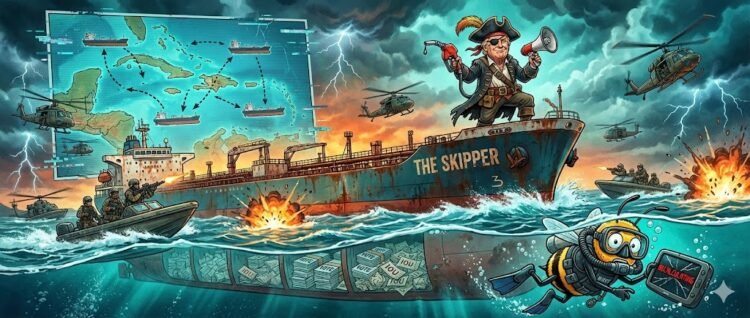
The scene was practically storyboarded for a campaign ad before the first rotor blade chopped the Caribbean air. It had the granular, high-definition aesthetic of a Michael Bay movie that went straight to streaming, complete with the requisite color grading that makes the ocean look dangerously teal and the American military hardware look like the fist of God. U.S. forces descended upon the massive oil tanker Skipper off the coast of Venezuela with the kind of kinetic enthusiasm usually reserved for alien invasions or Osama bin Laden. You had helicopters screaming overhead, the wash from their rotors whipping the sea into a frenzy. You had the Coast Guard and Marines fast-roping onto the deck, boots hitting steel with a rhythmic thud that screams “sovereignty is optional.” And watching from the safety of a monitor, presumably with a Diet Coke in hand, was President Donald Trump, narrating the heist in real-time like a streamer playing Call of Duty.
He bragged that it was the largest tanker ever taken, a claim that lands somewhere between historical fact and the braggadocio of a fisherman describing the one that didn’t get away. Then came the punchline, the little improvisational flourish that tells you exactly how the sausage is made in the new American century. “When it comes to the oil,” he joked, flashing that shark-like grin, “we keep it, I guess.” It was a moment of perfect, crystalline honesty. The pretense of international law, the careful diplomatic language about sanctions enforcement, the towering stacks of paperwork regarding maritime jurisdiction—all of it was swept away by the simple, ancient logic of the pirate. We have the bigger boat. We have the guns. We keep the loot.
This seizure is the cinematic climax of a drumbeat that has been pounding for months. The administration has been selling a war on “narco-terrorists” in Venezuela with the fervor of a televangelist selling holy water. They told us it was about drugs. They told us it was about safety. But as the Skipper sits under American guard, its hull groaning under the weight of nearly two million barrels of crude oil, the mask slips. This doesn’t look like a drug bust. It looks like a heist. It looks like a play for resources wrapped in the flag and sold as a police action. We aren’t just interdicting cocaine anymore; we are seizing the blackened lifeblood of a sovereign nation’s economy because we decided their paperwork was messy and their politics were inconvenient.
But to understand the true absurdity of this moment, you have to look past the helicopters and the fast-ropes. You have to look at the ship itself. The Skipper is not some random vessel plucked from the shipping lanes. It is a ghost. It is a Panama-flagged tanker that used to be known as the Adisa, and before that, it was built as The Toyo. It is owned through a labyrinthine maze of shell companies that eventually lead back to Triton Navigation, a Marshall Islands outfit that the Treasury Department sanctioned back in 2022. Why were they sanctioned? For running a sanctions-busting oil network that funneled money to the Iranian Revolutionary Guard Corps and Hezbollah. This ship is a veteran of the grey zone. It is a floating money laundering operation that just happens to weigh a hundred thousand tons.
The ship was carrying roughly one to two million barrels of Venezuelan crude, a black gold fortune that was reportedly bound for Cuba, another nation that exists on the naughty list of American foreign policy. This seizure slots neatly into Operation Southern Spear, the Trump administration’s naval campaign that started by bombing alleged drug boats into driftwood and has now graduated to grand theft auto on the high seas. It is an escalation that feels inevitable in hindsight. You start by shooting the small fish to show you are serious, and then you harpoon the whale to show you are profitable. The Skipper is the prize. It is the trophy. It is the tangible proof that the administration can point to on television and say, “Look, we caught the bad guy,” even if the bad guy is just a piece of steel that was following orders.
The Digital Ghost in the Machine
The most fascinating angle of this story comes from the reporting on how the Skipper lived its life before the Marines arrived. This ship has a rap sheet longer than a CVS receipt, but its crimes were mostly digital. Its automatic identification system, or AIS, is the transponder that all big ships use to tell the world who they are and where they are going. It is the maritime equivalent of a “Here I Am” app. But the Skipper didn’t use it to broadcast truth; it used it to broadcast fiction.
For years, this tanker has been playing a game of maritime catfishing that would impress a teenage hacker. Its transponder would claim it was peacefully bobbing around off the coast of West Africa, or cruising down a generic shipping lane in the Atlantic, looking for all the world like a law-abiding participant in global commerce. But satellite imagery and other data told a different story. While the digital ghost of the Skipper was enjoying the view in Africa, the physical steel of the ship was sidling up to Venezuelan terminals to load crude.
The reporters using open-source vessel tracking have laid this out with devastating clarity. They show a pattern of the ship going dark, vanishing from the digital ocean, and then popping back up somewhere too neat and convenient to be real. It is a kind of spoofing that has become standard practice for the shadow fleet. They clone position signals. They create impossible jumps in distance and speed, the kind of travel that would require a warp drive or a hull capable of breaking the laws of physics. They execute sudden course changes in the data that would rip a real ship in half. And they always seem to have convenient gaps in their history whenever the ship is parked at a blacklisted port.
This is the “Shadow Fleet.” It sounds like something from a spy novel, but it is just the grease in the gears of the illicit global economy. For years, this fleet has played the ghost ship routine, shuttling sanctioned crude from Venezuela and Iran to friendly refineries by turning off transponders, faking flags, repainting names on the stern, and lying to the digital ocean. The Skipper was a professional liar. It was already on U.S. watchlists. It was flying a Guyanese flag it did not really have. It was slipping in and out of ports like a thief in the night, moving the oil that Washington insists is funding terrorists and narcotraffickers.
Now, after weeks of Caribbean airstrikes that have killed dozens of suspected smugglers in small boats—strikes that have raised serious questions about the rules of engagement and the definition of a “combatant”—Trump and his Attorney General, Pam Bondi, finally get their prestige prize. They get a tanker. They get a visual. They get something massive and undeniable that they can drag into port and strip for parts.
The Morality of the Lie
Here is where the satire begins to write itself. We are presented with the spectacle of the United States government inventing moral outrage at lying, but only for ships. The same administration that treats the truth like a buffet option—shrugging at fabricated vote fraud claims, inventing fantasy budget math, and claiming that tariffs are paid by foreign nations—suddenly discovers its inner truth warrior because a steel hull fibbed about its GPS coordinates.
Imagine the scene in the Situation Room. A White House official, perhaps wearing a tactical vest for no reason, gravely declares, “We cannot tolerate falsified location data.” He says this with a straight face. Meanwhile, down the hall, staffers are drafting speeches that insist bombing survivors twice was a “misunderstanding” and that the economy is booming for the people standing in bread lines. The cognitive dissonance is loud enough to deafen a gunnery sergeant.
There is a running gag in modern American life: If you lie in a political speech, you get a primetime cable news hit and a fundraising bump. If you lie on a podcast, you get a nine-figure contract. But if your AIS transponder lies about being in Togo when it is actually in Caracas, you get boarded by a helicopter and seized by the Marines. The lesson is clear. Lying is a privilege reserved for the powerful and the human. Machines must tell the truth, or they get repo’d.
We have constructed a hierarchy of deceit. At the top are the “alternative facts” of the political class, which are protected speech. In the middle are the marketing lies of corporations, which are just “branding.” And at the bottom are the navigational lies of a tanker trying to make a buck in a sanctioned world. The tanker crossed the line. It tried to use the tools of the elite—obfuscation and misdirection—without the necessary clearance.
The Piracy of Policy
The Venezuelan reaction to this seizure was predictable, but that doesn’t make it wrong. They called it an act of piracy. They called it a shameless robbery of their natural resources. And if you squint, it is hard to argue with them. Maduro’s government is already under crushing sanctions. They are facing a collapsing economy where the currency is worth less than the paper it is printed on. They see this seizure as yet another step toward a total oil blockade and maybe even regime change.
International law experts are currently having a panic attack in the footnotes of their legal briefs. They point out that when a country treats the high seas as a place to enforce its domestic sanctions with military raids, the line between law enforcement and gunboat diplomacy gets very, very blurry. We are not at war with Venezuela, technically. We have not declared a blockade, technically. But when you are seizing their ships and keeping their oil, the technicalities start to feel irrelevant to the people losing the cargo.
Meanwhile, the markets react with the cold amorality of a reptile. Oil futures tick up. Shipping insurers start recalculating the risk premiums for the Caribbean. Every other sketchy tanker captain in the sanctions-dodging fleet quietly rechecks their own spoofing scripts, wondering if their algorithm is good enough to fool the Americans or if they need to start painting their ships a different color. The seizure disrupts the flow, but it doesn’t stop it. It just makes the black market more expensive, which means the profits for the survivors go up.
The Structural Absurdity
Zoom out further, and the structural absurdity of the world comes into focus. We have built a global economy where oil companies, dark fleet middlemen, and sanctioned regimes all treat AIS data as a suggestion instead of a rule. They have built an entire gray market on carefully curated lies. The tracking data is a fiction that everyone agrees to pretend is real until it becomes convenient to expose it.
The United States treats those same lies as both justification and opportunity. On the one hand, Washington uses the fake tracks as Exhibit A. They point to the squiggly lines on the map and say, “See? This is a criminal network. They are spoofing. They are hiding. They must be stopped.” And they are not wrong. The ship was lying. The network is criminal, at least by the standards of U.S. law.
On the other hand, the seizure becomes a political prop at home. It is folded into Trump’s narrative that he is “crushing narco terrorists” and standing up to dictators. It is a win for the “toughness” brand. Never mind that the same operation is under fire for a boat strike that allegedly killed survivors in the water. Never mind that the legality of seizing a foreign ship in international waters for violating domestic sanctions is shaky at best. The narrative is what matters. The tanker is just a 100,000-ton prop in a campaign commercial.
This tension powers the entire farce. The tanker really is dirty. The data really is damning. Yet the morality play is coming from an administration that treats the law of the sea like another stage for campaign footage. They aren’t seizing the ship because they love the truth. They are seizing the ship because it looks cool to seize a ship. It is the aesthetics of dominance.
The Action Franchise of the DHS
You can almost see the editing room at the Department of Homeland Security. They are taking the boarding video—the grainy, shaky-cam footage of Marines sliding down ropes—and setting it to an overdramatic soundtrack. Maybe something with heavy drums and a rising synth line. They cut it like a movie trailer. “In a world where tankers lie… one man… will take their oil.” They blast it out on social media as if U.S. law enforcement is now an action franchise.
And in the fine print, there are questions that never get answered. Questions that are designed to be ignored. Where exactly will the seized oil go? Trump said, “We keep it, I guess.” Does that mean it goes into the Strategic Petroleum Reserve? Does it get sold on the open market to pay for the border wall? Does it get auctioned off to a donor? Who profits from the sale of two million barrels of stolen—excuse me, seized—crude?
What happens to the crew? The sailors on that ship likely aren’t masterminds of the Iranian Revolutionary Guard. They are probably guys from the Philippines or India trying to feed their families, working on a ship whose ownership structure is a mystery even to them. Are they arrested? Are they deported? Or are they just left on a dock somewhere while the Americans high-five over the oil?
And the biggest question of all: How does this new “seize first, justify later” doctrine play out if another navy decides to copy the idea? What happens if China decides that a U.S. ship carrying rare earth minerals is violating their domestic laws and decides to fast-rope some marines onto the deck? We are setting a precedent that the high seas are a free-fire zone for anyone with a big enough navy and a grudge. We are normalizing the idea that might makes right, even in the shipping lanes.
The Slow March to War
We need to sit with the bigger, darker question. If open-source tracking can show a tanker lying about its location, it can also show a government building a slow-motion march to conflict. The data doesn’t lie, but the people interpreting it do. We can track the Skipper spoofing its GPS. Can we track the administration spoofing its intentions?
The buildup in the Caribbean—the airstrikes, the drones, the naval deployments—looks less like a drug interdiction campaign and more like the pre-game show for a war. We are moving assets. We are testing capabilities. We are normalizing the use of force against Venezuelan targets. The seizure of the Skipper is just one data point on a trend line that points toward escalation.
Are we really cracking down on deception? Or are we simply picking which liars are useful? The Skipper faked its position to move oil that should have been blocked, and it finally paid the price. It got caught because it was useful to catch it. It provided a win. It provided a headline. It provided oil.
But there is a different kind of spoofing happening in Washington. It is the kind of spoofing that moves entire countries toward war while insisting everything is just a routine enforcement action. It is the kind of spoofing that calls a blockade a “safety measure” and an invasion a “police action.” It is the kind of spoofing that tells you the economy is great while you can’t pay rent, and that the war is just while the bodies pile up.
The question for the satire—and for the citizen—is whether anyone in power will ever pay a price for that kind of spoofing. The Skipper got caught. But the captains of the state, steering the ship of state into dangerous waters with their transponders turned off and their flags faked, never seem to get boarded. They just keep sailing, carrying a cargo of lies, heading for a port that doesn’t exist on any honest map.
The Ghost in the Data
Ultimately, the Skipper is a perfect metaphor for the modern era. It is a vessel defined by its dishonesty. It exists in two places at once: the place where it says it is, and the place where it actually is. It is a Schrödinger’s Tanker. And we are all living on it. We are all passengers on a ship that is broadcasting a signal of normalcy while secretly loading a cargo of catastrophe.
The administration loves the Skipper because it validates their worldview. They believe the world is a nasty, brutish place where everyone is lying and the only safety comes from having the biggest gun. By seizing the ship, they prove their own point. They prove that force works. They prove that the law is for suckers and the spoils are for the strong.
But what happens when the spoofing stops working? What happens when the reality of the location crashes into the fiction of the data? For the Skipper, it meant Marines on the deck. For the country, it might mean something much worse. It might mean waking up one day to find that we have drifted so far off course, following a fake signal of our own making, that we can no longer find our way back to the shipping lanes of democracy.
So let’s enjoy the movie. Let’s watch the helicopters and the fast ropes. Let’s laugh at the President’s joke about keeping the oil. But let’s keep an eye on the horizon. Because out there in the gray zone, where the transponders are dark and the flags are fake, there are other ships moving. And they aren’t all carrying oil. Some of them are carrying the consequences of our own actions, and they are heading our way, silent and invisible, until the moment they arrive.