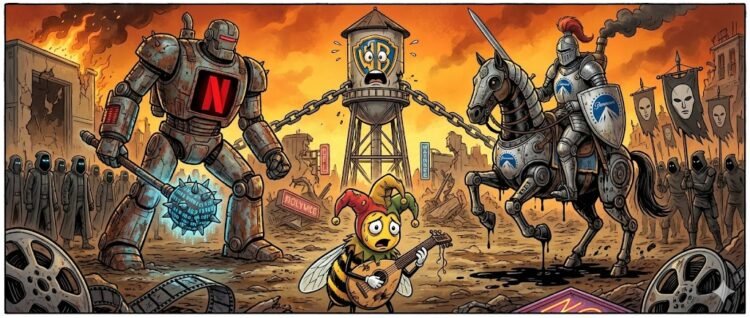
The ink wasn’t even dry on the surrender treaty before a new warlord arrived with a bigger bag of cash and a scarier line of credit.
Just when we thought the funeral for the Hollywood studio system was over, just when we had resigned ourselves to a future where Warner Bros. was merely a sub-directory in the Netflix user interface, the coffin lid flew open. In a plot twist that would be rejected by a writers’ room for being too melodramatic, the great media consolidation of 2025 has mutated from a corporate acquisition into a gladiatorial cage match. The combatants are no longer just companies. They are nation-states of capital, armed with debt, sovereign wealth, and egos large enough to be visible from orbit.
We were told it was a done deal. Netflix had prevailed. They had struck a deal to acquire the studios and streaming assets of Warner Bros. Discovery for roughly eighty-three billion dollars. It was a transaction priced at twenty-seven dollars and seventy-five cents per share, a mix of cash and stock that signaled the final triumph of the algorithm over the auteur. The plan was surgical and cynical: strip the valuable IP like Batman and Harry Potter, keep the HBO prestige factory, and amputate the dying limb of linear cable—CNN, TNT, TBS—into a sacrificial raft called “Discovery Global” to float away and die in the open ocean.
But then, the sky darkened. Paramount Skydance, an entity that sounds less like a movie studio and more like a private military contractor from a cyberpunk novel, swooped in with a hostile counter-bid. And they didn’t bring stock options. They brought cash. Thirty dollars a share. All cash. A valuation of nearly one hundred and nine billion dollars.
This is not a business transaction. This is a hostile takeover fueled by the kind of money that makes governments nervous. The Paramount bid is financed by leveraged debt, backed by the bottomless pockets of the Ellison family, and lubricated by foreign sovereign wealth funds. It is a war chest designed to bludgeon Netflix into submission. Paramount argues their offer delivers eighteen billion dollars more value. They promise a faster closing. They promise fewer regulatory headaches, a claim that is laughable given the sheer size of the beast they are building. And most importantly, they promise to keep the whole carcass together. They want CNN. They want the cable channels. They want the influence.
The Medieval Fiefdoms of the Twenty-First Century
To understand this fight, you have to stop thinking about capitalism and start thinking about feudalism. We are not watching companies compete for customers. We are watching warlords compete for territory.
Netflix plays the role of the modernizing invader. They spout the rhetoric of the future. “Innovation.” “Streaming convenience.” “A new Hollywood renaissance.” They frame their conquest as a liberation, freeing the content from the shackles of the old cable bundle. Their pitch is that they are the inevitable future, a sleek, frictionless utopia where everything you ever wanted to watch is available for a monthly fee that goes up every six months.
Paramount Skydance plays the role of the conquering emperor. They are waving gold coins and promising to restore the glory of the old empire. They are the “traditionalists,” backed by the tech-baron wealth of Larry Ellison, a man whose relationship with power is as subtle as a sledgehammer. They aren’t interested in “spinning off” assets. They want to own the means of cultural production, from the movie theater to the newsroom. They are leveraging the future to buy the past, betting that if they own enough of the landscape, they can charge whatever toll they want.
Both bids come with risks that would make a rational economist weep. Netflix’s deal is a blend of cash and stock, meaning the value fluctuates with the market’s mood. It involves assuming a massive debt load and navigating an antitrust minefield that makes the beaches of Normandy look like a putting green. Paramount’s bid is a debt-heavy, leveraged monstrosity that could saddle the merged company with financial burdens so unsustainable that it will be forced to cannibalize itself within five years just to pay the interest.
But in the high-stakes poker game of media feudalism, sustainability is a problem for the little people. The goal is possession. The goal is to plant your flag on the Warner water tower and dare anyone to take it down.
The Carnival of Grotesque Consolidation
Shift your gaze to the broader spectacle, and it looks like a grotesque carnival. We have media companies, defense-contractor scale money, tech-tycoon families, and streaming algorithms joining forces to carve up culture, liberties, and creative labor. And they have the audacity to call it “consumer benefit.”
They call it “free-market efficiency,” but it looks a lot like baronial looting. Imagine a map of medieval Europe. Netflix wants to buy France, burn down the vineyards, and turn the Louvre into a warehouse for distribution. Paramount wants to buy France, mortgage the Notre Dame to a foreign bank, and force everyone to watch news broadcasts approved by the King.
The “peasants” in this analogy—the writers, the actors, the directors, the crew members—are told they should be grateful. They are told that this consolidation will bring “stability.” But stability for whom? For the shareholders, perhaps. For the executives who will trigger their golden parachutes. But for the creatives, it means fewer buyers. It means reduced bargaining power. It means that if you have a script, there are only two desks in town, and both of them are owned by people who think “art” is a three-letter word for “asset.”
The regulators are trying to act like referees, but they look like drain cleaners trying to patch a levee when the flood is already underway. The Department of Justice and the FTC will make noise. They will cite the Clayton Act. They will talk about market concentration. But the money on the table is so large it creates its own gravity. When you are moving a hundred billion dollars around, the law tends to bend.
The Political Shadow of the Ellison Money
The Paramount bid carries a specific, darker frequency because of the Ellison connection. David Ellison is the face of Skydance, but the money trails back to the family fortune built by Larry Ellison. Larry Ellison is not just a tech billionaire. He is a political donor with deep ties to the current power structure in Washington. He is a man who has hosted fundraisers for Donald Trump. He is a man who believes in the exercise of power.
Why does Paramount want to keep CNN, a network that Netflix was eager to dump? Netflix saw CNN as a liability, a declining asset in a polarized world. The Ellisons likely see it as a weapon. In the age of information warfare, owning a global news network is better than owning a standing army. It gives you the ability to shape reality. It gives you a seat at the table where history is written.
The prospect of CNN, TNT, and the cultural machinery of Warner Bros. falling under the control of a family with such distinct political alignments raises the stakes for democracy itself. It isn’t just about movies anymore. It is about who controls the microphone. It creates a vertical integration of influence—from the servers that host the data to the news anchors who read the teleprompter.
The Human Fallout of the Merger Wars
While the titans fight in the clouds, the damage on the ground is already visible. The human fallout of this cage match will be severe.
If Netflix wins, the “synergies” will result in thousands of layoffs. The theatrical window will shrink to a vestigial tail. The mid-budget movie will be extinct. The independent theater owner will be turned into a manager of a nostalgia museum.
If Paramount wins, the debt service will demand cuts that make Netflix look generous. The pressure to monetize news content will degrade journalistic standards. The “global empire” will be built on the backs of overworked staff and underpaid writers.
In either scenario, the content gets homogenized. It gets shaped for global algorithms. It gets smoothed out. The eccentric, the weird, the dissenting voices—they don’t scale. They don’t drive subscriber retention in key growth markets. So they get cut. We end up with a culture that looks like an airport terminal: shiny, expensive, and identical wherever you go.
The “consumer” is left with the illusion of choice. You can subscribe to the Red App or the Blue App. You can watch the superhero movie owned by the tech company or the superhero movie owned by the debt-leveraged conglomerate. But you cannot choose a diverse, vibrant marketplace because that marketplace has been bought, sold, and foreclosed upon.
Pay-to-Play Media Feudalism
This isn’t business. This is pay-to-play media feudalism. It is a system lubricated by political connections, debt markets, and the lie of “competition.”
We have to ask ourselves: When culture becomes a leveraged financial asset, do we still have art? Or do we just have shareholder returns dressed up in costumes? When news becomes part of a hostile takeover package, is it still journalism? Or is it just another form of corporate communications?
Can we meaningfully choose anything when everything is owned by a tiny handful of families backed by debt and political clout? The answer, increasingly, is no. We are residents on their land. We pay rent to access our own culture.
The warning is clear. Whoever wins—Netflix or Paramount—the losers will be the same. The losers will be the workers who make the magic. The losers will be the diversity of thought that democracy requires. The losers will be the little theaters, the independent newsrooms, and the creative experiments that don’t show up on a balance sheet because they were never meant to make a billion dollars.
We are watching the enclosure of the American imagination. The fences are going up. The guards are being posted. And the price of admission is about to go up again.
Receipt Time
The invoice for this acquisition will be paid in monthly installments by every household in America. It will be paid in the price of your subscription, which will rise to cover the debt service. It will be paid in the quality of the news you watch, which will be filtered through the interests of the owners. It will be paid in the loss of the movies you never got to see because the algorithm decided they weren’t viable. The receipt shows a charge for “Consolidation” and a surcharge for “Oligarchy.” The total is your cultural soul. And please note: all sales are final.