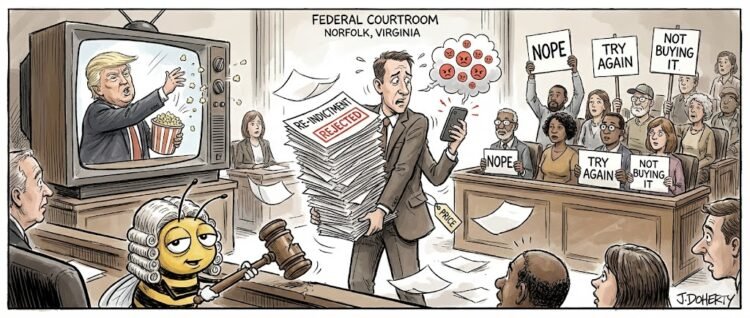
When a grand jury decides to go off-script, the director throws a chair.
The most dangerous sound in a democracy isn’t a gunshot or a siren. It’s the polite cough of a grand jury in Norfolk, Virginia, looking at a prosecutor and effectively saying, “Yeah, we’re not gonna do that.”
This week, something almost folkloric happened. A panel of ordinary citizens—the kind of people who usually serve as a rubber stamp for the Department of Justice—refused to hand up an indictment against New York Attorney General Letitia James. It was a rare, stunning rebuke that reads like a collective throat-clearing from a body designed to nod. And for the Trump administration, which has made prosecuting James a signature crusade, it was a faceplant of epic proportions.
To understand the sheer, comedic incompetence of this moment, you have to appreciate the procedural grotesque that led us here. This wasn’t the DOJ’s first bite at the apple. A federal judge had already tossed the original indictment because the prosecutor who presented it was unlawfully appointed. In a normal legal system, a dismissal based on unlawful appointment is a signal to stop, reflect, and maybe check the instruction manual. But in the vengeance-fueled funhouse of the current DOJ, it was merely a production delay.
Rather than accept the ruling, the department decided to try again. They swapped in a different presenter—a prosecutor parachuted in from Missouri like an understudy who hasn’t learned the lines—and refiled the charge. The logic was simple: if the first guy was illegal, surely a new guy reading the same script would fix everything. It is the legal equivalent of putting a fake mustache on a condemned building and calling it a renovation.
But the grand jury balked. They looked at the new presenter, they looked at the old evidence, and they decided that they were not interested in participating in the administration’s performance art. It was a moment of quiet, stubborn civic judgment that punctured the balloon of political inevitability.
The human choreography behind this failure is worth savoring. Imagine the scene at the Justice Department. The panicked text messages flying between political appointees. The career prosecutors rolling their eyes so hard they risk retinal detachment. The Missouri prosecutor, standing in a Virginia courtroom, realizing that his ticket to the big leagues has just been cancelled by a group of retirees who have better things to do.
This is what happens when you turn the justice system into an instrument of personal vengeance. You end up with a rotating cast of special prosecutors playing hot potato with subpoenas, while the White House cheers from the cheap seats. You end up with a legal strategy that reads like a start-up pivot: if the first indictment fails, rebrand it and try a new market. It is managerial spectacle masquerading as law enforcement.
The referral machine that powers this enterprise is equally absurd. A wealthy regulator ally makes a complaint, and that complaint travels through partisan channels like a congratulatory telegram until it lands on a prosecutor’s desk with a sticky note that says “Make it happen.” Suddenly, a complex political rivalry is dressed up in criminalese, and the machinery of the state is mobilized to settle a score. It is the moment the justice process becomes a merchandised grievance.
But the real damage goes deeper than the embarrassment of a failed indictment. The spectacle of weaponized prosecutions corrodes trust in the rule of law. When the administration uses personnel purges and tactical reassignments to keep politically charged cases alive, they are eroding the standards that protect everyone. They are warping the process to ensure that the target is hit, regardless of the legal cost.
The administration has a menu of tools for this kind of thing: fire the U.S. attorney who won’t bring charges, appoint a loyalist who will, have an unvetted lawyer present. It is a warping of process that turns the criminal bar into a tool for vendetta. And the harm is real. It means future administrations can do the same. It means ordinary citizens lose the reassurance that the law is not just a weapon for the powerful.
Letitia James, the target of this obsession, is not some abstract villain. She is an elected official who used her office to pursue a civil case that found wrongdoing in a powerful real-estate empire. That civil finding exists. It is a matter of record. But the White House’s criminal crusade against her is not about vindicating the law; it is about demonstrating power. It is about showing that no one attacks the king and gets away with it.
The satire here is unsparing because the reality is so bleak. We are watching a government that confuses theatrical victory with legal legitimacy. Subpoenas become trump cards. Judges’ rulings are inconveniences. Grand juries are chips on a board. It reduces the dignity of law to a production schedule for political operatives.
But let’s not lose sight of the petty fury that drives this machine. Picture the President publicly demanding prosecutions, the social-media taunts aimed at holdouts, the brass-knuckle loyalty tests. Picture the White House as a sports bar where criminal referrals are cheered like home runs. The humor is acidic, but it is precise. It targets the behavior, the hubris, the sheer, unadulterated pettiness of it all.
The tragedy is that this pattern invites a future where the best prosecutors leave, honest witnesses stay silent, and the courts spend their time undoing procedural damage instead of prosecuting crimes. It invites a future where public faith in neutral law enforcement is just a memory.
The grand jury’s refusal was a heroic act, a tiny democratic hiccup in a system designed to steamroll dissent. But it shouldn’t have to be heroic. It should be normal. The fact that we are celebrating a group of citizens for simply doing their job is a testament to how far we have fallen.
The worst thing isn’t that an administration seeks revenge through indictments. The worst thing is the day we stop being shocked that it does. If the machinery of justice can be repurposed as a season of political hits, then the civic architecture that keeps power accountable will be gone. And we will be left standing in the rain, wondering whether the shelter we once trusted was ever more than a stage prop.
Receipt Time
The invoice for this little adventure in prosecutorial malpractice is steep. It includes the cost of the flights for the replacement prosecutor, the hours billed by the DOJ attorneys who had to draft the new indictment, and the shred of dignity lost by every official who signed off on this farce. But the biggest cost is intangible: it is the erosion of the idea that the law applies equally to everyone, even the enemies of the President. The receipt shows a zero balance for “Justice” and a massive surcharge for “Political Theater.” And the saddest part is that we are all paying for it.