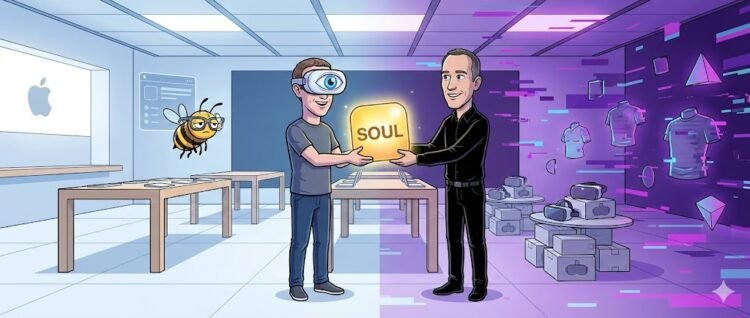
The biggest transfer in tech isn’t about hardware. It is about Mark Zuckerberg paying top dollar for the one thing he can’t code: vibes.
The announcement video looked less like a corporate hiring update and more like the trailer for a film about a brooding architect who accidentally invents a soul. There was Mark Zuckerberg, filtered into an uncanny valley of approachable hues, his t-shirt a specific shade of “relatable slate” and the lighting designed to suggest he lives inside a render. He was speaking about Alan Dye not as a human being who designs buttons, but as a kind of geopolitical resource, a rare earth mineral suddenly acquired by the nation-state of Meta.
“We are bringing Alan in,” Zuckerberg said, his avatar’s eyes shimmering with a proprietary glint, “to treat intelligence as a new design material.”
Pause on that. Let the phrase dissolve on your tongue like a communion wafer made of aerogel. “Intelligence as a design material.” It is the sort of sentence that sounds profound only in a room where the oxygen has been replaced by venture capital. It suggests that human cognition is just another texture to be beveled, shaded, and draped over a wireframe, a raw substrate waiting for the right creative director to give it a drop shadow.
This is the big news of late 2025. Alan Dye, the man whose taste has quietly governed the friction of your thumb against glass for a decade, is leaving Apple to lead a new “creative studio” inside Meta’s Reality Labs. The industry is treating it with the solemnity of a papal succession. The headlines are breathless, treating the migration of a UI designer from Cupertino to Menlo Park as a tectonic shift in the spiritual alignment of Silicon Valley.
But strip away the LinkedIn reverence, and what you are watching is the ultimate ritual of Big Tech’s late-stage prestige theater: the Executive Body Swap.
It is a perfect trade. Apple loses a quiet architect of the invisible, a man whose legacy is measured in the micro-seconds of delight you feel when a notification pill expands into a media player. In return, Meta gains a headline. They haven’t hired a designer; they have hired a permission structure. By bringing in the guy who made the Apple Watch feel like jewelry, Zuckerberg is buying a very expensive shield against the accusation that his company creates digital ugliness. It is a transaction of pure optics: Cupertino polish explicitly purchased to laminate over Menlo Park chaos.
Dye’s move is emblematic of a broader, exhausting condition in the tech economy of 2025. We have reached the point where executive movement has replaced shipping products as the primary unit of innovation. The “Creative Studio” he will lead is less a workshop and more a cinematic factory of reassurance. Its output will not be hardware you can buy, at least not for years. Its output will be vibes. It will produce breathless concept videos where ethnically ambiguous models in loft apartments gaze through translucent eyewear at floating orbs of “intelligence,” smiling as if their email inbox just hugged them.
This studio is the latest shrine in the industry’s long, expensive procession of rebranding problems instead of solving them. Reality Labs has spent billions trying to convince us that putting a computer on our face is the next stage of human evolution, rather than just a really efficient way to mess up our hair. But the hardware remains stubborn. The headsets are still dusty monoliths sitting on shelves next to 2018’s forgotten fitness trackers. The smart glasses still deliver social awkwardness faster than they deliver notifications.
So, what do you do when the physics of the future refuse to cooperate? You hire the guy who made the iPhone feel inevitable. You pivot to “storytelling.” You create a “studio” to manufacture the feeling of a breakthrough while the engineers are still trying to figure out battery life.
For the everyday user, trapped inside this churn, the news of Dye’s departure is just another reminder of our own digital fatigue. We are the ones who will actually live in the house these architects are arguing over. We are the ones who spent 2025 learning the translucent, shifting layers of Apple’s “Liquid Glass” design language, a UI overhaul that promised “ethereal depth” but mostly just made it harder to read text messages in direct sunlight. We are the ones perpetually toggling off the experimental effects, hunting for the “Reduce Motion” setting, and wondering why efficiency is always the first casualty of a designer’s need to leave a mark.
There is a dark comedy in watching Meta, a company whose DNA is built on the aggressive, metric-driven colonization of human attention, try to wear the skin of Apple’s restraint. They want the cool. They want the aura of inevitability. They want you to believe that their next pair of AI glasses won’t just harvest your gaze for ad targeting, but will do so with intentionality. They want to design the surveillance state to feel like a boutique hotel.
And “intelligence as a design material” is the incantation that makes it all okay. It frames the messiness of AI, the hallucinations, the privacy erosion, the uncanny intrusions, as an aesthetic choice. It turns uncertainty into a texture. It suggests that if the AI gets something wrong, it isn’t a bug; it is just a design material behaving with organic unpredictability. It is artisanal failure.
As Dye settles into his new glass-walled office in the Reality Labs compound, surrounded by prototypes that look like ski goggles from a sci-fi utopia, the rest of us will continue to swipe, scroll, and tap on the devices that actually exist. We will watch the press releases fly back and forth like shuttlecocks. We will read about the “vision.” And we will quietly disable the new “smart” features that drain our batteries, waiting for the day when technology stops trying to be a design material and goes back to being a tool.
But that day isn’t coming. In 2025, the product is no longer the thing you hold in your hand. The product is the momentum itself. The product is the feeling that something new is just around the corner, overseen by men in expensive t-shirts who talk about “intimacy” while building machines that ensure we never have to look each other in the eye again. Design is no longer how things work; it is how things are justified. And intelligence? It is just the costume the algorithm wears to get past the velvet rope.
The Golden Handcuffs of the Soul
There is a specific kind of melancholy that comes with watching a talented person get paid an obscene amount of money to fix a problem that shouldn’t exist. Alan Dye is a master of interface. He understands the subtle psychology of the glance. And now he is being paid to apply that mastery to a company whose primary product is a headache. It is like watching a world-class sushi chef being hired to redesign the menu at a gas station. The food might look better, the presentation might be exquisite, but at the end of the day, you are still eating sushi next to a diesel pump.
The “Creative Studio” is the ultimate expression of this dissonance. It is a place where “intelligence” is treated like clay, molded into pleasing shapes to distract us from the fact that the machine underneath is still hungry for our data. They will design beautiful, floating interfaces. They will create sounds that make you feel loved. They will build a digital world so polished, so frictionless, that you forget you are walking through a shopping mall where the walls are made of eyes.
And Mark Zuckerberg will smile his rendered smile, secure in the knowledge that he has bought the best design money can buy. He has acquired the aesthetic of privacy without the inconvenience of actually providing it. He has hired the architect to put a fresh coat of paint on the Panopticon.
Receipt Time
The invoice for this acquisition is not financial; it is cognitive. We pay for this theater with our attention span. We pay for it every time we have to learn a new gesture, every time an interface changes for no reason other than to justify a salary, every time we are told that “intelligence” is a feature rather than a human right. The tech industry has become a vast machine for generating headlines about hiring, while the actual experience of using technology becomes more fragmented, more intrusive, and more exhausting. We are the beta testers in a global experiment to see how much “design material” we can tolerate before we just want our old dumb phones back. And the receipt is getting longer every day.